Wholesale procurement coordinator handling engineered stone and granite orders for 8 years. I've personally made (and documented) 11 significant mistakes, totaling roughly $23,000 in wasted budget. Now I maintain our team's pre-order checklist to prevent others from repeating my errors.
That's the honest reason I'm writing this. Not because I'm an expert — because I spent years being the guy who learned the hard way.
Here's the comparison I wish someone had handed me back in 2018, when I started sourcing countertop materials for the wholesale side of the business: engineered stone (quartz, mostly Breton-process slabs) vs natural granite.
Four dimensions. No fluff. Let's go.
Dimension 1: Price Structure — What's Quoted vs What You Actually Pay
Everyone starts with price, so let's start there. And this is where I made my first $4,000 mistake.
Wholesale slab pricing, roughly (as of early 2025, at least):
- Natural granite slabs: $8–$35 per square foot, depending on origin and grade. Cheap Brazilian and Indian granites sit low; exotic colors (Blue Bahia, for example) can spike way past that.
- Engineered stone slabs: $15–$45 per square foot wholesale. Custom colors or small batch runs push higher.
So right off, engineered stone looks more expensive. That's what I assumed too, back in 2019. I loaded up on a cheap Brazilian granite, patched together an order for a distributor, and felt great about the margin.
Then the slabs arrived. Four of 32 were cracked in transit. Not the carrier's fault — thinner slabs (1.2cm) just don't take shipping abuse the same way a 2cm engineered slab does. Replacement slabs took 3 weeks. My distributor was patient, but only once.
The lesson: quoted slab price is a lie if you don't add breakage, replacement, and freight re-runs. On that order specifically:
- Quoted slab cost: $12,400
- Breakage on arrival: $1,550 worth of unusable material
- Emergency air-freight for replacements: $890
- Rush fabricator fees to hit the original date: $1,600
Add it up and the "cheaper" granite came out to roughly $20.75/sqft. The engineered stone I passed on sat at $18.30/sqft delivered, with a breakage rate under 1%.
Then again — this doesn't hold for every order. If you're buying full containers direct from a quarry with proper crating and you've got 6+ weeks of lead time, granite's sticker-price advantage is real. I've done those orders too. They work.
Dimension 2: Consistency — The Hidden Cost of Every Slab Being Different
I'm not a geologist. I can't speak to mineral composition or why one granite quarry produces veining that pops and another produces mud. What I can tell you is what inconsistency does to a wholesale operation's P&L.
Natural granite varies slab to slab. Same quarry, same "color," different block — different veining, sometimes a different shade entirely. Every industry guide mentions this. The operational reality is worse than the guide implies.
For a fabricator running small custom jobs, variance is manageable. For a distributor filling a 40-slab order for a hotel project that needs consistent visual across 200 rooms? Variance is a nightmare.
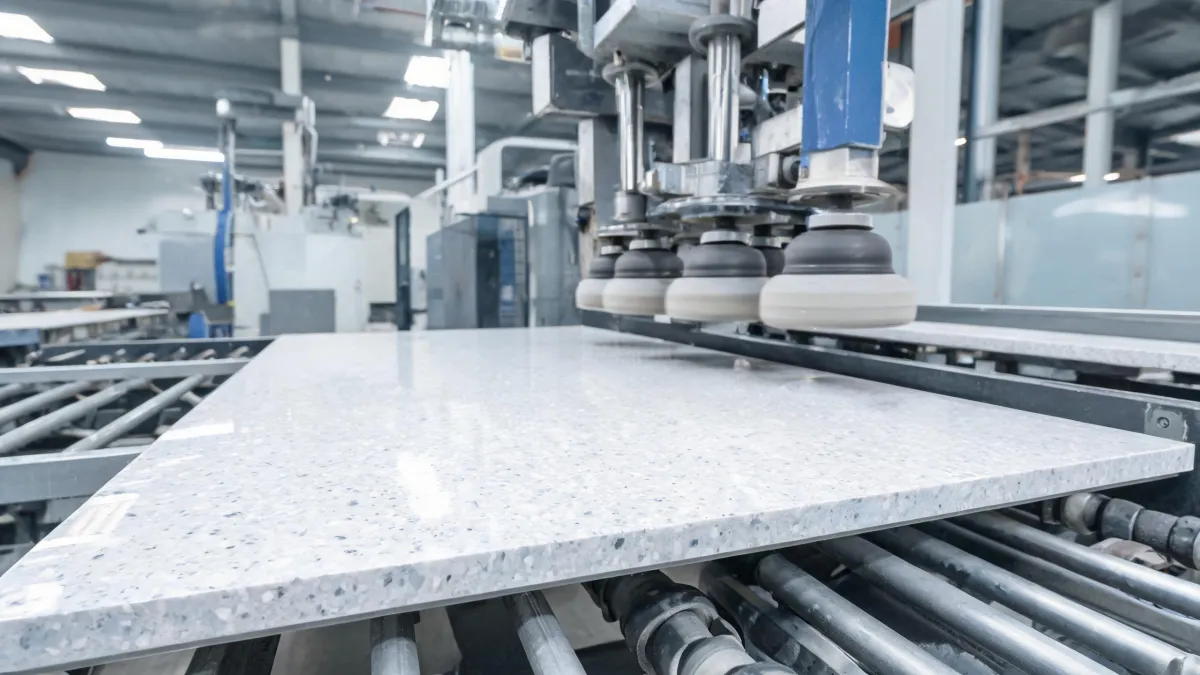
Engineered stone doesn't have this problem, because it's not dug out of the ground — it's produced. Batch consistency is what you're buying. Every Breton-process slab from the same batch matches the previous one within Delta E < 2, which is roughly the threshold where trained observers start noticing a difference.
The counterintuitive part: big granite orders are actually harder to keep consistent than small ones. If you order 20 slabs from one block, great. If you need 80 slabs, you're pulling from multiple blocks, and now you have a matching problem that costs real money in returns and re-cuts.
My worst experience here was in Q2 2021: 78 slabs of "identical" Absolute Black granite across 4 pallets. Eleven of them came from a different block. Fabricator flagged it before cutting, thank god, but that's $3,100 worth of slabs sitting in my warehouse that I had to discount or resell at cost.
If your end customers care about visual consistency even slightly, this dimension alone should tilt the decision.
Dimension 3: Private Label Flexibility — Where Engineered Stone Wins Clean
If you're building your own brand on top of these materials, this is probably your biggest differentiator.
Granite has almost zero private-label flexibility. It comes out of the ground. You buy blocks or slabs, you sell them. You can re-crate them, put your stencil on the packaging, but the material itself isn't yours. It's the quarrier's. Some distributors do create "collection" brands around curated granite selects — but you're not manufacturing anything, you're curating.
Engineered stone is a completely different game. Custom colors, custom surface textures (honed, polished, matte), custom slab dimensions, custom edge profiles at the factory level. Your brand goes on it. Your spec goes into it. If you contract with a manufacturer running Breton equipment, the batch is yours — the formula stays locked to your brand until you release it.
I built our first private-label line in 2022. Two colorways, 3cm slabs, ~600 sqft per batch. It took about 5 months from concept to first shipment, but once we had our own SKUs, we stopped competing on price against every other granite reseller in our region. That's the moment the material stopped being a commodity for us.
The tradeoff, and I'll be straight about it: private-label engineered stone requires minimum order quantities that most granite buyers never deal with. We're talking 400–2,000+ sqft per color typically (depends on the manufacturer, and I've seen it swing wildly). If you're a small regional distributor moving 200 sqft a month, this path isn't for you yet. Start with standard engineered stone slabs under someone else's brand, build volume, then transition.
Dimension 4: Lead Time and Capacity Scale
Last dimension, and it's the one that quietly kills the most wholesale timelines.
Natural granite is tied to quarry production. That sounds obvious, but the implications are brutal:
- A quarry in Brazil shuts down for monsoon season — your 6-week estimate becomes 10.
- Worker strikes (I had this happen in 2020) freeze shipments for weeks.
- Holiday windows around Chinese New Year or Brazilian carnival compress capacity hard.
- Exotic colors sometimes only ship a few containers per quarter, globally.
You can't control any of it. You can buffer against it with inventory — which is capital sitting in a warehouse.
Engineered stone is factory-scheduled. Which means lead times are quoted, not guessed. This is one of the most undervalued points in any engineered stone wholesale cost guide: the ability to say "your slabs will be ready on March 14" and actually hit March 14 is worth real money to a project manager.
Standard lead times I've worked with, ordered from fastest to slowest:
- In-stock engineered stone (existing colors, domestic warehouses): 3–7 days
- Made-to-order engineered stone (existing formula, new batch): 3–4 weeks
- Custom engineered stone (new color/formula): 6–10 weeks
- In-stock domestic granite: 1–2 weeks
- Imported granite: 4–10 weeks, occasionally longer
Real talk: this is mostly why engineered stone holds its price premium. It's not a "better" countertop material — it's a more predictable one. In B2B, predictable beats better almost every time.
So Which One — For Your Specific Order?
Here's where I'll be upfront about what I can and can't tell you.
If your situation looks like this, lean engineered stone:
- You need consistent visual across many units (hotels, multi-family, office buildouts)
- You're building a private-label or OEM program
- Your delivery windows are tight and non-negotiable
- Your fabrication partner prefers working with standard slab dimensions
If your situation looks like this, lean granite:
- You're selling to customers who specifically want natural stone and will pay for it
- You're buying full containers with 6–10 week planning windows
- You're working with a fabricator comfortable handling slab variability
- Your customers don't require tight color matching across units
And I'll say the thing most suppliers won't: if you're a small local shop doing under 500 sqft a month of countertops, neither wholesale channel is right for you yet. Buy from a regional distributor and pay the markup. The MOQs and freight economics don't work at low volume. You'll lose money pretending they do — I watched a shop try in 2021 and it didn't end well.
My experience is based on roughly 400 orders split across both materials, mostly mid-tier commercial and residential. If you're in ultra-luxury or bargain-basement segments, your math is different and you should trust your own numbers more than my averages.
One last thing — because I've made this mistake twice and don't want you to. Get written spec confirmation before you place any wholesale order over $10,000. Verbal agreements about color tolerance, slab thickness, and delivery windows disappear the moment someone on the other side changes jobs. Thirty minutes of paperwork has saved me from at least three disputes I can count.
Bottom line: there's no "best" material here. There's the one that fits your order, your customer, and your timeline. Those three things change, and so should your choice.