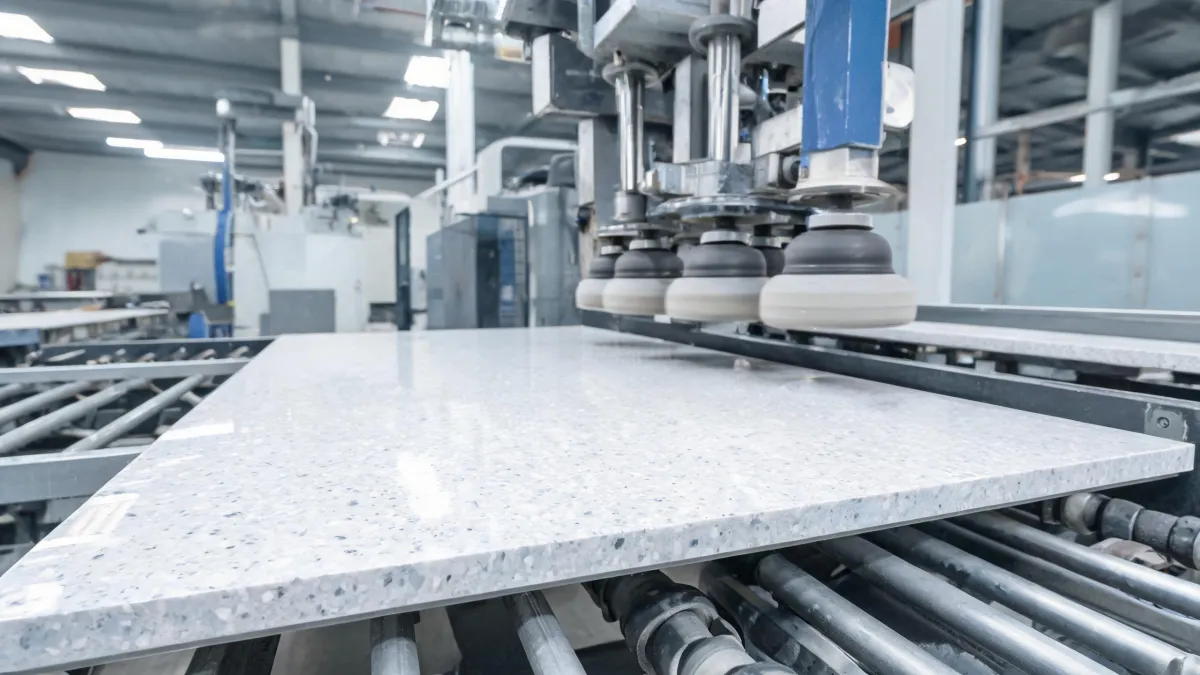
The quote that looks fair is never the final invoice
You get a bid. X dollars per square foot. It looks reasonable, so you sign off. Six weeks later, the invoice shows up 25-30% higher than the estimate. Your accountant asks why. The fabricator says "that's standard practice." And you realize "standard practice" is just a polite term for "surcharge."
It's not just you.
Over the past six years, I've managed our 60-person design-build firm's surface materials and finishes budget—$180,000+ in cumulative spending, across 40+ vendor relationships. That 25-30% gap isn't a one-off. It shows up like clockwork.
The problem was never the material. Cosentino's Silestone and Dekton perform exactly as spec'd, and they fail exactly as rarely as advertised. The problem is the procurement chain between the quote and the invoice.
You think it's the material's fault. It's actually four cost layers.
Here's what actually inflates your Cosentino bill, ranked by how much money they've cost us personally:
1. Color-tier pricing that nobody tells you about
Not all Cosentino Silestone colors come from the same pricing tier. Some are classified under premium series with a third-party surcharge. Your fabricator doesn't flag this on the quote because pointing it out means admitting "I'm upcharging you on color selection."
On a project in Q2 2023, I showed our designer a set of standard Silestone colors for a kitchen and two bathrooms. The quote came back at one flat rate. Two slabs were classified as premium at delivery. Extra cost: $600. Nobody flagged it beforehand. That's the kind of thing you catch immediately when you visit the showroom in person—and only then.
2. The distributor-to-fabricator markup stack
Most fabricators don't buy direct from Cosentino. They buy from distributors. Distributors buy from Cosentino. Each layer takes a cut. If your fabricator sources through a secondary distributor, you're paying two or three layers of margin on the same slab.
I'm not a geologist, so I can't explain why certain quartz batches have slightly different veining patterns. But from a procurement standpoint, I can point out that the same Silestone color quoted at two different fabricators in Queens versus Manhattan can vary by 28%. It's information asymmetry—and it's deliberate.
You can find a hundred articles on how to fix sound not working windows or which door trim matches oak flooring. Try finding a straightforward answer on why the same slab costs more in Queens than in Manhattan. The internet isn't covering the stuff that actually matters.
3. The "all-inclusive" unit price that isn't
That "$85 per square foot" sounds workable. Until you find out templating is billed separately at $200. Edge profile cutting is $18 per linear foot. A sink cutout runs $150. Installation adds $25 per square foot on top.
The quote isn't wrong. The scope was.
Any procurement article on total cost of ownership will tell you the same thing print buyers have known for a decade: the sticker price is rarely the transaction price. The difference has to get broken out eventually. The only question is whether you find out before or after the job.
4. The "courtesy" surcharge on small orders
This one I hate. A 15-square-foot bathroom countertop can arrive with a quote that's—per square foot—higher than a full kitchen. Ask the fabricator why and you'll hear "our minimum order is 30 square feet" or "small jobs aren't worth the setup."
I have mixed feelings about this one. On the one hand, small jobs do require the same mobilizing, template visit, and slab handling as bigger ones—there's a real cost basis there. On the other, when I was starting out, the vendors who treated my $200 orders with the same care as their $20,000 orders are the ones I still use for $20,000 orders. Small doesn't mean unimportant. It means potential.
And if a supplier won't quote you at all because the project is "too small"? That's not a cost problem. That's a relationship problem waiting to happen.
The real cost of these layers over six years
Let me break down an actual order. Q1 2023: we signed a small kitchen remodel contract. Fabricator quoted $4,200 "all-inclusive."
Here's how the final invoice broke down:
- Material (38 sq ft @ $82): $3,100
- Templating ("free" became chargeable): $200
- Rush fee (not requested, added by default): $300
- Premium color surcharge (found at delivery): $400
- Re-cut charge (measurement error): $250
Total: $4,250? No wait—$5,100. The rush fee applied twice, and the "all-inclusive" rate turned out to be $61/sq ft actual.
After that one, I built a weighted TCO model. Across six years, our surface materials budget has averaged 18% overrun. If you apply that to $180,000 in cumulative spending, you're looking at roughly $32,000 in "hidden line items" that shouldn't have existed.
Where did that money go? Into things nobody noticed, nobody asked about, and nobody bothered to disclose.
And then there's the maintenance cost. Most Silestone and Dekton surfaces clean fine with a neutral cleaner. SprayWay glass cleaner is a cheap, effective choice for keeping a quartz surface streak-free without damaging the seal. But if you bought from the cheapest fabricator and the seams weren't tightened properly, three months later you're paying someone to redo the job—and that line item never shows up in the original budget. That's the long-term cost nobody prices in.
Fine. So what do you actually do?
Three moves that have actually saved us money. No gimmicks, just a checklist:
- Visit the showroom before signing anything. The Cosentino showroom in NYC lets you confirm colors, compare pricing tiers, and ask the kind of direct questions your distributor won't volunteer answers to. It's not a power move. It's just what you're supposed to do.
- Ask for itemized quotes. Material, fabrication, templating, installation, rush fees—each on its own line. If your fabricator won't break it out, that tells you something. Probably something you don't want to know.
- Ask about small orders directly. "Can you handle 15 square feet?" The vendors who say yes—without a shrug or a sigh—are the ones you'll want for the next $20,000 job.
Everything else is just arithmetic. Most people skip the arithmetic.
I'm sharing this not because our company does some brilliant thing—we spent nearly three years paying the "learning tax" on our first dozen projects. I'm saying it because the material isn't the problem. The bill is. And once you break the bill open, you can't unsee it.
One more thing worth flagging: if you see a surface product claiming to be "eco-friendly" or "sustainable," look at whether it meets the FTC Green Guides (16 CFR Part 260). That's the one piece of information actually worth verifying in writing. Everything else is just a sentence that sounds good until you read the invoice.