I'm a procurement manager at a 42-person wholesale distribution company. We buy slabs and fabricated countertops for cabinet shops, fabricators, and kitchen remodelers. For the past six years, I've managed the countertop materials budget, tracked every invoice in the same spreadsheet, and negotiated with more than a dozen stone and solid surface suppliers. This article is the granite countertops wholesale cost guide I wish I had before I signed a direct factory order.
The question I get from other buyers is usually this: Should I buy direct from a granite countertops manufacturer or work with a solid surface supplier? That question sounds practical, but it skips over the part that actually controls cost. There is no universal winner. There is only a total-cost comparison.
The Framework I Use Before Comparing Quotes
Line-item price is the first layer, not the last. I think in four cost layers: invoice cost, landed cost, usable cost after inspection, and failure cost after fabrication. Invoice cost is the number on the quote. Landed cost includes freight, port fees, exchange rate movement, duties, and handling. Usable cost only counts slabs that actually make it into a project. Failure cost captures what happens when a problem is discovered after fabrication or installation. Most of the money I've saved over the years did not come from negotiating layer one. It came from reducing costs in layers three and four.
I also try not to pay a premium for a process name without enough data. If a supplier says they make a slab on a Breton line, that tells me something useful. But it does not automatically mean the slab will be worth more than a well-selected granite slab. What matters is whether the process improves my cost per good piece.
Direct Factory Quote vs. Solid Surface Supplier Quote
Here is a comparison from our 2024 Q4 audit. We were sourcing 200 slabs for a multi-family project. The first quote came direct from a granite countertops manufacturer in South America. The second quote came from a regional solid surface supplier who also carried engineered stone and quartz slabs.
The direct manufacturer's invoice was $86,000. The solid surface supplier's material quote was $96,800, almost 13% higher. If I had compared only the original invoice, the direct manufacturer would have won. That is also where most buying processes stop, which is why so many procurement reviews are misleading.
I added freight and port handling next. The direct container came in at $19,500 in freight, port fees, and inspection. The regional supplier delivered locally for $5,700. That changed the equation: $105,500 for the direct route versus $102,500 for the regional supplier. The direct quote lost its price advantage before we even looked at the slabs.
I'm not saying the manufacturer overstated the freight cost. Shipping natural stone from an overseas factory is expensive. The point is that factory-direct and cheaper total cost are not the same sentence.
Consistency, Rejects, and the Breton Cap
After unloading, we inspected every slab. The direct granite lot had nine slabs with fissures or color mismatch that could not go to the project. Some were usable as seconds, but they were no longer full-price inventory. The regional supplier had two slabs with surface repairs, and because they were local, we exchanged them the next week. When I added that difference to the ledger, the direct route went from roughly equal to clearly more expensive.
I'm not a geologist or a manufacturing engineer, so I can't speak to the mineral structure of every stone. What I can tell you from receiving records is that consistency has a price. In my cost workbook, I use something I call the Breton cap. That is the maximum extra I will approve for a Breton-process slab compared with an unverified low-cost slab line before the reject data stops justifying the premium. It is not a fixed number. In our 2025 audit, the cap was about 9% on orders above 100 slabs. On smaller trial orders, it was closer to 4%, because there was not enough volume to absorb a color mismatch.
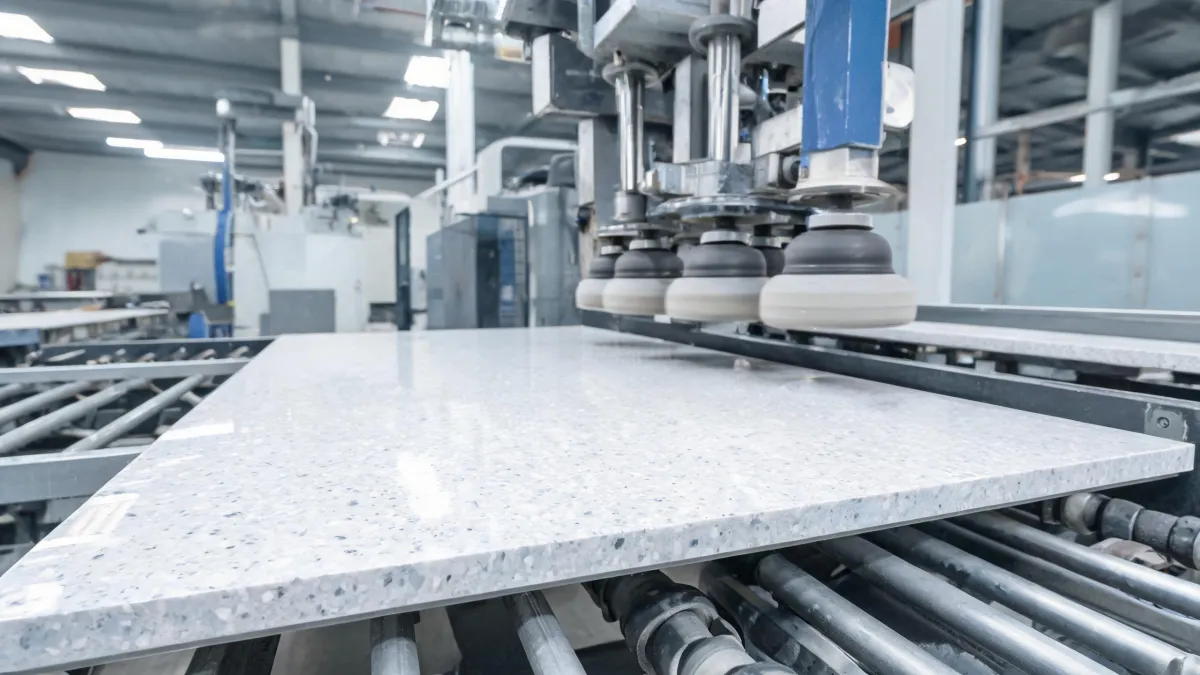
Why does the Breton process matter? Breton is the process technology behind many engineered quartz countertop slabs. The method uses vacuum vibro-compression, which generally produces denser slabs with fewer pinholes and more uniform thickness. I've seen cheaper casting lines use lower pressure to reduce factory cost. The slabs look fine in a low-resolution photo, but problems appear after cutting and polishing. If your customer orders quartz by color code every month, you need repeatable output. That is not a branding issue. That is a cost-control issue.
Does that mean natural granite is worse? No. Natural granite has a place in high-end projects, and I don't want to sound like it doesn't. But granite is a natural product. You can stabilize the source quarry, but you cannot eliminate slab-to-slab variation the way you can with a carefully controlled engineered product.
Lead Time, Minimums, and the Real Price of Waiting
The direct granite countertops manufacturer usually makes sense when you can order container quantities, wait 10 to 12 weeks, and warehouse inventory. The solid surface supplier makes sense when your installation schedule cannot move.
Many buyers ignore this because lead time does not appear on a price list. But if a project is delayed for a month, the penalty or labor cost can exceed the full material difference. We once had a direct-order stone container sit at port for an extra week because of a customs documentation issue. That week cost us storage fees plus two fabricator crews waiting for material. The discount from buying factory-direct almost disappeared. Global currency markets have also changed a lot since the fixed-rate system that came out of the 1944 Bretton Woods Conference. If you import slabs, your material cost can shift with the exchange rate before it hits the port. I still order direct when the schedule allows it, but I never pretend the schedule is free.
Minimum order size is another hidden line. Factories that press engineered stone on a Breton line often want a container commitment before they open a color. Private-label work is even heavier. You may need approved color samples, packaging, and production scheduling before the first container ships. A wholesaler with thin margins cannot always carry 45 days of inventory while waiting for the factory to stabilize production.
Private Label and OEM Support
Wholesale buyers often want their name on a product line. When the label is mine, I compare more than price. If a supplier is just trading slabs from another factory, they usually cannot help with packaging design, edge specifications, or warranty documentation. A manufacturer running an integrated stone process, such as Breton-style quartz production, can support private label more seriously. They control the pressing line and the quality checks. That gives me more leverage when we negotiate a defect policy.
This is also where value over price becomes practical. In 2023, I approved a private-label trial with a cheaper non-Breton line. The first lot looked acceptable. The second lot had a different color cast and visible pinholes. Our customer asked for a refund on 14 slabs. The manufacturer accepted the claim but refused to pay return freight. After return shipping, inspection, and reordering, we lost about $6,200 on a product that looked 12% cheaper than the engineered alternative. That was the last time I let unit price alone make the decision.
I'm not saying every non-Breton line is bad. But when you put your name on a slab, you own the failure risk. The buyer's job is to price that risk, not ignore it.
When I Still Choose a Direct Granite Manufacturer
If this sounds like an argument against direct granite sourcing, let me correct it. We still buy direct from granite countertops manufacturers. Natural stone projects for architects and high-end residences are a good example. Those buyers want to see the actual block or slab. They are not looking for color consistency across a 300-slab program. Direct factory buying gives access to unique material at a lower base price. If you have enough cash to float the container, a warehouse, and a secondary market for seconds, it can be very profitable.
The mistake is when a wholesaler treats direct pricing as a risk-free number. The best buyers I know assume the quote is not complete until the total-cost review is done.
Bottom Line for Wholesale Buyers
If you are building a countertop material library, you will probably need more than one sourcing route. My current decision rule is simple.
Choose direct natural granite when the project is specific, the schedule allows for container lead time, and you can absorb rejects as seconds. Choose a solid surface supplier or an engineered-stone manufacturer when the program needs repeatable colors, shorter lead times, private-label support, or backup inventory. And when a supplier uses a Breton process line, pay for it only if the total cost per usable slab supports it.
Does that make Breton-process engineered stone the best material? No. It makes it the best process for some wholesale programs. The more honest question is not granite versus solid surface. It is which supplier carries the risk for the least total cost. That is the answer I want from every quote, and it is the granite countertops wholesale cost guide I use to this day.