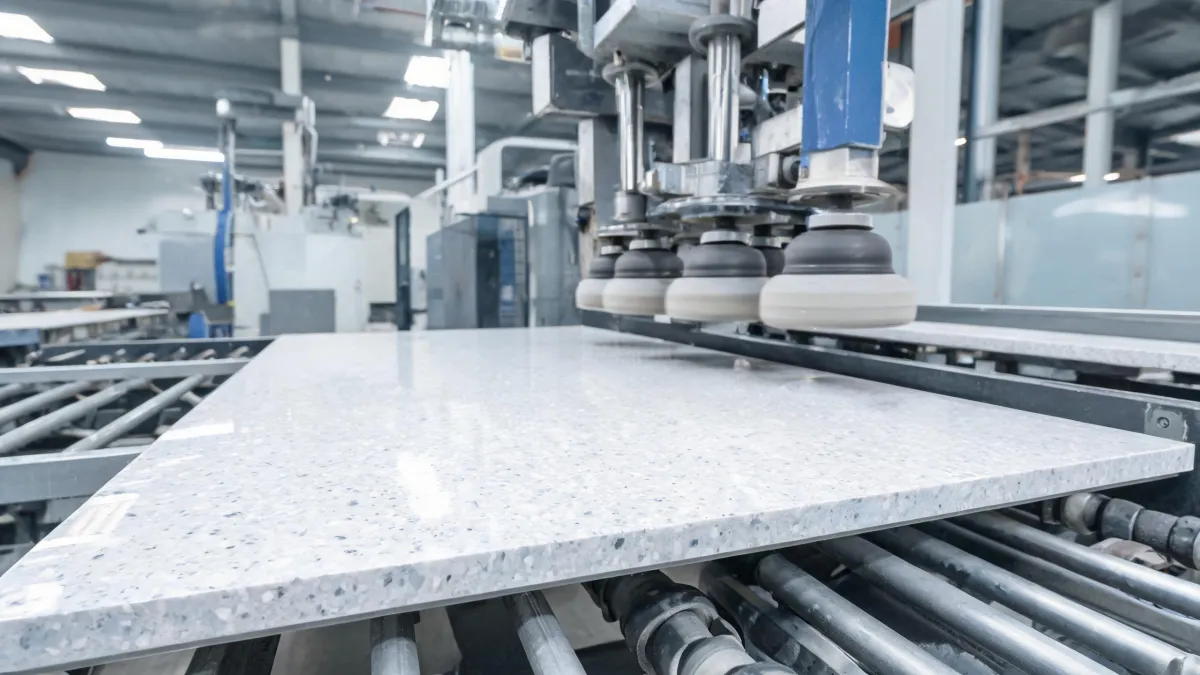
I sit on the procurement side of the desk, not the manufacturing side. My job is ordering, supplier management, and making sure that whatever we spec actually arrives on time at the price we agreed on. So when I had to vet solid surface and engineered stone manufacturers for a 2024 consolidation project — four countertop vendors collapsing into two — I'll be honest: my first framework was wrong.
Here's a checklist that actually works, based on what I've learned the hard way. Seven points. Run them in order. Skip one and you'll find out why it was there.
When this checklist applies
Use this if you're a wholesale buyer, distributor, fabricator, or an OEM/private-label partner sizing up a new stone supplier. It's built for evaluating engineered quartz, solid surface, and granite countertop manufacturers who claim wholesale or export capability. Not useful if you're buying a single slab for a kitchen remodel — different game entirely.
1. Separate actual manufacturers from traders
Half the "manufacturers" listed on B2B platforms are trading companies with a showroom and a relationship with an actual factory. Not necessarily bad, but you need to know which one you're talking to.
What to ask:
- Can they show a manufacturing license under the company name?
- What's their press capacity in tons? (For engineered stone, this is a hard number, not marketing language.)
- Request a live video walkthrough of the production line — date-stamped.
- Do they own their slab polishing equipment, or does that get outsourced?
A real factory answers all four without friction. A trader pivots to "we work with several partners" — which is a fine answer, just not the same answer.
2. Understand which engineered stone process they run
This is the step most buyers skip, and it's the one that bites hardest later. The Breton method engineered quartz process — vacuum vibro-compression under controlled pressure — is the reference technology for a reason. If a supplier claims to use it, they should be able to walk you through the actual press line, resin-to-aggregate ratio, and cure cycle. Not in a brochure. On a call.
"When I compared our Q1 samples against our Q2 batch — same vendor, same SKU, different press run — I finally understood why the process question matters. Slight variation in binder ratio changes how the slab cuts, chips, and takes a polish."
Ask directly: which press, what tonnage, what cure temperature, how long. If they can't answer, they either don't run the line or they're buying finished slabs from someone who does.
3. Verify certifications — with current documentation
Compliance claims expire. A certificate dated three years ago is not a certificate — it's a museum piece. Request:
- Current ANSI/ISO documentation for the specific product line (not the whole company).
- Test reports for the exact slab thickness and finish you're ordering.
- For any food-contact or healthcare application, the relevant NSF or equivalent certification with a live expiration date.
Per industry practice, verify current certificate validity through the issuing body's public registry rather than accepting a scanned PDF. This takes ten minutes and has saved me from at least one awkward conversation with our compliance team.
4. Stress-test the OEM and private-label capability
If you're ordering engineered stone OEM under your own brand, the barrier isn't the slab — it's everything around the slab. Label printing, packaging spec, warranty card language, batch traceability. Ask for:
- A sample of a previous private-label run (with client permission, redacted).
- Their minimum order quantity for custom packaging.
- What happens when a downstream customer files a warranty claim — whose process is that?
Vendors who've done OEM before will have template answers. Vendors who haven't will improvise, and you'll hear it. Improvised OEM logistics cost me roughly $2,400 in rejected shipments once — never again without a template.
5. Audit quality control, not the marketing deck
Quality control is where two manufacturers with identical press lines diverge. Ask for:
- Rejection rate on finished slabs over the last 12 months (as a percentage, not "very low").
- How they test for resin spots, pinholes, and bowing.
- Whether every slab is individually inspected or batch-sampled.
- What happens to a rejected slab — scrap, seconds sale, or does it ship anyway?
That last question is the tell. Suppliers who ship seconds without disclosure show up in your refund cost per unit within six months.
6. Test responsiveness before you place the first order
Response time before the order is the ceiling. It never gets better after the invoice. Send a technical question — not "what's your price," an actual technical question — and time the reply. Then send a follow-up to the same thread and see if the same person answers.
Consistency in who answers matters more than speed. Three different reps across four emails means no account owner, which means no accountability when something goes sideways.
7. Nail down wholesale terms and logistics in writing
Before any verbal agreement becomes anything:
- FOB terms, port of loading, estimated transit window for your destination.
- Packing method — crated, A-frame, loose? Damage claims usually start here.
- Payment terms, currency, and what triggers a renegotiation.
- Breakage policy: who eats the cost of a cracked slab in transit?
I had a vendor last year try to reclassify transit damage as "customer handling" for a shipment that never left the port intact. Crate method was in the email thread and saved us the claim. Get it in writing, in the thread, before you wire anything.
Things people usually get wrong
Trusting the sample alone. A perfect sample is the easiest thing to fake. Trust the process, the certification, and the rejection rate — the sample is a sample.
Assuming Breton branding equals Breton quality. The Breton method is a process; running it badly is a real possibility. Ask what the actual press is, not what the marketing deck says.
Ignoring the invoicing capability question. I once watched a $1,800 order get rejected by finance because the vendor could only produce a handwritten receipt. Roughly the same amount got eaten out of the department's budget. Verify invoicing format before the first purchase order, not after.
Skipping the second question. Anyone answers the first email well. The second email is where you learn whether you have a supplier or a salesperson.
Seven points. Run them every time a new manufacturer shows up on your radar, and once a year for the ones already on your approved list. It's a boring checklist. That's the point — boring is what keeps refunds low and reorders clean.