It Almost Never Starts With a Crack
Last year, I stopped 38 slabs out of a 96-slab production run before they went into a shipping container. To the sales rep, they looked fine. To me, they were a warranty claim waiting to happen. I'm a quality and brand compliance manager at an engineered-stone manufacturer, and I review every production lot before it's released — roughly 400 lots a year. In 2025, I stopped about 3% of first runs for rework. Not because the product was automatically bad. Because the buyer didn't specify what they expected.
If you've ever bought bulk stone countertops as a distributor, fabricator, or private-label partner, you've probably felt this gap. You look at a quote, a catalog, and a sample, and you think you know what you're getting. Then the first container arrives and something is off.
This article isn't going to tell you that any one technology is universally better. It's going to explain why 'Breton' keeps showing up in quartz countertop specs, what it does and doesn't mean, and why the OEM vs. private-label distinction matters more than most buyers realize.
Why Breton CAP and Breton Woods Get Mixed Up
Searching for 'Breton' in the stone industry can feel like chasing a ghost. 'Breton CAP' appears in technical documents. 'Breton woods' appears in product lists. Another supplier's solid surface catalog uses 'Breton' as a style label. Buyers reasonably assume they're all referring to the same reliable standard. They aren't.
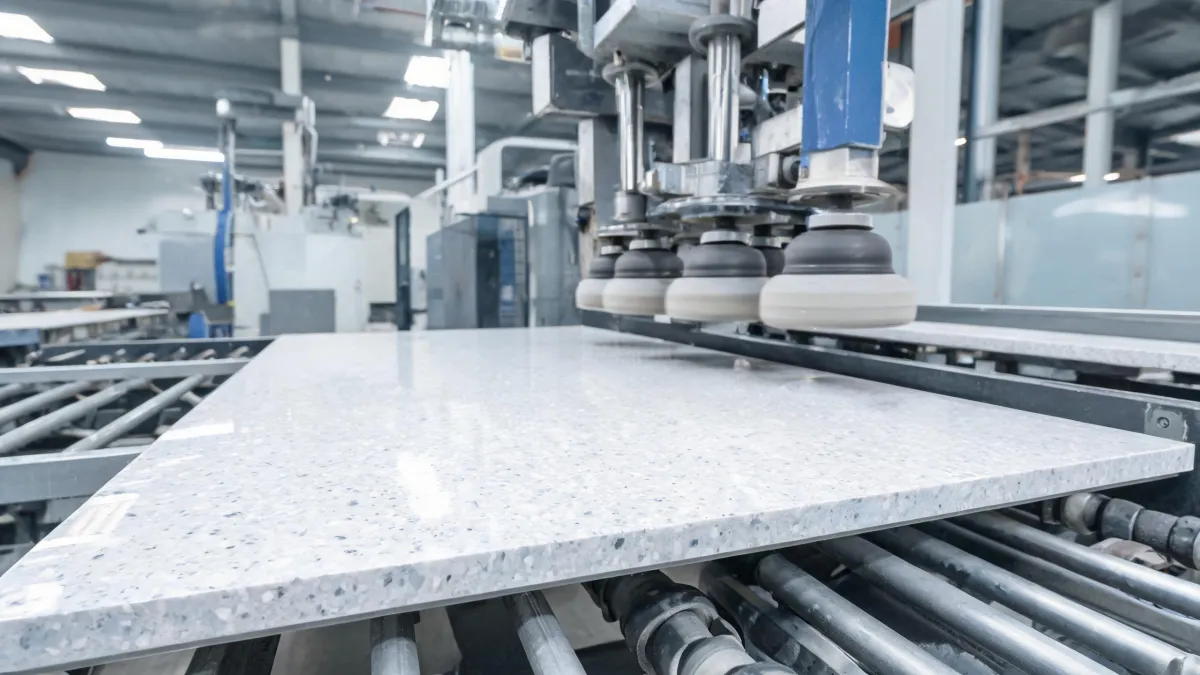
Breton is an Italian engineering company that designs and builds plants for producing engineered stone. The CAP process is Breton's patented compaction system — a combination of vibration, vacuum, and pressure that produces dense, homogenous slabs. If a supplier says a slab was made on a Breton CAP plant, that tells you something about the machinery. It doesn't tell you about the resin quality, the quartz particle gradation, the pigment control, or the operator's willingness to reject an off-shade lot.
Then there are product names. A label like 'Breton Woods' often describes a wood-effect quartz series in a supplier's catalog. It might be made with Breton technology. It might also be another manufacturer's take on the same style. The product name alone is not a process claim, a quality certification, or a warranty.
I've had buyers send me a screenshot of a wood-look countertop and ask, 'Is this Breton CAP?' The honest answer is: I can't tell from a photo. I can only tell from the manufacturing documentation and the lot test results.
The Real Difference: OEM vs. Private-Label Quartz Countertops
The phrase 'quartz countertops OEM vs private label' usually gets asked as if it's a simple classification. It isn't. The difference is who owns the specification.
When you buy on an OEM basis, you define the product. You decide the color target, the dimensional tolerance, the surface finish, the packaging, and the test criteria. The factory executes against your plan. If something goes wrong, the specification belongs to you, and you have the right to hold the manufacturer to it.
A private-label purchase is different. You're taking a product the manufacturer already designed and putting your name on it. You're buying their standard, not writing your own. That can work well, but only if you know what their standard includes. To be fair, some of the strongest slabs I've reviewed were sold under private labels. The distributor didn't rely on the manufacturer's word. They audited the process and locked in the quality thresholds with an actual contract.
I get why private label is popular. It's faster, it's simpler, and it gives you a ready-made offering. But speed is not a substitute for specification. In bulk stone countertops, the difference between a beautiful sample and a repeatable production reality is exactly the quality data you didn't ask for.
What Vague Specs Actually Cost
In 2024, I saw a distributor's private-label launch fall apart over color drift. The showroom sample was warm and consistent. The first two containers matched. The third was noticeably greener. The distributor had already sold the color to a multi-unit residential project. Re-fabrication, site delays, and expedited freight added up to roughly $22,000. The manufacturer didn't think they had a defect. They'd produced within their own tolerance. It just wasn't the buyer's tolerance.
That story always comes to mind when someone asks why quality matters in bulk countertop purchases. The material itself didn't crack. The spec did.
The failures I see most often are consistent: color drift between lots, thickness or flatness variation that makes fabrication slower than planned, and under-cured or brittle resin that only shows up when a CNC bit or a drill hits it. Any one of these can turn a profitable order into a loss. All three are avoidable with a clear specification.
How to Buy Bulk Stone Countertops Without Guessing
I'm not going to turn this into a 20-step procurement manual. If you're on the B2B side, you already know how to negotiate. What you need is a way to connect the words in a catalog to the reality in a production lot.
- Decide whether you're buying OEM or private label. If your brand is on it, you need to own the spec. If it's a private-label purchase, ask what the manufacturer's standard actually is and whether it matches your customer's expectations.
- Ask what 'Breton' in the quote refers to. Is it the CAP plant, a product name, or a marketing reference? Put that answer in writing.
- Request lot-level test data. For engineered stone, standardized test methods for water absorption and flexural strength are common — as of early 2026, the EN 14617 series is the one I see most often for agglomerated stone, and some suppliers also use ASTM methods. Ask which your factory certifies to, then ask for the last three lots of the exact SKU you're ordering, not a generic datasheet.
- Do a physical panel review. Photos don't show surface texture, resin coverage, or edge quality. Have a slab cut, inspected, and measured before you commit to a full container.
Use the solid surface catalog as a navigation tool, not a compliance document. A catalog can tell you what a product is supposed to look like. It can't tell you whether the next run will meet your tolerance. That's what lot data is for.
At Breton, I sit on the manufacturing side, so I know the temptation to say 'trust us.' I'd rather you don't. Take the lot reports, compare them to your standards, and hold us — or any supplier — to the performance you need.
And one last boundary: I'm not a structural engineer. If your project involves large overhangs, unusual edge profiles, or commercial load requirements, bring in an installation or engineering specialist before you finalize anything. My job is to make sure the slab isn't the weak link in the chain.