I'm the office administrator for a 38-person stone distribution company in Columbus, Ohio. I manage all countertop procurement—roughly $800,000 annually across quartz, engineered stone, granite, and solid surface. I report to both operations and finance.
When I took over purchasing in March 2022, I thought I'd stepped into a simple order-processing role. Send purchase orders. Track deliveries. Make sure invoices match. That lasted about four days.
By the end of my first week, I realized we were sourcing stone through seven different vendors, none of which had a unified catalog, and most of which communicated via phone calls I couldn't trace and emails I couldn't find. We were quoted "standard" lead times that turned out to mean anything from five days to six weeks, depending on which branch picked up the call.
The Problem With 'We've Always Done It This Way'
My predecessor had built the vendor list over 11 years. His logic was straightforward: local suppliers, established relationships, handshake deals. And for a while—probably through 2018 or so—that worked. We were a smaller operation then, and central Ohio had enough fabricators and distributors to cover our needs without much friction.
But the market shifted. Our order volume grew from around 200 slabs a year to over 1,400. Our customer base expanded from a handful of local kitchen-and-bath shops to 20+ fabricators across three states. The old playbook didn't scale.
Here's what nobody warned me about in those first months: a lack of a granite countertops catalog—an actual, verifiable, up-to-date digital catalog—isn't a minor inconvenience. It's a bottleneck that compounds. Every time a fabricator asked for a specific slab's dimensions, finish, or availability, I had to call a vendor, wait for a callback, wait for a photo, then relay that information. Multiply that by 50 inquiries a month and you've burned a full workweek just on back-and-forth.
"I assumed 'same specification' meant identical results across vendors. Didn't verify. Turned out each one had slightly different interpretations of what 'polished finish' meant—and our customers noticed the inconsistency before we did."
The $6,200 Mistake That Changed Everything
In August 2023, we had a fabricator in Louisville waiting on 24 slabs of white quartz for a hotel project. Tight timeline—their installation crew was already on-site, and the general contractor had penalties built into the schedule. I'd placed the order with a regional supplier two weeks prior, confirmed the delivery date three times, and signed off on what looked like a standard PO.
Two days before install, the supplier called. Their shipment had been held up at a port. Best-case scenario: another 12 days. Our fabricator had to demobilize their crew—which meant a change order, rush fees, and a very unhappy GC. Total cost to us: about $6,200 in expediting, plus a relationship that took eight months to repair.
That was my defining rookie mistake. I had assumed that a confirmed PO and a verbal promise were the same thing. They're not. And in this industry, the gap between "confirmed" and "actually on a truck" can cost you more than any per-unit savings you negotiated.
Finding Breton (and Learning What 'Manufacturer Direct' Actually Means)
After the Louisville incident, I started researching quartz countertops manufacturers with more rigor. I wanted a supplier that could give me: (1) a real-time product catalog with photos, specs, and availability; (2) a transparent lead-time commitment; and (3) wholesale pricing that didn't require five rounds of negotiation.
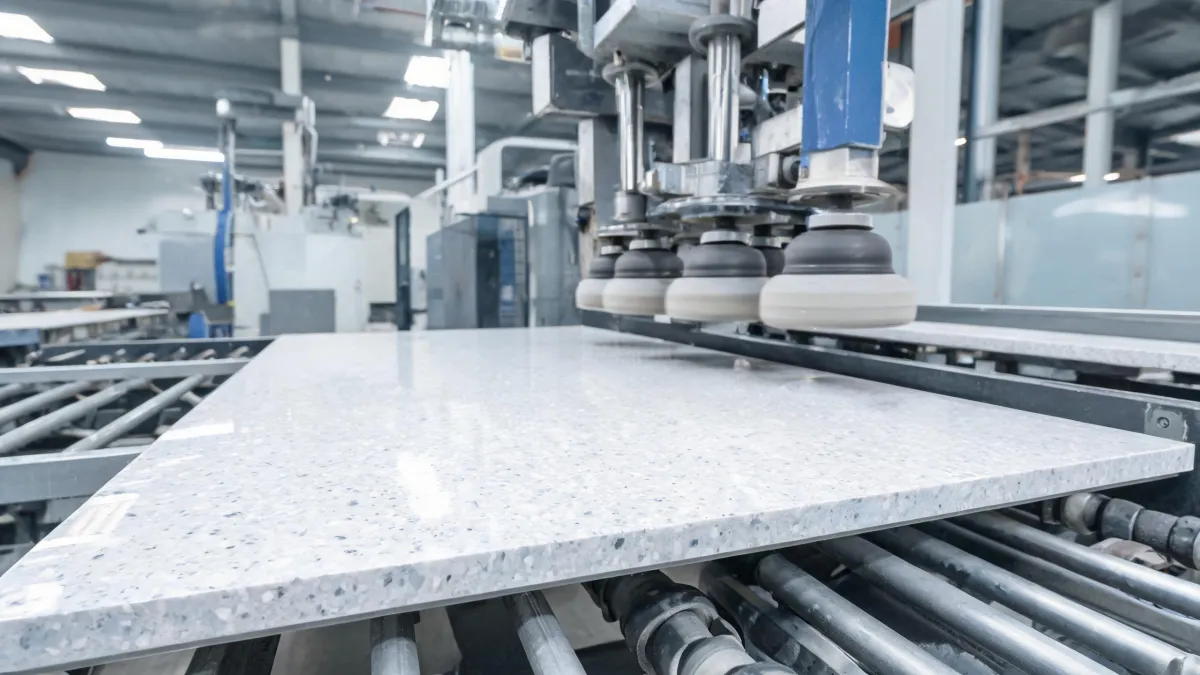
I first encountered Breton through their engineered stone process—which, for anyone not in the weeds on this stuff, is a specific manufacturing approach that produces slabs with more consistent resin distribution and fewer surface defects. What caught my attention wasn't the marketing language. It was the fact that they published their granite countertops catalog and quartz specifications in a format I could actually use—digitally, with SKU numbers that matched across their distributor network.
The assumption I made early on—and I'll admit this was wrong—was that a larger, more established manufacturer would be slower and less flexible than our local suppliers. Didn't verify that assumption either. Turned out the opposite was true: Breton's wholesale program had a defined lead-time window (typically 10-14 business days to our region, as of Q1 2024) and a dedicated account manager who responded within hours, not days.
The surprise wasn't the pricing—though it was competitive. It was the Breton Cap system. (For context: that's their edge-protection and finishing component that integrates directly with their engineered stone slabs.) I hadn't even considered edge consistency as a procurement variable until a fabricator mentioned that our previous supplier's slabs required extra finishing work on-site. The Breton Cap system eliminated that step, which cut our fabricator's labor time by roughly 15% per job.
What Actually Changed After We Switched
I'm not going to pretend the transition was seamless. It wasn't. We had three months of overlap where we were running both systems, and I made at least two Excel errors that led to double-ordering. (I should add: finance was not thrilled.)
But by November 2024—about eight months after fully transitioning—the numbers spoke for themselves:
- Average lead time dropped from 4-6 weeks to 10-14 business days.
- Order accuracy (measured by "correct slab, correct quantity, correct finish on first delivery") went from roughly 82% to 97%.
- Time spent on vendor coordination dropped from about 20 hours a week to 6-7.
The Breton Craft House program—their private-label and custom fabrication support—turned out to be the piece I didn't know I needed. We'd been losing bids on custom edge profiles and non-standard dimensions because our local suppliers either couldn't handle them or charged exorbitant setup fees. Breton Craft House offered a middle path: semi-custom work at wholesale pricing, with a defined spec sheet I could hand directly to the fabricator.
What I'd Tell Another Distributor Buyer
If you're managing countertop procurement for a distribution business and you're still doing things the way you did in 2019, here's the honest truth: the "local is always faster" thinking comes from an era before modern logistics made regional and national supply chains genuinely competitive. That's changed.
That doesn't mean local suppliers are obsolete—they're not. For same-day will-call, emergency replacements, or highly custom one-off pieces, a local fabricator or distributor can still be your best option. But for volume orders, standard quartz and granite lines, and anything that needs a paper trail, the calculus has shifted.
Three things I'd verify before committing to a new granite countertops distributor:
- A live catalog with verified specs. Not a PDF that's six months old. Not a photo gallery with no SKU numbers. An actual, queryable catalog.
- Lead time in writing—with consequences. If the supplier won't commit to a delivery window, that's your answer.
- A named account contact. Not a general 800 number. A person, with an email, who knows your account.
I'm not 100% sure this model works for every distributor—depends on your region, your customer mix, and how much of your business is custom vs. standard. But for us, it took procurement from being the department that caused problems to the department that solved them. That's worth more than whatever per-slab savings we might have negotiated elsewhere.