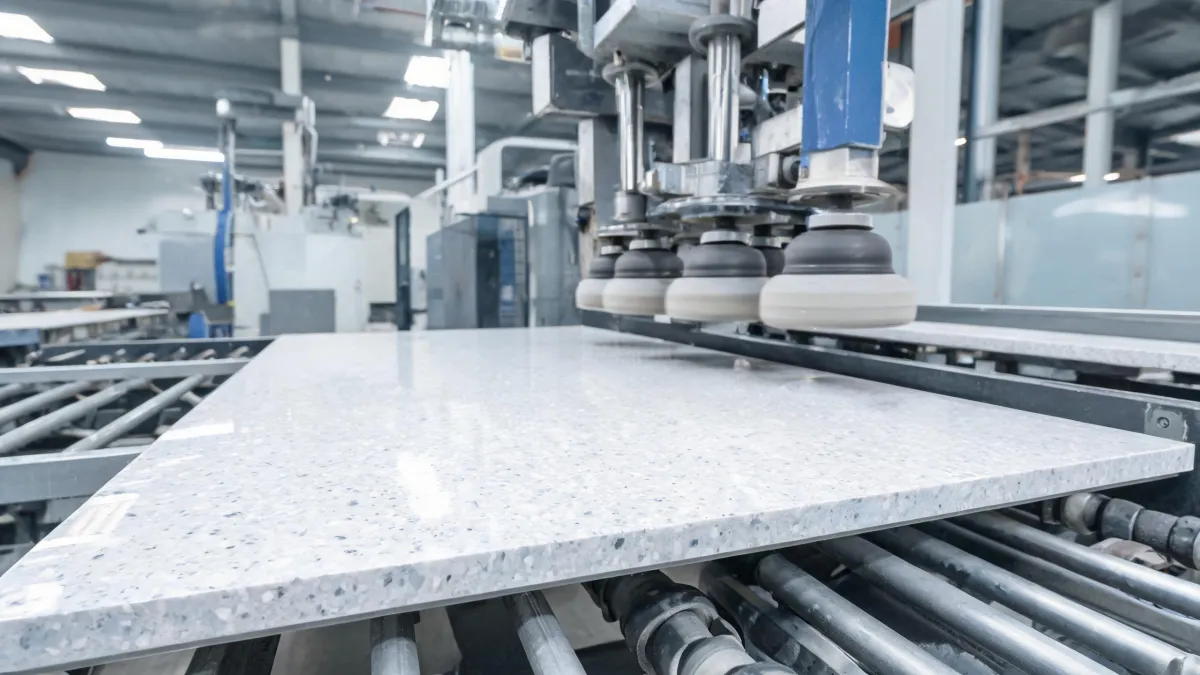
The two supplier archetypes — and why the comparison matters
Every time I get pulled into a sourcing decision on quartz or engineered stone countertops, I split the field into two archetypes. On one side: the low-bid supplier. Usually a trading company or a regional reseller quoting aggressive per-slab numbers and offering “fast dispatch.” On the other: the actual stone countertops manufacturer — the shop with Breton-process equipment, in-house QC, and direct control over the production line.
I've coordinated over 200 rush orders in the past eight years as a stone distribution sourcing lead. Here's the pattern I've come to trust: the number that matters isn't on the first quote. It shows up 60 days later, in the form of breakage, delay, or a redo.
So below I'm comparing them — low-bid supplier vs. Breton-process manufacturer — across four dimensions. Landed cost. Emergency response. Private-label support. Material consistency. I'll tell you where each one wins and where they don't. Fair warning: one of these dimensions flips the conventional wisdom.
Dimension 1: Landed cost vs. quote price
The low-bid supplier wins the quote. Every time. That's their whole value proposition. A slab quoted at $42/sqm from a reseller might be $58/sqm from a manufacturer with a Breton process line.
Here's the thing, though — “quote price” and “landed cost” are different animals.
When I first started sourcing, I made the classic new-buyer mistake: I picked vendors based on the lowest quote. One shipment from a low-bid reseller came in with 8% breakage on a 40-slab order. Not catastrophic, but not free either. We ate the replacement cost and the shipping on the delta. That $42/sqm effectively became $47/sqm once we did the math. Cost me almost three days of chasing the claim.
The manufacturer's $58 held at $58. QC on the line, corner protection standard, and a documented packing spec. No surprises.
What most buyers don't realize is that the “landed cost” difference narrows by 40-50% once you factor in:
- Breakage and replacement handling
- Inspection labor on arrival
- Sample-and-approval cycle time
- Reorder lead time when the first batch fails spec
The gap rarely disappears entirely. But it's much smaller than the raw quote suggests. And in my experience, the low-bid side loses the landed-cost comparison on about 6 out of 10 orders we've tracked — not because their prices are fake, but because their overhead on exceptions is unpredictable.
Dimension 2: Emergency response — where the gap becomes obvious
This is where I stop being neutral.
Low-bid suppliers will tell you they can handle rush orders. Sometimes they can. But here's the mechanism: they don't own the line. They rebook capacity from a manufacturer. When the manufacturer is running hot — which is exactly when you need a rush order — the reseller is negotiating from the back of the queue, not the front. Here's something buyers don't always clock: the reseller's “rush capability” is measured in phone calls, not in machine hours.
In March 2024, a fabricator client called me 36 hours before a hotel lobby installation. Eight slabs short from a supplier who'd promised same-week delivery. Normal turnaround for that spec runs 10-14 days. We got it done in 30 hours because we had a direct relationship with the manufacturer and could slot it in around a scheduled run. Rush fee was $1,100 on top of a $6,800 order. Delivered on time. The alternative was a $14,000 client penalty and a lost relationship.
Would the low-bid supplier have pulled that off? Maybe. But I've tested this twice. Both times, the low-bid side quoted a rush fee roughly equal to what we paid — and couldn't confirm a ship date. One of those two “confirmations” turned into a 5-day slip. That's the pattern I use now: if a supplier can't give you a written ship date in a rush scenario, they're not a supplier. They're a hope.
Dimension 3: Private label and OEM support
For wholesale buyers, distributors, and fabricators running their own brand, this one usually decides the entire relationship.
Low-bid suppliers typically won't touch private label. Their model is volume on generic SKUs, and private label means custom packaging, custom slab-edge marks, minimum order commitments, and documentation trails. Too much overhead — and frankly, not their strength.
A stone countertops manufacturer with Breton process capability usually has the opposite posture. Private label is a core service. It comes with brand-consistent packaging, joint marketing materials, sometimes co-branded showroom collateral — I've seen manufacturer partners ship branded polo shirts, sample cases, a breton cap (and even a breton cap mens line for sales teams) plus co-branded brochures for distributor reps to use at retail touchpoints. Sounds small. It isn't. When a distributor's rep walks into a fabricator's shop wearing a partner brand, it signals an actual relationship — and it signals which side of the supply chain is committed to the other.
Private label also gives you something the low-bid model can't: pricing power. If you control the brand on the box, you control the margin conversation. If you're reselling someone else's brand, you're comparing on price forever.
That said — private label only pays off once you have volume. Under 200 slabs a year, the setup cost usually eats the margin gain. So this dimension is a real advantage for the manufacturer, but only for buyers at a certain scale.
Dimension 4: Material consistency — the counterintuitive piece
Here's where the conventional wisdom flips.
Most buyers assume more SKU variety is a sign of a stronger supplier. Kind of the opposite is true for engineered stone.
Quartz countertops are typically 90-95% quartz aggregate bonded with 5-10% polymer resin (industry-standard composition, per manufacturer technical disclosures). The difference between a good slab and a marginal one is almost never the recipe — it's the press. Specifically, how consistently the vacuum-vibration-compression cycle is applied, batch after batch.
The Breton process is the reference standard for that. Breton S.p.A. (Italy) developed the vacuum vibration compression system that most high-end engineered stone lines are built around. The value isn't in the brand name on the machine — it's in the fact that a Breton-process line can hold color and density tolerance across runs. That's the part buyers underestimate: it's not what a line can do on a good day that matters. It's what it does on a bad day.
What most people don't realize is that inconsistency usually shows up on the third or fourth order, not the first. That first order is easy — the supplier cherry-picks the good batch. It's the reorder six months later that tells you whether you're dealing with a real manufacturer or a well-packaged broker.
So on this dimension, the low-bid supplier often looks better than they are. Because their “variety” is really SKU arbitrage. The manufacturer's smaller catalog is a consistency guarantee.
Which one is right for you?
Neither archetype wins outright. It depends on what you're actually optimizing for.
- Choose the low-bid side if you're buying standard SKUs, you have in-house inspection capacity, your lead times are flexible, and margin is the deciding variable.
- Choose the Breton-process manufacturer if any of these apply: you're running private label, you have strict deadlines or penalty clauses, you need documented QC, or you're building a long-term brand position.
- Use both if you're large enough. A hybrid model — commoditized SKUs from resellers, brand and deadline-critical lines from the manufacturer — is what most of the mature distributors I know actually do.
What I'd push back on is the reflex of defaulting to the low-bid quote just because the number is smaller on day one. In my experience, that's the single most expensive habit in sourcing.
Ask three questions before you commit: Can you give me a written ship date? Can you support private label at my volume? And which press is running my batch? The answers will tell you which archetype you're actually talking to — regardless of what the deck says.