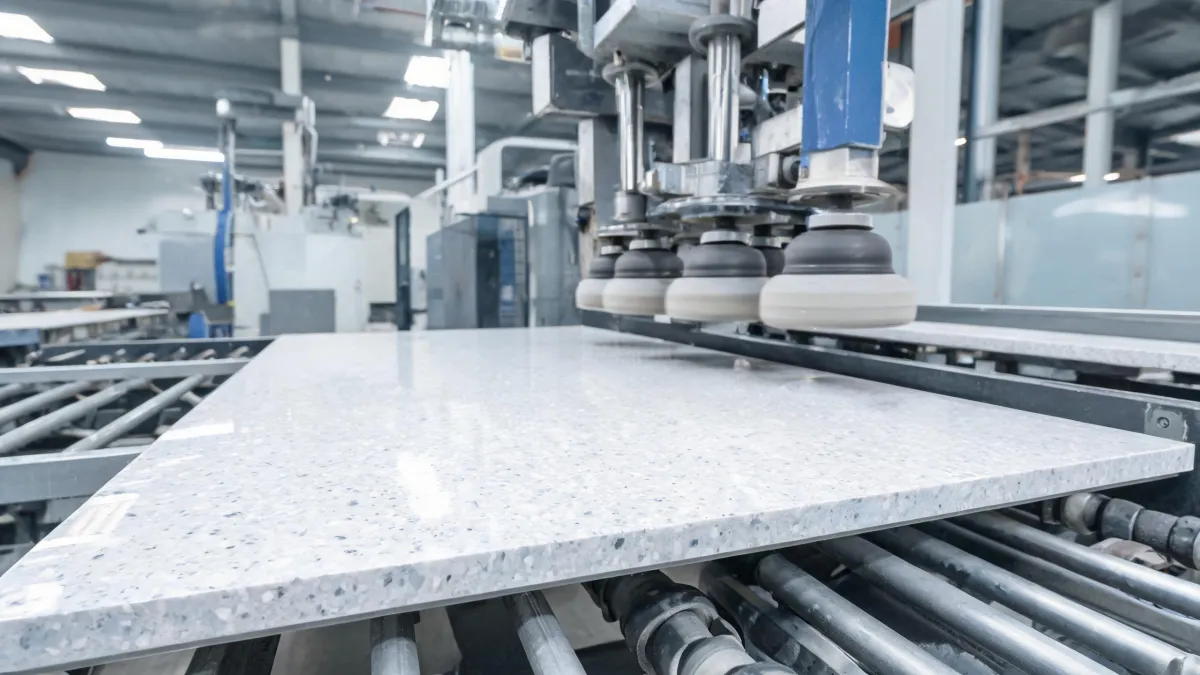
When I first started in this industry, I thought sourcing granite countertops OEM partners was simple: find the lowest price per slab, run the numbers, sign the contract. It took one color-inconsistency disaster and a client threatening to walk to teach me otherwise.
That's the thing about engineered stone and granite countertop OEM sourcing. The surface problem is easy to spot: you found a supplier with an unbeatable price per slab, you signed a private label agreement, and things unraveled after a few shipments. But the deep cause—the one that keeps biting buyers year after year—is something most people never see coming.
The Surface Problem: Cheap Slab Prices and Expensive Consequences
Here's how it usually goes. A distributor or fabricator gets an engineered stone private label quote that's 20–30% below the market average. The samples look okay. The sales rep is responsive. They sign, maybe even celebrate the margins they just created.
Then shipment two arrives with color variation visible from three feet away. Shipment three is ten days late because the factory "had capacity issues." The contractor's crew is standing by, the homeowner is calling daily, and suddenly that great margin doesn't feel so great.
The uncomfortable truth: the problem isn't that you picked a bad supplier. The problem is the way you evaluated them in the first place.
The Deep Cause: What You're Actually Buying
Over the years, I've been the person who gets called when these sourcing situations spiral. I've triaged more emergency reorders than I can count—200-plus rush jobs involving quartz, granite, and solid surface, including same-day turnarounds for clients whose projects were falling apart.
What I've learned is that most buyers misunderstand three things about engineered stone private label and OEM production.
1. Breton Technology Doesn't Mean What You Think It Means
"Breton engineered stone" is the gold standard. Breton S.p.A., based in Castello di Godego, Italy, developed the Bretonstone® process in the 1980s—the technology that essentially created the engineered quartz category. If you're in the countertop business, you know the name. It's a seal of approval, a shorthand for quality.
(Interesting aside: every few months, a client asks me about Cap Breton, France—the coastal town on the Bay of Biscay—assuming there's a connection. There isn't. Breton the company is Italian. Cap Breton is a surf town in Basque country. Even I got that mixed up when I first started.)
Here's what people miss, though. A factory having Breton equipment tells you they have the capability to produce high-quality engineered stone. It doesn't tell you they do it consistently, batch after batch. I've walked through Breton-equipped plants that were meticulous—temperature-controlled curing, documented resin ratios, rigorous testing. I've also seen plants with similar equipment cutting corners on raw materials and skipping QC steps when the line ran behind.
The license isn't the quality. It's a starting point.
2. The "Breton Cap" Effect
This one is subtle, and it's bitten more buyers than I can count.
Even Breton-licensed manufacturers have finite production capacity. When demand spikes—and in construction, it always does in spring and summer—somebody's orders get pushed. If you're the low-margin private label client who negotiated the rock-bottom price, guess whose order slides first?
I've seen this play out from the inside. A factory running at 95% capacity will prioritize its house brand and high-volume accounts. Your "great deal" suddenly isn't a deal—it's a delay. And a delay in this industry cascades: your distributor's project stalls, the contractor bills for idle crews, and the end customer starts talking about penalty clauses.
The $50 per slab you saved doesn't look so smart when it costs you a $15,000 project and a client relationship.
3. The Private Label Trap
Private label engineered stone is a beautiful business model—you sell slabs under your own brand without owning a factory. But here's what I tell every client considering it: you're renting quality, not owning it.
Your brand is built on a promise that your product performs. When you private label, you're trusting another company's production discipline to uphold that promise. One bad batch—crazing, resin spotting, thickness inconsistencies—and the contractor who spec'd your brand won't touch it again. That reputation damage is hard to quantify in dollars, but it's very real.
The Cost of Getting It Wrong
Let me make this concrete. In spring 2024, a distributor client of mine was riding high on a "great" deal with an engineered stone supplier. Slabs priced around $150 below market average. They'd won several large projects on the strength of that pricing.
On paper: $150 × 200 slabs = $30,000 in "savings" per big project. Solid numbers.
Then reality hit. Crazing appeared on 12% of the slabs in one shipment. Color consistency drifted between batches. One large installation had to be completely re-fabricated at the distributor's cost.
The total bill for that single project: roughly $42,000 in rework, replacement material, logistics, and overtime labor. Plus another $800 in emergency rush shipping to get replacement slabs within the deadline. Plus the project still finished late.
That "cheap" supplier cost them $42,000 more than the "expensive" one would have—and they still lost the client's trust.
The math gets even uglier when you factor in the rest: your own labor spent managing the chaos, the contractor relationships damaged on-site, the time your sales team spent apologizing. The slab price might be 40% of your total cost. The other 60%—fabrication, installation, logistics, and problem-solving—is where cheap sourcing starts leaking money.
For context on pricing: as of early 2026, wholesale engineered stone (quartz) typically runs $35–60 per square foot depending on finish and pattern, while solid surface wholesale costs range from about $25–50 per square foot for standard sheet goods (based on industry pricing data, January 2026; verify current rates). If your quote lands dramatically below that range, there's a reason. Not an exciting reason. A reason.
What Actually Works (Keeping This Short)
You didn't come here for a textbook. Here's the condensed version of what I've learned:
- Audit the factory, not the brochure. Breton equipment is table stakes. Walk the plant. Talk to the QC team. Ask about rejection rates and rework percentages. The difference between a 2% and 5% internal rejection rate is enormous over a year.
- Check capacity headroom. Ask about current utilization before you sign. If they're running at 95% capacity during peak season, your private label orders are future emergencies waiting to happen.
- Negotiate the failure terms, not just the price. What happens when a shipment fails inspection? Who pays for replacement fabrication? What's the guaranteed lead time on reorders? A supplier who answers confidently is worth more than one who dodges.
- Get quality hold points in your private label agreement. You should have the right to inspect batches before shipment. If a supplier resists that, that's your answer.
The bottom line is simple, and I only believe it because I've watched the alternative play out over and over:
Cheapest is never actually cheapest. Total cost is what matters. And in this industry, total cost includes the price of emergencies that should never have happened.
Final Thought
People assume the lowest quote means the vendor is more efficient, more streamlined. What they don't see is which costs are being hidden or deferred—until they show up on your invoice.
Next time you're evaluating a granite countertops OEM or engineered stone private label partner, ask yourself: when this supplier gets busy, whose orders get cut first? When the line gets stressed, whose batches get the least attention?
Answer those honestly, and you'll know exactly what a "good deal" is really worth.