If you Googled 'breton horse price' looking for a draft horse, this article will disappoint you. If you searched 'breton' because you're evaluating quartz countertops for a private label program or a bulk project, you're in the right place. Breton is one of the most important names in engineered stone—not because it's a material you can order by name, but because it's the process and machinery behind many of the world's engineered stone surfaces.
I've spent 11 years sourcing stone for hospitality and multifamily projects, and I've handled more than 400 rush orders, including same-week turnarounds that should have taken a month. This guide compares two ways to buy bulk stone countertops: direct from a Breton-process manufacturer, or through a generalist importer and distributor. If you need a practical engineered stone distributor buying guide, this is the framework I use.
What 'Breton' Actually Means
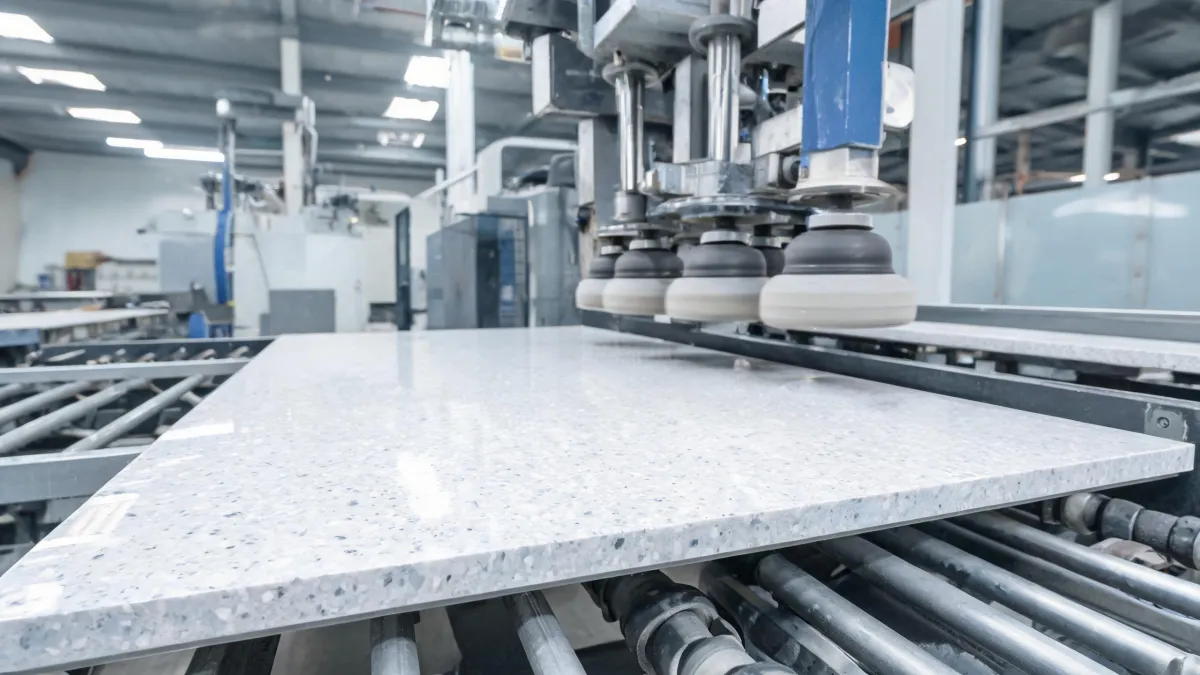
Breton S.p.A., founded in 1963 in Castello di Godego, Italy, builds the machinery and licenses the process used to produce a large share of the world's engineered stone. The Bretonstone process mixes quartz, aggregates, and pigments with resin, then compacts and cures slabs under vacuum and vibration.
It's tempting to think 'Breton' is a quality guarantee. But the finished slab still depends on the factory's formulation, curing cycle, and quality control. Two plants can run the same machinery and produce different countertops. That's why supplier evaluation matters more than keyword reputation.
The Comparison Framework
I'll compare two sourcing models:
- Model A: Direct Breton-process manufacturer. A factory that owns or operates a Breton line and can produce private label quartz for your company.
- Model B: Generalist importer/distributor. A middleman who buys engineered stone from multiple factories and resells it locally.
Both models can work. They answer different problems. The rest of this article compares them on five dimensions.
Dimension 1: Process Control and the 'Breton Cap'
When a supplier says they run a Breton process, I don't stop there. I ask about the production cap. That 'Breton cap' is the plant's max output—slabs per shift, color changes per week, order slots per month, and maintenance downtime. It tells you whether your order will actually fit in their schedule.
Model A usually has a clear answer because they control the plant. Model B often doesn't know, because they're one step removed from production. For bulk stone countertops, that uncertainty is a risk.
Dimension 2: Quartz Countertops Private Label
If you're building a quartz countertops private label business, the comparison is simple: a generalist distributor sells someone else's brand. They can't create your color palette, your slab marking, or your packaging.
A direct Breton-process manufacturer can. But private label is not a handshake. Ask about minimum order quantities, development time, and whether they're willing to run trial slabs before you commit to a container. And if a factory says 'we don't do private label,' respect that boundary. I'd rather hear that upfront than pay for a program they can't execute.
Dimension 3: Bulk Stone Countertops and Lead Times
For bulk stone countertops, lead time is often the entire game. Here's something vendors won't tell you: the 'standard turnaround' quoted by a distributor often includes buffer time. It's not necessarily how long your order takes; it's how long they want your promise to be safe. Direct manufacturers, by comparison, usually quote in production days once you have a slot.
In March 2024, a client called 36 hours before a hotel opening because 14 slabs were damaged in the fabricator's shop. The distributor said the color was discontinued. A direct Breton-process factory had matching slabs in stock and could produce 20 more in 72 hours. We paid $4,800 in expediting fees on top of the $18,000 base cost. The alternative was delaying the opening—estimated penalty, $50,000.
The lesson: stock is not the same as supply. Stock is the tail of a supply chain. If the tail gets cut off, you're waiting for the next container.
(Note to self: always ask for the production schedule before promising a client a date.)
Dimension 4: Quality, Traceability, and Accountability
The surprise wasn't the price difference between the two models. It was how much hidden value came from batch traceability. A direct manufacturer can show you a production batch number that maps back to raw materials and shift. A distributor can show you an import batch, but if they buy spot lots from multiple factories, the original process data may be incomplete.
I still kick myself for choosing a distributor whose quote was $2.10 per sq ft lower than the direct factory. After three containers, veining started to drift. The distributor blamed the factory; the factory blamed the distributor; the client rejected the shipment. The re-fabrication and expedited freight cost more than we saved.
To be fair, I've also seen direct factories produce bad batches. 'Breton process' is not a magic shield. But when one party controls the process, accountability is much easier to enforce.
Dimension 5: Total Cost, Not Unit Price
It's tempting to compare price per square foot and stop. That simplification ignores freight, inventory, defects, communication, and the cost of your own time.
- Direct manufacturer: Usually a lower unit price at container volume, but you need warehouse space, import logistics, and willingness to plan around production windows.
- Generalist distributor: Higher unit price, but you can buy one pallet, get it quickly, and shift some inventory risk to them.
For a one-off project, the distributor often wins. For a steady private label program, direct wins—if you can manage the logistics. Honestly, I used to avoid direct factories because I didn't want to deal with import paperwork. That was a lazy reason.
Which Model Should You Choose?
If you need less than 10 slabs next week, a generalist distributor is probably your best option. That's not an insult; it's their strength. If you're running a quartz countertops private label brand, buying bulk stone countertops on a regular cycle, or need batch-level traceability, a direct Breton-process manufacturer is worth the operational overhead.
My experience is based on roughly 200 mid-volume orders. I can't tell you how this scales if you buy 1,000 slabs a month or work at the ultra-luxury edge. In those segments, the economics and relationships look different.
The Engineered Stone Distributor Buying Guide: Final Checklist
Use this when evaluating either model:
- Ask for the factory name and which Breton process line it runs.
- Ask for the production cap: shifts, slabs per day, color changes per week.
- Ask what tests accompany each batch: flexural strength, water absorption, stain resistance, quartz content.
- Ask for private label requirements: MOQ, packaging, slab marking, trial slabs.
- Ask what happens if a container arrives defective—who inspects, who pays, who replaces.
- Ask for two references with orders of similar volume, not just written brochures.
(Mental note: the references tell you more than the sample. A polished sample can be made in a lab; 50 containers cannot be faked.)
Bottom Line
Neither model is universally better. The Breton process gives a direct manufacturer the ability to control quality, customize product, and support a serious private label program. A good distributor gives you speed and flexibility without factory overhead. The question is not 'which is the better name.' It's 'which sourcing model fits the way you buy?'
And if you're still here after searching for 'breton horse price'—well, I can't help with the horse. But the stone side of Breton is worth your time.