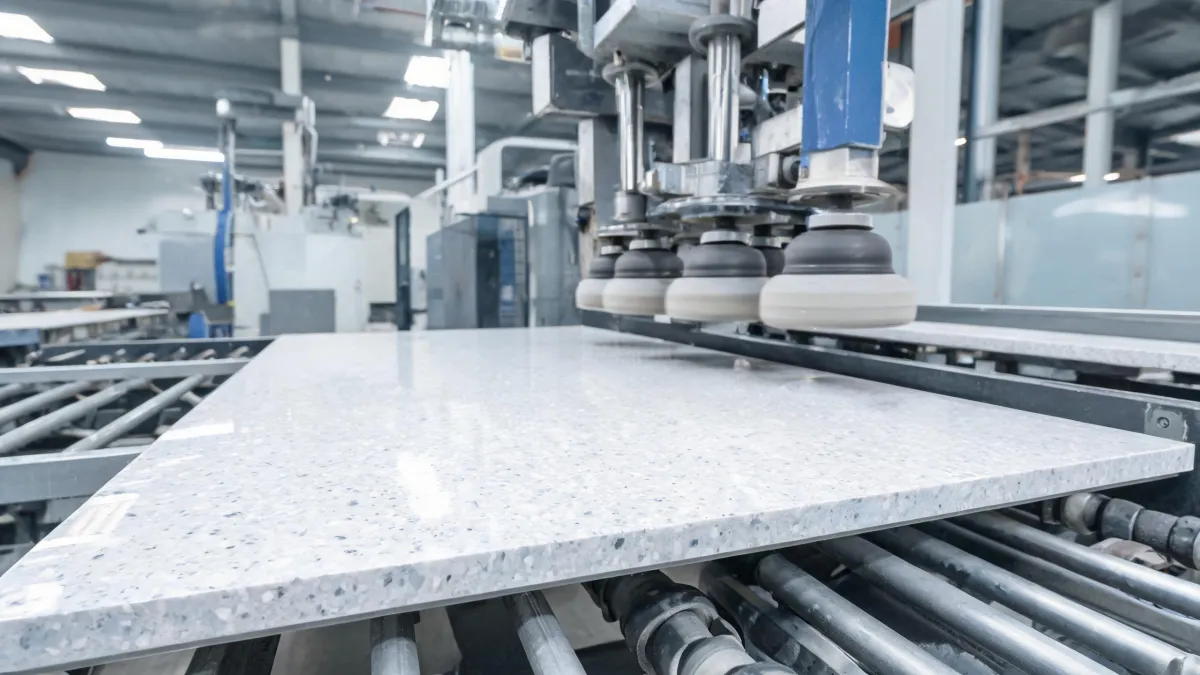
If you're a quartz countertops distributor evaluating a new Breton quartz source, here is the conclusion up front: the Breton process tells you which technology made the slab, not how well the plant operated it. Breton's engineered-stone process is a genuine achievement, and when it is run with discipline it produces remarkably consistent material. But the technology is only an enabler. The supplier's resin specifications, calibration routines, curing times, and inspection practices determine what actually arrives at your warehouse.
I manage purchasing for a 40-person countertop distribution company. Between quartz, granite, solid surface, and edge material, I place roughly 90 buy orders a year—about $1.6M in annual material spend. I report to both operations and finance, and I'm the person who gets the call when a shipment does not look like the sample. So this is not a theoretical point. The most expensive mistake a wholesale buyer can make is treating a brand name as a quality guarantee.
The shipment that changed how I buy
I did not fully understand the gap between process and proof until March 2023. I found a deal that looked too good to pass up—about 11% below our regular supplier—from a factory that said it used Breton technology. The sales rep was responsive, the physical samples looked great, and finance liked the pricing.
The first container arrived with two problems a sample could never reveal: inconsistent thickness across several slabs, enough to make seams difficult to level, and a gray undertone in the white background that did not match the approved standard. The certificate of analysis showed PASS in every field. Turned out it was a template, not a per-lot report. The factory did use Breton equipment. It just did not control the process the way our regular source did. That lesson cost us about $7,400 in freight and restocking charges, plus a very uncomfortable meeting with my VP (ugh).
After that shipment, I rewrote my supplier qualification process. I no longer let brochures do the procurement work.
What the Breton process label does and doesn't tell you
Breton is the Italian machinery company whose technology underpins much of the engineered quartz sold globally. Its vacuum vibro-compression process is a real engineering advantage. When the raw materials are measured correctly and the curing cycle is respected, the result is a dense, consistent slab with fewer surface defects and better dimensional stability than older casting methods.
But a machine does not set its own resin ratio. It doesn't decide to let a batch cure for the full cycle, and it doesn't calibrate its own pigment scales. The operator does that. The operator is where quality lives. Period.
That's why the phrase Breton cap shows up in wholesale conversations. In practical B2B terms, it refers to a plant's realistic production limit—the maximum output a line can sustain before quality or delivery discipline starts slipping. I ask every potential supplier two things: what is the monthly production cap on the line that will make my order, and how much of that capacity is already committed? A supplier who can't answer probably hasn't thought about it. A supplier who claims to accept every order, forever, is telling you more than they intend to.
The operator-level questions matter more than the nameplate:
- Which specific plant produces the color we are ordering, and can we audit it?
- Is the certificate of analysis generated from lot-specific testing, or is it a generic document?
- What is the agreed tolerance for color and thickness, and how is a rejected lot handled?
Most strong suppliers are happy to answer these. The ones who get uncomfortable are usually the ones to avoid.
Granite and engineered stone: what compliance actually looks like
If you search for granite countertops compliance requirements, you will find a lot of conversation about radon and natural radioactivity. That topic comes up more in residential media than it does in wholesale purchasing. In practice, what I need from a granite supplier is more routine: clear country of origin, quarry documentation, and an accredited lab report when a project asks about naturally occurring radioactive material. We keep current copies of those documents for every granite batch we sell.
Engineered stone is a different file. Because quartz countertops contain resin and pigments, I ask for an SDS that can be passed downstream, a certificate of analysis linked to the specific lot, independent low-emission test data where the product claims Greenguard Gold or similar certification, and a commercial invoice that clearly states the country of processing. Depending on the source country, anti-dumping and countervailing duty orders may apply, so customs needs the real manufacturing origin, not just a billing address.
There is also the health side. OSHA's permissible exposure limit for respirable crystalline silica (50 µg/m³ as an 8-hour TWA, under 29 CFR 1910.1053) and California's Proposition 65 requirements mainly affect fabricators who cut the material, not a distributor that stores whole slabs. But labels and safety data sheets need to travel with the order. If our customer's customer has compliance obligations, they cannot meet them unless we pass the paperwork along.
Solid surface private label: three clauses before your name goes on it
Solid surface private label is a different animal. I introduced a house-brand solid surface line in 2024, and the biggest lesson was this: when you put your name on a slab, the market blames you, not the factory. So the contract has to protect you before the product ever ships.
We now require three things. First, assignability of test reports and certifications, because many certifications belong to the manufacturer and do not automatically transfer to your brand. Second, an instrument-measured color tolerance, using a sealed physical master and a Delta E report, rather than a visual looks-fine approval. Third, a lot-specific certificate of analysis with every shipment. If a manufacturer hesitates on any of those, the product may still be fine, but the relationship is not ready for your label.
When this level of checking is overkill
I want to be honest about limits. I do not run the full verification process on every order from an approved supplier who has performed well for two years. The heavy checklist is for new sources, new colors, private-label agreements, or any supplier that suddenly wins a large contract with pricing far below the market. Those are the moments where shortcuts create expensive problems.
This is also not meant to imply that Breton-equipped plants are untrustworthy. Most work hard to produce good material, and a well-run Breton line is a legitimate reason to consider a supplier. But good suppliers are not threatened by good questions. If anything, they expect them.
The machine makes the quartz. The operator makes the quality. Verify both, and you are as close to a sure thing as wholesale buying gets.