I'm the office administrator and procurement lead for a 45-person countertop company. Since 2020, I've managed roughly $1.8M in annual slab and finished-countertop purchases across quartz, granite, engineered stone, and solid surface lines. I don't choose colors for my own kitchen. I choose suppliers for business use. Here's what to look for in a stone countertops supplier based on the mistakes I've made and the vendors I've walked away from.
Is Breton a material or a process?
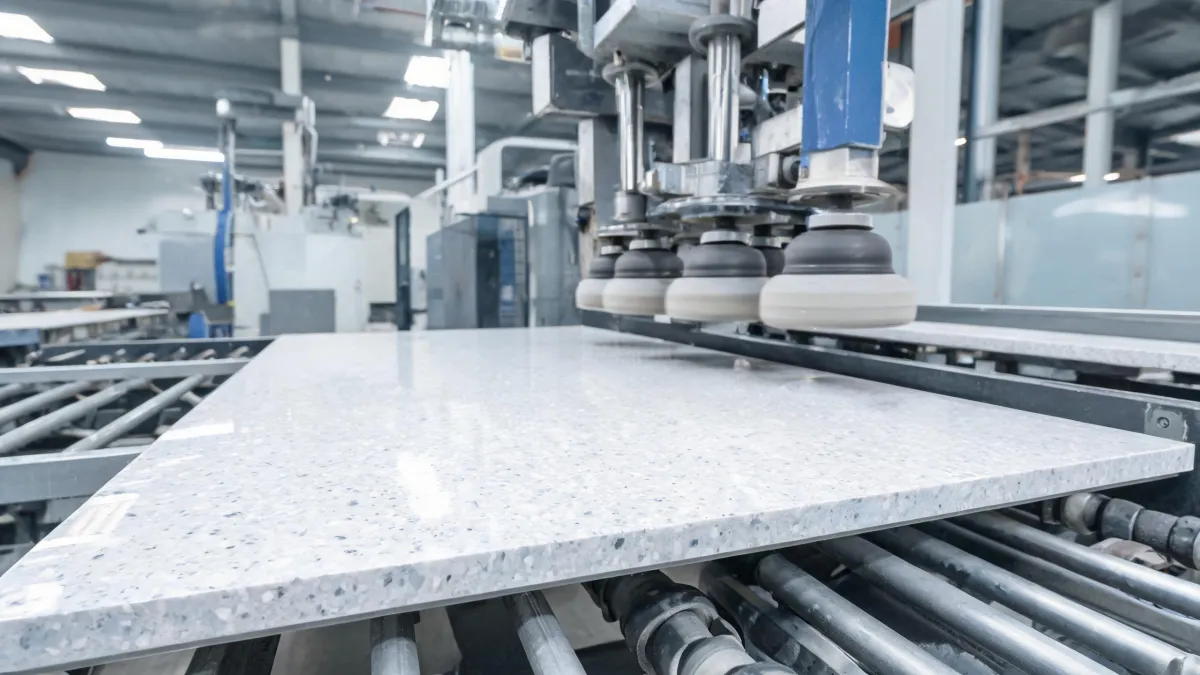
Breton is not a countertop material. It's an Italian engineering company, Breton S.p.A., that builds equipment for making engineered stone slabs. According to Breton's own site, the original Breton process combines vibration, compression, and vacuum to compact a mix of aggregate and binder into slabs. You can call the result engineered stone or quartz, and some suppliers use Breton as shorthand for that production method.
When I see Breton in a supplier's marketing, I treat it as the beginning of a conversation, not an automatic quality stamp. What matters is the production line, raw material formula, pigment controls, batch QC, and what happens after the slab leaves the factory. A factory using Breton equipment can still make bad slabs if they don't manage the process. A smaller non-Breton line can make a very consistent product if their process controls are disciplined.
For B2B buying, the Breton label is useful because it forces the supplier to explain their process. If they can't explain it, I don't care what the machine is called.
What should I look for in a stone countertops supplier?
The obvious answer is price per slab. The less obvious answer is repeatability and paperwork. I didn't understand that in 2020. I chose a supplier with a gorgeous quartz sample and a low quote. The first reorder was okay. The second reorder wasn't. The supplier called it acceptable variation, but the variation showed up on a wall of slabs in the middle of a commercial job.
Now I work from a checklist:
- Delivered cost, not quote cost. Freight, insurance, packaging, unloading, taxes, customs, and delay exposure all live inside total landed cost.
- Batch traceability. When slabs arrive, are they labeled with lot or batch numbers? Can the supplier reproduce the same look later, or is this a one-time run?
- Documentation. Commercial invoices, packing lists, safety data sheets, technical data sheets, country of finish, and the production plant name should arrive before payment. If a vendor cannot issue a clean invoice with matching details, finance will eventually reject the order.
- Claims process. A cracked or flawed slab will happen. The supplier's response tells you more than their showroom. Ask exactly who handles shipping damage and what they need from you.
In 2023, a supplier with a low price gave us a handwritten invoice, no batch references, and no safety data sheet. Finance refused the expense. I ended up covering $2,400 from the department budget while we waited for a corrected order. Since then, paperwork is part of my supplier evaluation, not just a sales conversation.
Does buying from a granite countertops manufacturer mean better prices?
Not automatically. The granite countertops manufacturer label doesn't mean one thing. A quarry company can call itself a manufacturer because it processes blocks into slabs. A slab distributor can call itself a manufacturer because it owns fabrication equipment. A fabricator can call itself a manufacturer because it makes custom countertops. All three have different commercial models and risk profiles.
If you're buying full containers of granite, direct factory relationships can work. If you buy smaller quantities or need local inspection, a distributor with local inventory may give you a better total cost despite a higher quote. I use both models.
What makes a direct granite countertops manufacturer attractive? Better slab selection and access to production records. What makes them risky? Higher minimums, longer lead times, and return policies that don't always help once a container is loaded. The fix is the same: get supplier commitments in writing before you rely on them.
For manufactured stone and quartz, the same question applies. Is the slab manufacturer also applying the private label? Do they own the factory, or are they manufacturing only through finishing? I need a clear chain of production. Even good supply chains can produce a flawed slab. The real difference is how the manufacturer replaces it before my fabrication schedule slips.
What should I check if I need OEM or private-label countertops?
If you're buying for OEM or private-label projects, price is not the priority. Consistency is. A customer sees a full range, not just one sample. Every batch must match the spec they approved.
- Master sample and tolerance. Ask the supplier to sign off on a master sample and state slab-to-slab tolerance in writing.
- Custom color development. What is the minimum order for a new color? How many development iterations are included? Who owns the formulation?
- Rework and reject policy. If one numbered slab is bad, what is the replacement process? Is the defect recorded against the batch? Do they give credit quickly?
- Audit access. A real manufacturing partner will allow third-party audits or provide recent audit reports from recognized certification bodies.
I also prefer a supplier who admits a boundary. If a supplier says this product segment is not their strength and recommends a specialist, that earns trust for everything else. In 2021, one vendor told me they don't do custom solid-surface edge profiles and referred us to a local shop. That supplier is still on our approved list today.
What do Breton cap and Breton House Portree have to do with countertops?
Honestly, not much as standard buying terms. Breton cap could describe a decorative top layer over a neutral base, especially on a slab made with Breton technology. A cap layer can be a legitimate way to control cost, but it affects how the slab looks on edges and miters. If a supplier uses that phrase, ask for a slab cross-section and an edge sample. If the pattern doesn't run all the way through the slab, you need to know before quoting a waterfall or thickened edge.
Breton House Portree appears to be an unrelated search term, likely referring to a property name rather than a stone product. If that phrase brought you here, don't use it as a purchasing signal. What matters is the manufacturing source, slab thickness, batch consistency, color control, and written documentation.
What is a warning sign I don't ignore anymore?
Overpromising. I avoid suppliers who claim they can do everything, that all orders ship in 24 hours, or that defects never happen. Stone is a natural material or a large-format manufactured slab, so production and transport will always involve some variation. A supplier with an honest process for managing that variation is more reliable than one who says problems don't exist.
The second warning sign is a supplier who can't name their boundaries. A good supplier states their limits clearly. In my view, saying this line is not our strength and recommending someone else is a sign of professional confidence. The generalist who promises the universe but can't produce proper documentation when finance asks for it is the one who causes project delays.
I mention this because what to look for in a stone countertops supplier is not a product spec. It's how the supplier behaves before and after the order. If a vendor has the process and the honesty, the slabs usually follow.