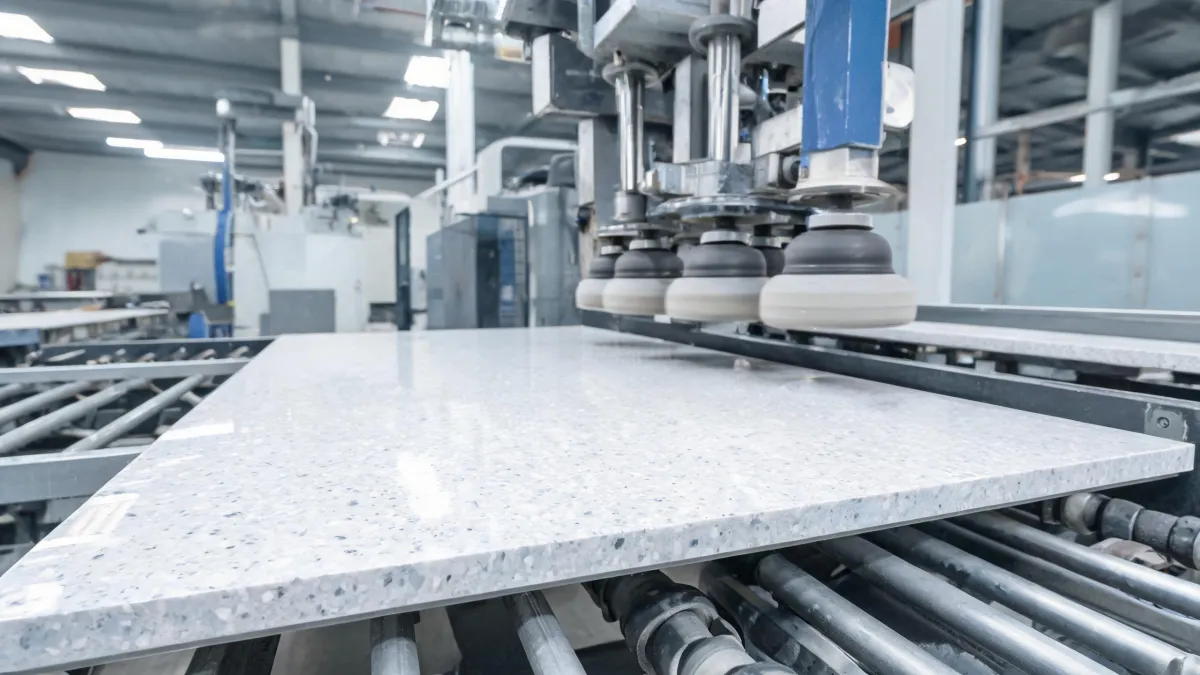
I'm the quality and brand compliance manager at a stone countertop manufacturer. Every year, roughly 320 export batches cross my desk before they ship—quartz, granite, solid surface. None of them leave without my sign-off.
Here's a number that probably says more about sourcing than any "best quartz countertop manufacturer" list: in 2024, about 30% of first deliveries I rejected were pulled back for spec drift or color inconsistency. Not pricing issues. Spec issues.
So when someone asks me which bulk quartz countertop supplier is the best, I usually turn it around: which buying stage are you actually in right now?
Sounds like a dodge. It isn't. Your stage decides what you should be looking at—more than any quote sheet will.
Four scenarios below. Find yours. Then we can talk price.
Four Scenarios in Quartz Countertop Sourcing
Scenario A: First overseas pilot order
Typical profile: one to three orders a year, 20–60 slabs per order, mostly testing whether a new supplier is worth another round.
The mistake I see most often at this stage is obsessing over unit price. I did the same thing the first time I ran overseas QC. Took me two bad batches to figure out that at pilot scale, the biggest cost isn't the unit price—it's rework risk.
What to actually check:
- Ask for physical test data referenced to ASTM C1325 (Standard Specification for Solid Surfacing). A PDF certificate with no test values attached tells you nothing.
- Request their color retention record and Delta E standard. Above Delta E 2, trained eyes start to notice the shift. Above 4, most customers will.
- Confirm the per-color minimum order quantity. That's more negotiable than price and it directly affects how painful your restocks will be.
Rough TCO at pilot stage: unit price × quantity + sampling fees + inspection fees + rework risk. That last line item gets underestimated constantly.
Scenario B: Full-container distribution scale
Typical profile: six or more orders a year, full-container minimums, your customers are fabricators and regional dealers.
By this point, unit price is already squeezed tight. There isn't much left to win there. What moves the needle now is batch consistency.
I watched a distributor switch suppliers to save $4 per square meter. Two out of three containers came in with color drift beyond their Delta E tolerance. Their downstream clients returned about 40% of the order. By the time those slabs came back, got reshipped, and got reinstalled, they'd burned through two years of the savings.
What to negotiate here:
- Batch lock-in: once the PO is confirmed, is the supplier committing to a single production batch instead of pulling from mixed stock?
- Breakage clause: who absorbs shipping damage, and above what percentage does the supplier take responsibility?
- Color compatibility window: if you reorder six months later, what Delta E range can they guarantee against the original batch?
Those three clauses in a contract will do more for your bottom line than squeezing another 2% off unit price.
Scenario C: OEM / private label
Typical profile: you're selling under your own brand. Customers recognize your name, not the factory's.
In Scenario C, brand risk is the heaviest cost line. Not unit price.
In Q1 2023, I ran a brand compliance audit after one of our OEM clients had a shipment pulled in the North American market for a mislabeled material descriptor. Cargo value was around $18,000. Recall, customs, and relabeling costs pushed past $40,000. That audit is why our OEM contract template now includes a double-signature label approval step.
Before you go private label, lock these down:
- Material and process descriptions are dictated by compliance, not by the buyer's marketing team. Whether the stone is a Breton-process engineered quartz or a cast polymer matters for labeling, and it matters differently in different markets.
- Where the warranty sits. Factory-to-buyer warranty and buyer-to-end-customer warranty follow different logic. Don't assume one transfers to the other.
- Whether the raw material supply chain is disclosable. If your clients ever run their own compliance checks, this matters more than you think.
Scenario D: Emergency restock / deadline pressure
This one is counterintuitive. I know some procurement folks will disagree. I'm saying it anyway.
When you're up against a deadline, the cheapest supplier is the most expensive one.
Lead time is a cost line. A fabricator sitting idle for a day loses labor hours and eats penalty clauses worth way more than a 10–15% material premium.
I've seen a distributor wait three weeks on a low-cost factory to save $6 per square meter. Project delivery window blew up. They air-freighted stone at roughly triple landed cost to recover. Not great.
The judgment call at this stage is simple: what premium are you willing to pay to lock in a ship date? If your answer is under 15%, the project probably isn't as urgent as you think. If it's over 30%, stop shopping on price and start shopping on confirmable lead times.
How to tell which scenario you're in
Three questions. Five minutes. Be honest with yourself.
- How many orders a year? Under three → lean A. Three to six → lean B. Six+ → B or C territory. One-off restock → D.
- Do your end customers remember your brand, or just your SKU list? Brand → C. SKU → B.
- If a shipment is a week late, do you lose one order or one long-term client? One order → B math. One relationship → D math.
If those three answers point to different scenarios, go with the one that carries the highest cost weight in your business. Don't overthink the classification. The classification isn't the point—knowing which cost line will hurt most is.
The TCO line, spelled out
Total cost of ownership for countertop stone sourcing, roughly:
Unit price + freight & insurance + breakage cost + rework cost + color-match reorder cost + late-delivery cost + brand-exposure cost.
First two are easy to line up across quotes. The last five are where most price wars quietly lose money.
Bottom line: when you compare quartz countertop manufacturers, you're really comparing who keeps those hidden cost lines lowest. Not who puts the smallest number on the first page. That shift in thinking is a deal-breaker for some procurement habits—and a no-brainer for anyone who's been burned once.
The supplier that looks expensive on paper is sometimes the cheapest one you'll work with. Took me a while to accept that. A lesson learned the hard way, honestly.