Why This Comparison Matters Before You Place Your Next Order
Look, if you're comparing quartz countertops wholesale quotes against granite quotes, the number on that PDF is maybe 60% of what you'll actually pay.
I've been sourcing stone for wholesale distribution for about 11 years. Roughly 200+ urgent orders handled—some with 24-hour turnarounds, most with 2-3 week windows. And I can tell you: the distributors who get burned are almost always the ones comparing sticker prices instead of landed costs.
I'm going to break down four comparison dimensions: landed cost, private-label flexibility, supply reliability, and hidden costs. For each one, I'll put engineered quartz and natural granite side by side. Then I'll tell you when to pick which. Fair warning—at least one of these conclusions genuinely surprised me when I ran the numbers.
Dimension 1: Landed Cost—What You Pay Once It Hits Your Warehouse
Granite is almost always cheaper per square foot at the supplier level. That's not controversial. Based on wholesale price sheets I've reviewed from Q3-Q4 2025 across US distributors, granite runs roughly $12-40 per square foot in bulk pallet quantities, versus $20-50 for engineered quartz. The gap can be 30-40%.
But here's where it gets interesting—and where most comparisons fall apart.
Granite has a higher damage rate in transit. I don't have hard data on industry-wide breakage rates, but based on our own receiving logs over the past five years, we see about 3-5% breakage on granite shipments versus 1-2% on quartz. Quartz slabs are more uniform, stack tighter, and survive LTL freight better. That 3-5% eats into the price advantage. If you're paying $18/sq ft for granite and losing 4% to breakage, your real cost is closer to $18.75. The quartz at $24 just got relatively cheaper.
Then there's the finishing side. Granite often needs more edge work, more sealing, and occasional slab-specific fabrication adjustments because no two slabs are the same. Quartz is more predictable—you can quote a kitchen from a sample and the slab will match. With granite, the fabricator needs to see the actual slab. That adds coordination time, which adds labor hours, which adds money.
Dimension 1 verdict: Granite wins on raw sticker price. Quartz wins on landed cost per installed square foot. The gap depends on your volume and how much rework you're absorbing.
Dimension 2: Private-Label and OEM Flexibility
This is where engineered stone pulls ahead, and honestly, it's not close.
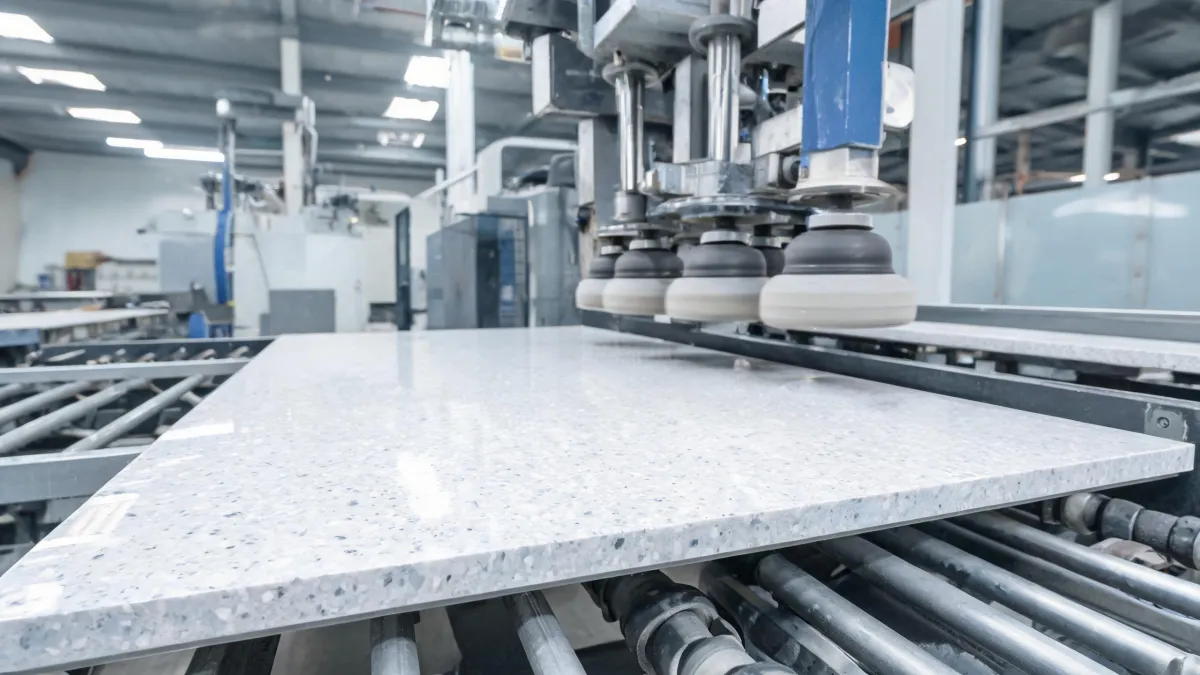
If you're an engineered stone OEM buyer, the production process is standardized. Breton technology—the original engineered stone manufacturing system—produces slabs with consistent color, veining, and thickness from batch to batch. That consistency is what makes private-label viable. You can put your brand on a slab and trust that the next container will match.
Granite is the opposite. Every block is unique. You can't promise a customer "this granite, exactly this pattern, in six months" because the quarry might be tapped out or the next block might look different. That creates real problems for distributors who want to build brand identity around specific materials.
I wish I had tracked this more carefully from the start: how many granite SKUs we had to discontinue over the years because the quarry ran out or the color shifted. What I can say anecdotally is that it was a lot. Probably 15-20% of our granite catalog turned over annually. Engineered stone? Maybe 5%.
Dimension 2 verdict: If private-label or OEM is part of your model, engineered quartz is the clear choice. Granite works for one-off projects and premium natural-stone positioning, but it's a headache for brand consistency.
Dimension 3: Supply Reliability and Reorder Speed
I'll tell you a story. In March 2024, 36 hours before a distributor's install deadline, we got a call. They needed 14 slabs of a specific gray quartz—same batch, same lot number. We had it. If they'd ordered granite in the same situation, we'd have been on the phone to six quarries trying to match a pattern.
Engineered stone is manufactured. That means inventory is predictable, reorders are consistent, and you can plan around lead times. Granite is quarried. That means availability depends on mining conditions, import logistics, and whether the specific block you need is even out of the ground yet.
Emergency sourcing for quartz: we can often pull from stock within 48 hours. For granite, in an emergency, we're at the mercy of whatever's on the water or sitting in someone else's yard. Sometimes that works. Sometimes it doesn't.
Here's what I've learned after enough rush orders: the cost of a missed deadline almost always exceeds the savings from choosing the cheaper material. One distributor we worked with lost a $40,000 contract because a granite shipment arrived two weeks late. The savings on that granite order? Maybe $2,000. They've been a quartz-first distributor ever since.
Dimension 3 verdict: Quartz wins on supply reliability. Granite requires buffer stock and flexible timelines. If your clients have hard deadlines—and they do—factor that in.
Dimension 4: The Hidden Costs Nobody Quotes You
This is where total cost of ownership really matters. Let me run through the items that rarely show up in a wholesale comparison:
- Compliance testing. Engineered stone requires silica dust compliance documentation in many markets. Some suppliers include it; some charge for it. Granite's natural composition sometimes sidesteps certain requirements, but radon testing and import documentation still apply. Both have costs—they're just different costs.
- Return and rework rates. Quartz defects tend to get caught at the factory. Granite defects show up when you cut into the slab. One is cheaper to fix than the other.
- Dead stock. Granite's variability means if a color goes out of style, you're stuck. Quartz colors can be re-run as long as the line is active.
- Customer claims. If a homeowner or builder claims the granite doesn't match the sample, you're on the hook. Quartz doesn't have that problem.
I'd estimate hidden costs add 10-18% to granite's effective cost, depending on volume and market. Apply that to a $20/sq ft granite quote and you're looking at $22-24/sq ft actual. Suddenly the quartz at $24 doesn't look so expensive.
Dimension 4 verdict: Quartz has more predictable hidden costs. Granite's hidden costs are variable and harder to forecast—which makes budgeting harder.
So Which One Should You Actually Choose?
It depends on what you're optimizing for. Here's my honest breakdown:
Choose engineered quartz wholesale if:
- You're building a private-label or OEM brand
- Your clients have hard install deadlines
- You need consistent supply and predictable reorders
- You want to quote clients directly from samples
- You're willing to pay a slight premium on sticker price for lower total cost
Choose granite wholesale if:
- Your market values natural-stone uniqueness over consistency
- You have buffer inventory space and flexible timelines
- You're positioning at the premium custom end, not volume distribution
- You have established quarry relationships that give you first pick
- Your clients understand that "natural variation" is part of the product
There's also a hybrid play: use quartz as your core volume line and granite as your premium specialty offering. That's what most of the successful distributors I've worked with end up doing. But they always lead with quartz for the bread-and-butter orders.
One Last Thing Before You Request That Quote
If you're asking for a quartz countertops wholesale cost guide, you're probably already comparing vendors. Here's what I'd tell you: ask about landed cost, not unit price. Ask about reorder consistency, not just current availability. Ask whether their production line uses Breton technology—it's not the only engineered stone process, but it's the benchmark for slab consistency.
And if the numbers say go with granite but your gut says quartz—listen to your gut. I've seen that play out wrong enough times to trust it.
Prices and timelines in this article reflect our own order data and market observations through early 2026. Verify current pricing and availability directly with suppliers before committing to volume orders.