Who This Checklist Is For
I'm the purchasing coordinator for a mid-size countertop distributor in the Southeast. We stock about 30 SKUs of quartz and granite slabs, plus solid-surface sheets for a group of independent fabricators. I manage roughly $2.5M in annual material purchases across eight suppliers. I report to both operations and finance, so my success is measured by price, workflow, and whether the next delivery is problem-free.
If you're ordering countertops for a single kitchen, most of this is overkill (enjoy that). If you're a wholesale buyer, distributor, or fabricator thinking about a new granite line, a quartz program, or your own solid-surface brand, this is the checklist I run through before I commit.
1. Start With the Installation Conditions, Not the Color
The first question is not which material looks best. It's what the countertop has to survive. An office breakroom gets coffee spills and harsh cleaners. A medical reception desk gets disinfectants. A restaurant host stand gets constant contact, food acid, and the occasional sanitizing wipe left sitting on the surface.
Most requests land in my inbox with a render attached and no installation conditions. Before comparing quartz and granite, I ask the project team to confirm the cleaners, the daily use, and whether a long run of countertop can have seams. That changes every material conversation after it.
2. Read Quartz Countertops Specifications Like a Buyer, Not a Marketer
When a supplier sends what they call “quartz countertops specifications” and the PDF is mostly lifestyle photography, that tells me something. A serious supplier sends technical data plus the standard test method used to get each number. For engineered quartz, I generally check water absorption as measured by ASTM C97, flexural strength by ASTM C880, slip resistance if the area gets wet, and thickness tolerance. The material may be durable, but “durable” is not a specification.
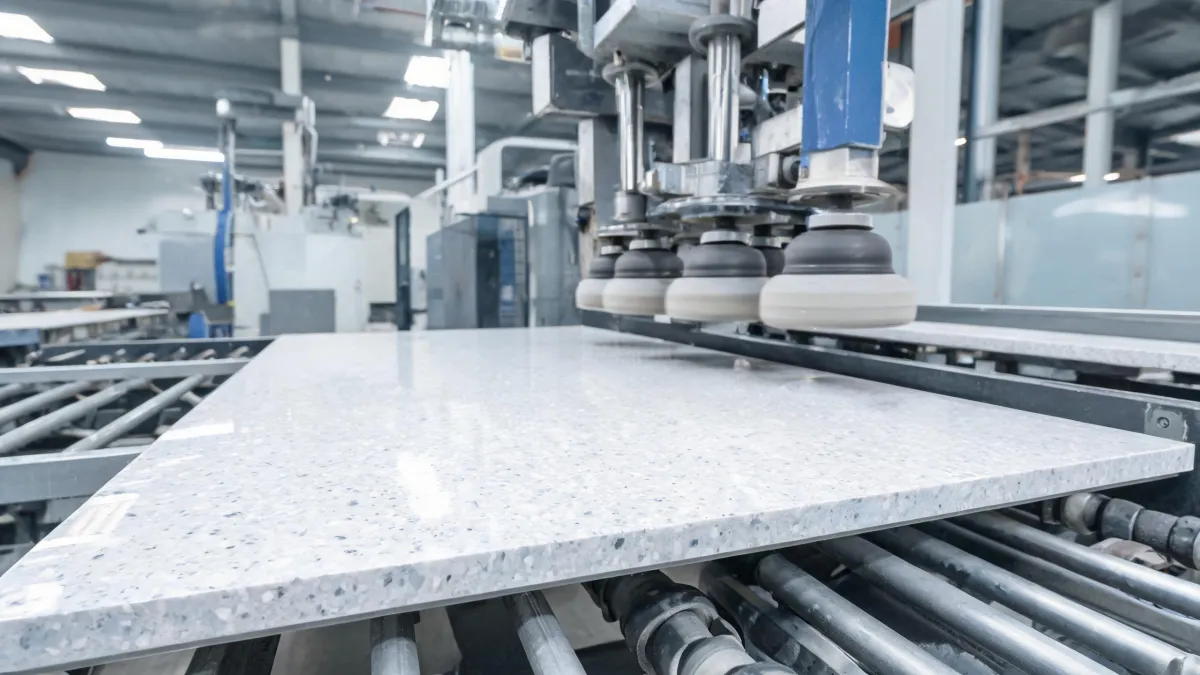
It also helps to know how the slab was made. Much of the engineered quartz sold under familiar names—and a lot of private-label quartz, too—is produced on Bretonstone lines developed by Breton S.p.A. in Italy. That process uses vacuum vibrocompression to make dense, consistent slabs. But the equipment is only part of the story. A factory using the same process can still cut corners on resin content, curing, or color control.
So ask the producer to explain their process. If a salesperson cannot tell you whether their plant runs a Breton-based line or an alternative compaction method, they probably are not checking the details either. If they can explain it, ask what their batch rejection rate looks like. Good mills track it; average mills guess.
3. Remember That Granite Is Natural
Granite countertops do not have the same batch regularity as engineered quartz, and they should not pretend to. Each quarry block and each slab has its own variation. The 2x2 sample on your desk may be lovely; the 40 slabs in the container will not all look exactly like it.
I still kick myself for a 2023 granite order. A new exporter quoted 27% below our established supplier. The sample was great. The paperwork looked fine. We placed a trial order for 40 slabs without viewing the actual lot. Eleven slabs arrived with an obvious color cast or fissures that the sample did not show. After third-party inspection, restocking fees, and expedited replacement freight, that “cheap” experiment cost us about $18,000 and one very annoyed general contractor. Now I evaluate natural stone slabs from the actual lot, or I hire someone to do it for me. A photo of the real slab is worth more than a polished sample.
4. Test the Supplier Before the Big Order
Before I accept a new vendor, I place a small pilot order. Not a truckload, not a container—just enough slabs or sheets to see how they actually operate. A pilot of 12 to 15 pieces tells me more than a two-hour sales call.
During a pilot, I compare the shipment to the approved sample under natural light, check thickness at a few points, and inspect the edges. I also confirm that each slab or sheet has a lot number. If those basics are wrong at pilot stage, they will not improve at scale. That has been my experience, anyway.
(Should mention: our standard terms now include a 10% payment holdback until final inspection. If a supplier refuses that, I treat it as a signal.)
5. Solid Surface OEM vs Private Label: Choose the Business Model First
Solid surface is different from stone because you are not just buying slabs; you are buying into a manufacturer's program. And in this industry, the phrase “OEM vs private label” gets used loosely. Some suppliers use the two terms as if they are identical. They are not.
In my buying context, OEM usually means the factory makes the product to your specification—your color, thickness, finish, and quality requirements—and you go to market under your own brand. Private label usually means the factory makes one of their standard products and puts your label on it. Both models work, but they carry different risk and different price structures.
Before signing anything, get these four things answered in writing:
- Who owns the formula? If the factory changes a pigment or resin supplier, do they have to tell you? At what point does the product stop being “yours”?
- What is the minimum order and color-change fee? Private label looks cheap at container volume, but slow-moving colors can turn into expensive inventory.
- How are reorders handled? If you need the same color six months later, can the factory reproduce it within a reasonable color tolerance? Ask how they measure and document color consistency.
- Who owns the warranty problem? If a sheet fails in a finished restaurant, the owner will not call the factory. They will call the name on the sample—which is your name.
Private label is not printing a logo. It is standing behind someone else's chemistry. Whenever the quality perception of your brand matters, the supplier's process becomes part of your process.
6. Demand Clean Documentation
A low price is not a price until the shipment clears your receiving dock and your accounting team can actually file it. I have seen excellent material lose money because the supplier's commercial invoice did not match the packing list, or because the certificate they sent was for a different factory altogether.
Ask for certificate numbers, not just scans. Verify that the certificate belongs to the actual production plant. If a supplier says they meet ISO 9001 or some other standard, ask for the issuing body and certificate number. If they hesitate, that is an answer.
Honestly, I have never fully understood why some factories ship a clean first order and then go sideways on the second one. My best guess is they change raw material suppliers or switch production lines without telling anyone. That is exactly why lot numbers and documentation matter. Oh, and do not let “certificate of compliance” replace actual batch test results. One is paperwork; the other is proof.
Mistakes That Still Cost Me Money
If I had to shrink this entire article into a list, these are the five mistakes I see most often—and the ones I still have to watch myself on:
- Treating granite like quartz. Natural stone varies. Buy it like a natural product, not like a factory-made one.
- Approving the factory’s “representative sample.” Ask for samples from the actual production lot that will be shipped, not from the sample bin.
- Comparing only the per-square-foot price. Freight, customs, inspection, waste, and fabrication issues can add 30% to a “cheap” slab.
- Taking on a private label before you can support it. Your company will own the complaints, the returns, and the reputation damage.
- Believing a generic compliance statement. If there is no standard test method and no certificate number, it is marketing language.
Every mistake above traces back to one skipped check: I trusted the sample more than the process, or I trusted the brand more than the documentation. That is why this checklist exists. Print it, use it before your next PO, and keep the approved sample somewhere safe. The supplier may forget what they shipped you; your own records should not.