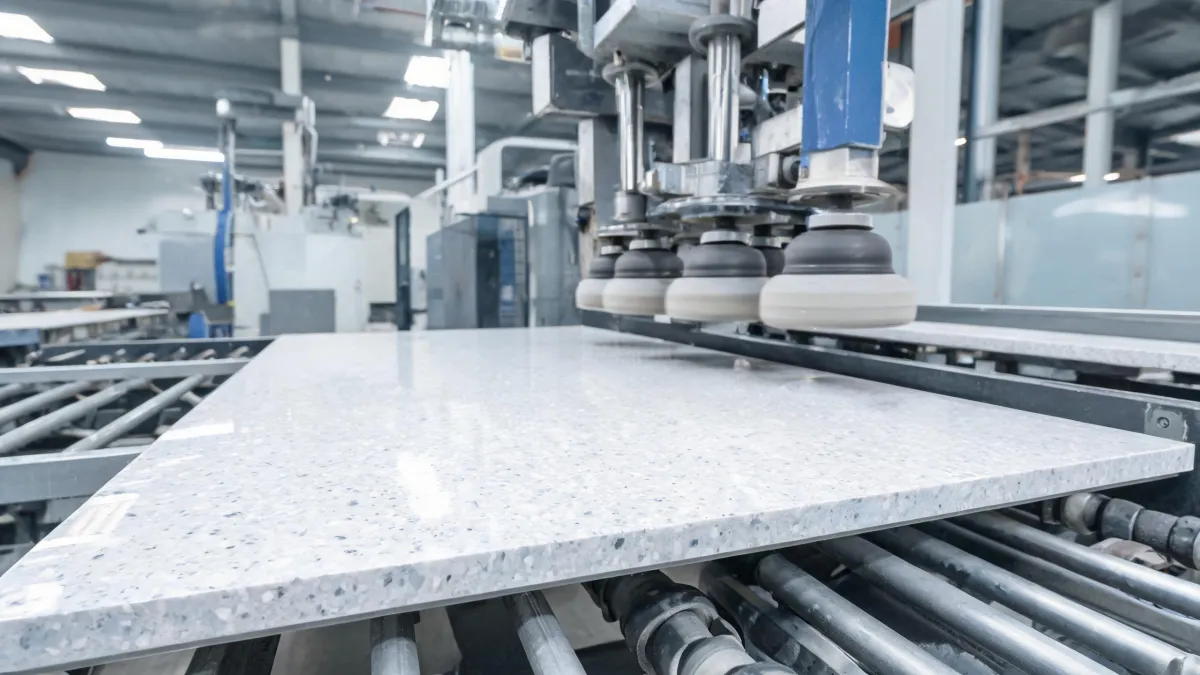
In May 2024, twenty-two kitchen countertop panels came off a truck and failed visual inspection the same afternoon. Same supplier we'd used twice before. Same spec sheet. Different lot, different batch codes, and twenty-two slabs that read one color under daylight and a noticeably different one under showroom lighting.
The general contractor gave us ten calendar days to solve it. It took eighteen.
I'm the procurement manager at a 45-person stone distribution company. I've managed our materials budget (around $1.4M annually across quartz, granite, and solid surface) for six years, negotiated with more than 30 vendors, and logged every order into our internal cost-tracking system. When I say most countertop sourcing evaluations are testing the wrong variable, I have the spreadsheet to back it up.
The Problem You Think You Have
When a buyer starts sourcing engineered stone, the problem usually shows up looking like arithmetic. One vendor quotes $34 per square foot. Another quotes $29. Both list the same quartz content, same thickness, same finish. Pick the cheaper one, save 15%, move on to the next line item.
I ran that exact comparison in 2022 on a $46,000 order — two vendors, nearly matching spec sheets, a 12% gap. I went with the lower quote and told myself I'd validated the variables that mattered.
What I'd actually validated was that the paperwork matched. Not the product.
The Problem Underneath the Problem
The reason price-first comparisons keep producing bad outcomes in quartz countertop sourcing isn't that vendors misrepresent. It's that "same specification" is doing far more work in the buyer's head than it can honestly carry.
"Same Spec" Is a Fiction at the Slab Level
Two boards can both say quartz surface, 93% quartz and still differ in ways a spec sheet has no field for: pigment batch and dispersion, resin system (polyester versus acrylic blends — this one affects UV stability), pressing density and porosity, and backer mesh type with its bonding adhesive.
I assumed those variables averaged out across a large order. They don't. They compound.
If you want a number to anchor on: Delta E below 2 is the industry-standard tolerance for brand-critical colors. Trained observers notice a Delta E of 2 to 4; above 4, most people can see the shift without a reference. A single slab from a good factory usually clears that bar. Six months of slabs, drawn from different lots and stood next to each other in the same kitchen, is where it gets ugly. Reference: Pantone Color Matching System guidelines.
The Breton Label Is a Floor, Not a Ceiling
Almost every engineered stone buyer eventually hears about the Breton process. The Italian Bretonstone vacuum vibro-compression method — roughly 93% quartz bound with 7% resin — produces denser, more consistent slabs than the older cast-polymer approach, and factories running it correctly tend to show lower rework rates.
But "we run the Breton process" and "we run the Breton process and validate every batch against it" are different sentences. Same machine, different shift, different operator, different maintenance calendar — different slab. Think of two identical commercial ovens. Same equipment, different baker, different bread.
Files Don't Ship, Slabs Do
Another habit worth breaking: treating the documents a vendor sends as proof of the product. Test reports, ISO certificates, VOC documentation — these matter, and on residential work you'll need them for compliance. But a test report dated August 2024 tells you nothing about what comes off the line in March 2026.
I assumed an ISO certification meant every batch produced consistent, verified results. Didn't read the scope statement carefully enough. Turned out the certification covered the quality management system, not the specific product line we were buying. System proof and product proof are two different things (note to self: always ask for the certificate scope, not just the certificate).
What the Wrong Evaluation Framework Actually Costs
Let me put the 2024 incident in numbers.
Direct cost to resolve twenty-two failed panels — removed material, re-fabrication, and expedited freight for the replacement lot — came to $38,000. That's about 22% of the order value, on top of an order we'd already paid for once.
The indirect costs were worse and mostly invisible on a variance report:
- 1.4 extra labor hours per panel to tear out the failed tops and reset new ones
- Eight lost days on the project schedule
- Two projects the GC quietly routed elsewhere over the following quarter
That third item never appears in a budget variance line. It's still the most expensive part of the story.
And then there's the trial-order problem. A lot of factories set minimum order quantities that make small-batch validation feel like a nuisance — a five-slab trial order reads as wasted line time. From the buyer's side, that five-slab trial is exactly the artifact that would have caught the batch inconsistency before we committed to the full run.
Small doesn't mean unimportant — it means a five-slab test order that shows you lot-to-lot color drift and lets you walk away for $600 instead of $46,000. I've stopped treating high MOQs as a neutral fact of the industry. They're a signal about how the supplier thinks about risk, and they're usually the first clue about which vendors will still be standing after a warranty claim. The vendors who treated my small orders seriously when we were testing them are the ones we still call for six-figure runs. At least, that's been my experience with fabricators and distributors at our scale — a national builder running 400 kitchens a month would reasonably feel differently.
What I Do Now (Short Version)
None of this is complicated, which is part of why it took me three bad orders to build it:
- Compare slab to slab, not paper to paper. Physical samples, from the actual lot, in the actual lighting the project will live in.
- State a color tolerance in every RFQ. Delta E target and reference light source, in writing, before pricing.
- Run a trial order before committing volume. Even if it means splitting the first order across two suppliers. The extra freight is cheap insurance.
- Read the scope on every certificate. The document tells you what's covered. The slab tells you what shipped.
- Cost the full landing price, not the FOB price. Rush charges, rework exposure, and schedule risk belong in the comparison from the first quote, not after the first failure.
One limit on everything above: I'm not a materials scientist, so I can't speak to resin chemistry or pigment formulation at the molecular level. What I can speak to, from a procurement chair, is the evaluation sequence — what to verify, in what order, before money leaves the building.
That sequence isn't difficult. Most buyers just don't adopt it until after a batch of tops has already come off a wall.