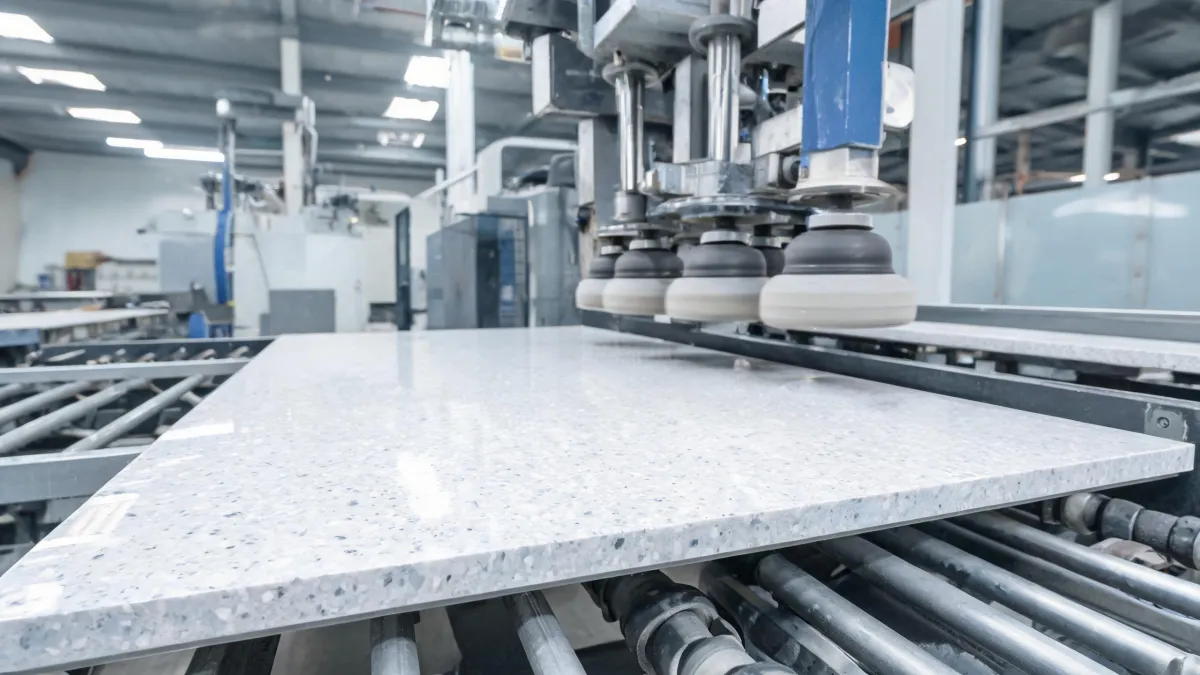
Let me start with a confession. When I first started coordinating wholesale stone countertop orders, I thought buying direct from the factory was always the smarter play. Three years and 200+ rush orders later, I know I was wrong. Direct from a quartz countertops OEM and buying through a stone countertops distributor are two different tools, not two versions of the same tool.
Consider this a stone countertops distributor buying guide from the OEM side—but not the one that tells you direct is always better.
Here's the framework I use when a buyer asks me where to source. Four things matter:
- Minimum order size
- Lead time when things go wrong
- Quality control and after-sale support
- Total landed cost
Minimum Order Size: The First Filter
Quartz countertops OEM contracts are built on repetition. You book production, the factory makes slabs using a consistent recipe, and over time the per-slab cost drops. That works well if you're buying by the container and planning 12 months ahead. It works less well if you need enough stone for one kitchen.
On the distributor side, the granite countertops catalog is basically a warehouse. You can buy 10 slabs or, in many cases, a single slab. You get a color that's already in production, so there's no waiting for a custom batch. The trade-off is that you don't get your own label or your own color formula.
So what's the verdict for this dimension? It depends. If you're testing a new market, a distributor is usually the safer start. If you're building a private-label quartz line, OEM direct gives you control that no distributor can match.
And before I forget the phrase you're looking for: the Breton cap on small-batch quartz isn't a mysterious brand policy. It's batch economics. A press run has a minimum volume. Ask any supplier what their minimum batch size is, then compare that to your forecast.
Lead Time: The Part I Care Most About
Because I've spent years coordinating emergency deliveries, lead time matters to me more than any other metric. The intuitive answer is that direct OEM means fewer middlemen and therefore faster delivery. In practice, that's wrong for one-off orders.
A factory can only push production so fast. Quartz has to be pressed, cured, calibrated, and polished. Curing alone can't be shortened safely. But a distributor with inventory can load a slab on a truck today.
In March 2024, a contractor called at 3 p.m. with a 36-hour deadline. They needed a quartz countertop for a model home, and the original supplier had failed. Normal custom production was ten business days. We called a distributor who stocked the same color, paid $700 extra for emergency freight, and the slab arrived the next morning. The contractor kept their $12,000 job. The $700 was annoying; the lost contract would have been worse.
That experience changed how we handle rush orders. We now keep warehouse buffers near large job sites and treat distributors as part of our emergency system, not as competition.
Roughly speaking, our last quarter included 47 rush orders and 95% on-time delivery. That didn't happen because direct channels are magically fast. It happened because we had the right stock in the right place.
Quality Control: Who Owns the Problem?
Direct OEM gives you a clearer line to the people who made the product. If a color is off, you can ask for the batch report. With a distributor, there's one more link in the chain, but a good distributor can replace a slab locally without you spending months chasing overseas claims.
The surprise wasn't that low-priced stone had imperfections. It was how much documentation mattered when something went wrong. In one case, a contractor blamed a cracked slab. Our test report showed the crack happened because the slab was installed without expansion allowance. That document saved us a chargeback and made the contractor look better to their client.
For color consistency, engineered stone should be checked like print, not like art. In color QC, Delta E is the common reference: below 2 is a tight match, 2–4 is noticeable to trained observers, above 4 is visible to most people. Reference: Pantone Color Matching System guidelines.
I still kick myself for accepting a supplier's verbal quality promise back in 2023. We skipped the batch report, paid freight on 14 slabs, and then replaced four because the veining didn't match the sample. That's the kind of mistake that follows you. It took one hour to ask for the data. It took three weeks to fix the mess.
Total Cost: The Argument for Value Over Price
If you're comparing stone suppliers, please stop looking at unit price alone. The lowest quote has cost us more in about 60% of the cases I've managed. Sometimes it was a grading dispute. Sometimes a slab arrived with cracks hidden by tape. Sometimes the shipment was delayed, and we paid overtime for a crew that had nothing to do.
That $200 saving is not worth a $1,500 callback. And I'm not talking about hypothetical numbers. When a slab fails after fabrication, you absorb the replacement material, reinstallation labor, freight, and your client's lost trust.
Think in total cost:
- Unit price
- Freight and handling
- Minimum order storage cost
- Grading risk
- Rework and warranty exposure
This is why I push back on the idea that cheaper is smarter. A good quartz countertops OEM may not give you the lowest quote, but it can give you consistent slabs and documented QC. The Breton engineered stone process is built around consistency, and consistency is what reduces hidden costs. That's not marketing; that's how we avoid expensive surprises.
Does Breton Cap Women's-Specific Runs?
The short answer is no. I get variations of this question, and most of the time the real concern is whether a small-order buyer can access Breton material without committing to container volume. We don't have a separate cap for women-owned fabrication shops or women's-specific product lines. Same batch minimums, same pricing, same access to the granite countertops catalog.
The more practical question is what fits your order. If you need a few slabs to test color demand, use a distributor. If you're launching a private-label brand and need stable production, OEM direct is the right route. The cap is always the same: batch size and forecast reliability.
So Which One Should You Choose?
There is no permanent answer. I know that's unsatisfying, but it's true. Here are the scenarios I see most often:
- You need 2–10 slabs this week: call a distributor. Even the best factory can't beat warehouse stock for speed.
- You're building a brand: OEM direct. Private labeling, custom colors, and repeatable quality matter more than one-off convenience.
- You're testing a new granite color: start with the distributor's granite countertops catalog. Test demand before committing to a container.
- You need consistent color for a multi-phase project: OEM direct with written QC data for every batch.
At the end of the day, the best stone countertops distributor buying guide won't tell you to marry one sourcing route. It'll tell you to match the route to the order. Direct OEM and distributors both exist because they solve different problems. The winning move is to know which one solves yours.
Between you and me, that's the real skill. The factories, the catalogs, and the freight lanes are all just tools. You decide which tool gets the job done.