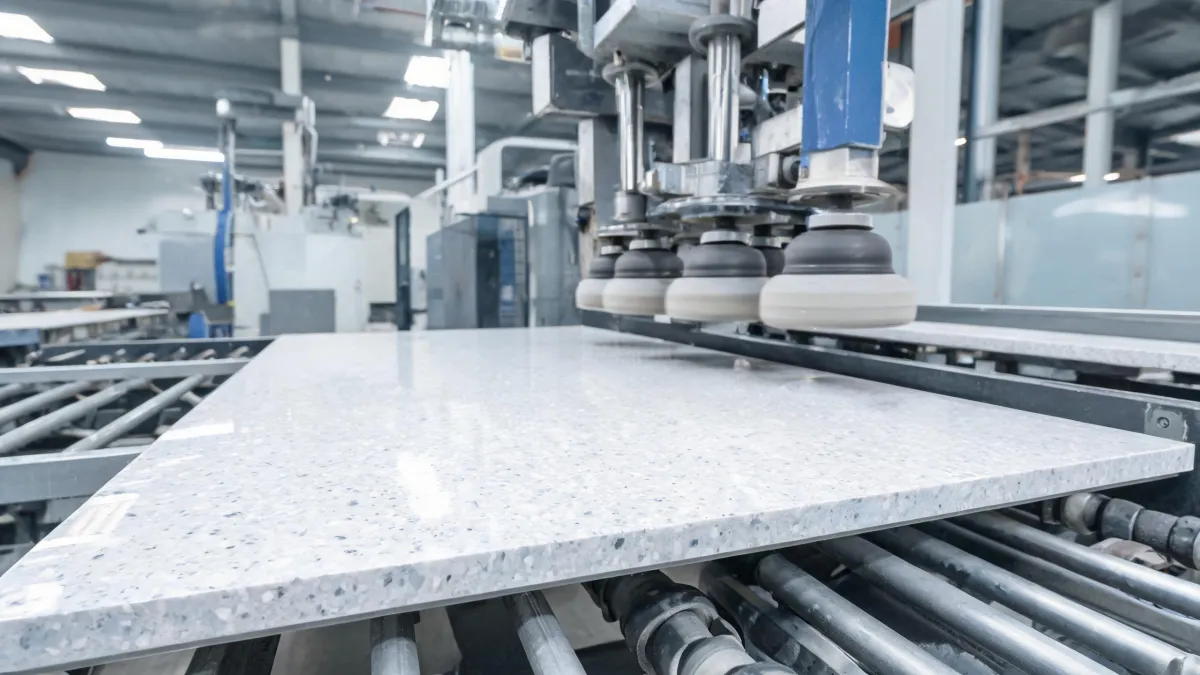
Let's clear one thing up before the sales pitch starts: “Breton” is a process, not a paint color. When you search for quartz countertops wholesale, you keep seeing the name because Breton-based technology makes a large share of engineered stone slabs. The other “Breton” you might have been looking for — Breton blue paint — is a color chip. I'll get to why that matters in a minute.
I've spent 12 years coordinating wholesale supply for stone fabricators. Last quarter alone, we processed 47 rush orders with 95% on-time delivery. That 5% miss is where all the lessons are.
If you're a distributor trying to choose between engineered stone OEM vs private label, this article is your comparison. I'll use a framework I call the Breton CAP — Cost, Availability, Performance. (It's my own shorthand, not an official Breton term. But it works when you're in a hurry.)
What You're Actually Comparing: OEM vs. Private Label
OEM means a factory makes slabs to its own specs, and you buy them under a generic or supplier brand. Private label means the factory makes slabs specifically for your brand — your color formulas, your packaging, your warranty support.
Both can run on Breton technology. Both can be a good or bad fit depending on your volume. The mistake I see is buyers choosing based on price per slab without thinking about how the slabs will fill a rush order, how the color will match across batches, or what happens when something goes wrong. That's why the Breton CAP exists.
Before we dive in, one category note: solid surface is not the same as quartz. It's a non-porous acrylic/polyester material, usually sold under brand names, and it behaves differently in fabrication. Keep solid surface in your back pocket. This guide focuses on quartz because that's where OEM vs private label decisions get complicated.
Dimension 1: Color Control — Why Breton Blue Paint Is a Good Test
Here's where Breton blue paint comes in. A customer hands you a paint chip and asks for countertops to match. If you're buying OEM quartz, you pick from the factory's standard color line. If the factory has a color close to that blue, great. If not, you have two choices: propose a different color or go private label.
Private label gives you custom color development. In March 2024, a client needed an exact dark blue for a commercial project. We had 48 hours to lock the material schedule. The OEM line was close, but not close enough. We paid a private-label setup fee and rushed the first slabs. It cost $2,300 more and added nine days — but the alternative was missing the design spec and potentially losing a contract.
Was the extra cost worth it? For that project, yes. For a standard white kitchen, probably not. In my experience, custom color is the single biggest reason to consider private label over OEM. If that's your market, color matching capability should be at the top of your checklist.
Dimension 2: Manufacturing Technology — What the Breton Process Actually Does
According to Breton S.p.A. (breton.it), the company developed vacuum vibrocompression for engineered stone back in the 1960s. That process combines quartz aggregate, resin, and pigment under high pressure and vacuum to create a dense, consistent slab. In plain English: it's reproducible.
For quartz countertops wholesale, reproducibility matters. It means the slab you get in a reorder should look like the slab you approved. Non-Breton lines can produce good material too, but the batch variance I've seen on some lines is noticeable. In February 2025, we rejected three slabs from a non-Breton supplier because the veining was way more pronounced than the approved sample. We switched to a Breton-based line and the replacement was nearly identical. Seriously, the difference was obvious.
I'm not saying every Breton-based slab is automatically perfect. You still need a color approval process and a good QC team. But the technology baseline is the reason many wholesale programs standardize on it.
Dimension 3: Cost — The “C” in Breton CAP
Let's talk money. OEM usually has a lower base price. The factory runs standard colors in high volume, so economies of scale work in your favor. Private label adds setup costs, color matching, and minimum-order quantities. On paper, OEM wins.
But the real cost is not always on the invoice. In 2023, I quoted a job using an OEM slab that looked 12% cheaper. Or rather, it looked 12% cheaper until I added freight, storage, and the extra 72 hours of coordination. The final cost was 9% higher than our usual private-label partner. I still kick myself for not running the full math before promising a client a “deal.”
That's the lesson. When you compare costs, calculate the total installed cost with rush scenarios included. A slab that saves $200 at the dock but delays your delivery by three days is not a bargain.
Solid surface sits somewhere else. It tends to have simpler fabrication and easier repairs, which can lower your labor risk. But for a wholesale quartz program, private label's custom color and premium margin often outweigh the upfront savings.
Dimension 4: Availability — The “A” in Breton CAP
Availability is the most underrated part of the Breton CAP. In a normal week, almost any supplier can hit a lead time. In a crisis, the difference between a supplier who has your color formula and one who doesn't is enormous.
With OEM, you're tied to the manufacturer's production calendar. If they're booked, you're waiting. With private label, you're a named customer. The factory has an incentive to hold inventory for your brand, and you can often order a short run with priority.
I remember an April 2024 job: 36 hours before the deadline, a slab cracked during fabrication. Our client was looking at a $50,000 penalty clause if we didn't deliver. Because the color was registered with our private-label producer, they had an extra slab in the warehouse. It arrived the next morning. If we'd been buying generic OEM, we would have needed a miracle.
After three failed rush orders with discount vendors, our policy changed. We now require a 48-hour buffer on any custom-color project. That buffer costs money, but it saved that April job.
Dimension 5: Performance — The “P” in Breton CAP
Performance means both physical material specs and how the material behaves in the field. Breton-based engineered stone generally has low water absorption and good impact strength, but I'd be careful with general statements. Verify the actual technical data sheet — and verify it for the exact mill producing your slabs.
Private label also carries brand liability. When the warranty has your name on it, you own the results. That's a strong reason to do your own QC. Conversely, if you're selling high-volume standard colors at low margins, OEM lets you avoid that liability.
If you're comparing solid surface to quartz, performance changes again. Solid surface is repairable and seamless, which is attractive for commercial restrooms and healthcare projects. Quartz is harder and resists scratches better in kitchens. Neither is inherently superior; it's about your customers' needs.
Also, do not say or assume automatic compliance with international standards. Check current regulations for your export markets and get the compliance documentation in writing.
So Which One: OEM or Private Label?
Here's my practical rule — and yes, it's the kind of answer with conditions:
- Choose OEM if you're a small distributor with seasonal volume, selling standard colors, and you can live with factory lead times.
- Choose private label if you're building a brand, you need custom colors, or your business depends on quick replenishment in rush situations.
- Consider solid surface as a complementary line if you serve commercial projects where seamless fabrication matters more than quartz toughness.
If your customers regularly ask for designer touches — say, a navy kitchen island that matches a specific Breton blue paint — private label is almost required. You can't reliably hit that with a standard OEM color catalog.
Bottom Line
No supplier is going to announce “we have no availability.” That's why the Breton CAP framework exists. Ask about Cost beyond the slab price. Ask about Availability in a worst-case scenario. Ask about Performance with a real technical data sheet and a sample you can touch.
In my 12 years of doing this, the biggest mistake I've seen is treating engineered stone as a commodity. It's not. The difference between a good wholesale quartz partner and a cheap one only shows up when something goes wrong. The goal is to make sure something doesn't go wrong.