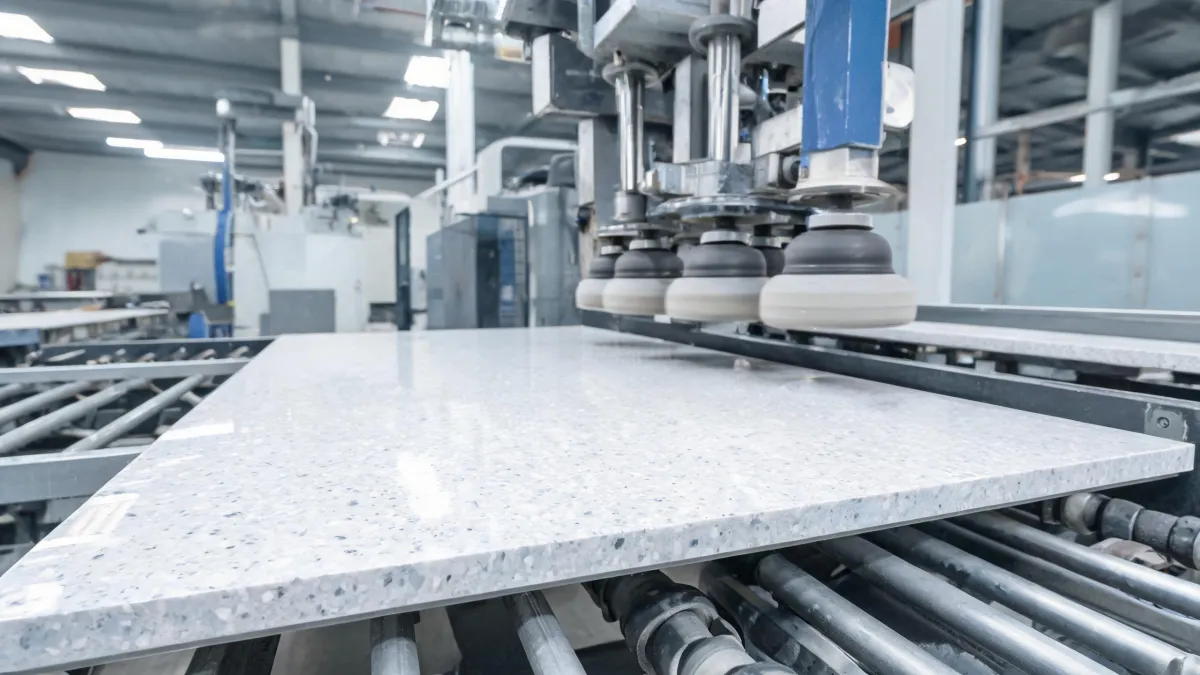
Breton Cap History: The Framework I Use to Evaluate Quartz Countertop Manufacturers
In my first year of handling wholesale countertop orders, I made the classic rookie mistake: I assumed a supplier's impressive machinery meant the product would be impressive too. It cost me a $2,800 rework, a three-week delay, and a very frustrated distributor. That's when I started writing down what went wrong. Nine mistakes later, that list became the evaluation framework our team now uses on every new supplier request.
I work at Breton, so you can take this with a grain of salt if you want. But the process I describe is the same one we use internally to judge ourselves. It's based on documentation, not vibes.
This article compares two ways to evaluate quartz countertop manufacturers. I'll call them Approach A and Approach B. Approach A looks at equipment, catalog size, and samples first. Approach B looks at process, inventory depth, quality systems, and communication first. The reason I write about 'Breton cap history' is that Breton technology is a classic example of equipment that looks magical but only works if the process around it is disciplined. The 'cap' is the ceiling that good manufacturing creates—or the ceiling that bad manufacturing puts on the same machine.
Dimension 1: Equipment vs. Process
Approach A says this: 'They have a Breton press, so the quartz must be good.' Approach B says this: 'The machine is just the beginning. Show me how you check the slab before it ships.'
I've seen top-tier equipment produce awful slabs. In 2018, I received a pallet where the faces looked perfect but the backs had resin pooling in three areas. The machine wasn't the problem. The inspection process was missing. When I asked the factory for their written quality check, they couldn't produce one.
So how do you evaluate process? Ask these questions:
- How many inspection points are between the press and the pallet?
- What is your documented tolerance for slab thickness?
- Do you test the resin-to-quartz ratio on every batch, or once per shift?
- Can I see your defect and scrap records for the last twelve months?
A manufacturer who can answer quickly is rare. A manufacturer who pulls out records without hesitation is even rarer. If you're evaluating quartz countertops manufacturers, this is your first filter.
One more thing I've learned: equipment brands are not quality brands. A fabricator with a lesser-known press but a rigorous calibration schedule will outperform a factory with the most famous name on the machine and no discipline. I don't care about the sticker on the control cabinet. I care about the maintenance log.
Dimension 2: The Granite Countertops Catalog Trap
The next mistake I see buyers make is confusing a big catalog with real capability. A granite countertops catalog with sixty colors looks like a dream for a distributor. But when you ask, 'Which colors are actually in stock today?' the answer often turns into 'we can order it.' That's not a catalog; that's a wish list.
I once had a distributor show me a beautiful granite catalog, then explain that every order needed four weeks and was subject to confirmation. Their sourcing network was fine, but the inventory process didn't exist. For mixed-color container orders, that's a disaster. I said 'mixed loads.' They heard 'loose slabs of whatever we have.' We discovered the mismatch when the first partial shipment arrived with three colors I hadn't ordered.
A process-first evaluation checks physical inventory. Ask for slab numbers, not just product names. Ask which colors have at least five slabs available right now. Ask how often the catalog is updated and what happens when a color is discontinued. Those questions separate a real granite wholesaler from a reseller with a nice PDF.
This doesn't mean a broad catalog is bad. It means the catalog is not the proof. The proof is in the warehouse, and any credible supplier will be happy to walk you through it.
Dimension 3: Solid Surface Private Label and the Boundary Problem
Private label is where 'yes' becomes expensive. A distributor once asked me about solid surface private label because their customers wanted a single-brand solution for quartz and solid surface. I've also been on the buyer's side of that conversation, so I understand the appeal: fewer suppliers, faster quoting, more consistent branding.
But here's where I learned the boundary lesson. A supplier who says 'yes, we can do everything' is usually about to build a new process with your money. The supplier who says 'here's what we're great at, and here's who you should call for the other part' is the one who earns trust. That boundary is a sign of maturity.
I remember a factory that added a solid surface line to complete their catalog. The quartz was solid. The solid surface varied batch to batch. They blamed the resin market, but the real cause was that they didn't have a dedicated process for a material with different viscosity, curing time, and reinforcement requirements. A different factory told me, 'We don't do solid surface well, but these two specialists do,' and sent me to a competitor. That honesty built more loyalty than any markup.
So when you're evaluating solid surface private label partners, ask: How many years has this line been running? Who is the process owner? What's the defect rate? Can you walk me through a sample request from start to finish? If the answer is vague, treat it as a red flag. Private label means your brand goes on the product. You need to know exactly what your name is attached to.
Dimension 4: Samples vs. Quality Systems
Samples are the favorite evaluation tool of Approach A buyers. I get it—a good sample reassures you. But a sample is a single point in time. It doesn't tell you what happens when the factory runs a full batch.
Here's the mistake I made with a $4,300 order: I approved a sample, the production batch arrived, and the color was noticeably different. The factory said 'normal variation.' The specification didn't include a reference sample number, pigment formula, or pressing parameters. There was no way to prove they'd deviated, because I hadn't documented the agreement.
Approach B looks for quality systems before looking at colors. Ask about batch traceability. Ask for the written specification that the factory uses to match a production run to your approved sample. If they can't produce one, your sample approval is just a piece of paper.
Certifications matter here. NSF/ANSI 51 is a real baseline for surfaces that contact food. GREENGUARD certification addresses indoor air emissions. ISO 9001 doesn't guarantee a good slab, but it tells you the factory believes in documented procedures. I use these as conversation starters, not trophies.
Also ask about the sample itself. Many suppliers hand-polish a sample slab in a way that doesn't reflect production. Ask: 'Is this sample made from a regular production batch, or was it made separately?' The pause after that question tells you more than the sample ever will.
Dimension 5: Communication When It Counts
Let's be honest: you only understand a supplier's communication quality when something goes wrong. Before closing an order, I ask how they handle an out-of-spec batch. Do they quarantine it? Do they tell me before shipping? Do they provide a credit memo without me having to ask?
I had a supplier once say 'we'll ship it ASAP.' I heard 'it's in production, expect it soon.' They heard 'schedule it whenever you have space.' The shipment arrived eleven days later, which caused a mess at my warehouse. We were both speaking English and both completely misaligned.
Now I insist on written dates, named checkpoints, and explicit penalty-free delay notifications. A good supplier welcomes this. It reduces their risk too. A supplier who avoids written specifics is hiding something—maybe not intentionally, but hiding.
Here's a simple test: email the supplier with a detailed spec and ask them to confirm each line. Approach A suppliers respond 'Looks fine.' Approach B suppliers respond with corrections and follow-up questions. The second response is worth twice as much.
Dimension 6: The Price Causation Reversal
People assume that expensive vendors deliver better quality. Actually, vendors who deliver quality can charge more. The causation runs the other way. Good process reduces defects, which reduces wasted material and rework, which gives a manufacturer confidence to price for value. The cheapest quote usually skips steps that don't show up until the product lands in your warehouse.
Price matters, of course. But compare spec first, then price. Ask for a quote that includes thickness tolerance, packing standard, loading order, and certificate availability. Compare those line by line. The first phone call about a surprise fee is usually more expensive than the upfront difference.
I've learnt that total cost includes redo, freight, rejected inventory, and the time you spend explaining a bad batch to your own customer. The lowest quoted number rarely survives contact with reality. If a manufacturer won't break down their pricing to the component level, I assume they can't break down their production process either.
How to Run a 15-Minute Supplier Audit
You can see a lot in fifteen minutes if you ask the right questions. Here's what I do:
- Ask for the names of the operations manager and quality manager. If there is no quality manager, stop.
- Ask for the last three customer complaints and how they were resolved. A good manufacturer doesn't hide them.
- Ask for a written process overview of a standard order, from PO to delivery.
- Ask what happens if the batch fails the visual inspection before packing.
- Ask for a reference who's been a customer for at least three years.
The answers tell you whether the supplier thinks like a manufacturer or a broker. If they talk about their own production line, curing times, and inspection thresholds, you're on the right track. If they talk mainly about logistics and MOQs, keep looking.
So Which Approach Should You Use?
I'm not going to pretend there's a single right answer. If you're buying standard quartz slabs in full containers and you've already used the same supplier for years, Approach A might be fine. But for anyone entering a new relationship, evaluating a private brand project, or expanding into granite, I vote for Approach B every time.
Here's my practical scenario guide:
- For a private label quartz launch: require a dedicated process line and documented inspection points. Use Breton technology as a minimum qualification, not a differentiator.
- For a granite countertops catalog: verify physical inventory and lead times before you count colors.
- For solid surface private label: demand proof of experience. Years in production, known defect rates, and a process owner.
- For any large order: test the manufacturer with a smaller one first. How they handle the small order tells you how they'll handle the big one.
The phrase 'Breton cap history' stays in my head for a reason. The history of Breton technology is a reminder that great tools produce great work only when the people using them have discipline. The cap isn't the machine. The cap is the process.
If you want to see what that discipline looks like on our side, I encourage you to ask us the same questions. We might not be the best match for every order, and I'll tell you that honestly. But if we are a match, I'd rather show you the process than sell you the dream.