The stone countertops OEM vs private label decision is not about branding. It is about who carries the risk when a batch goes wrong. If you have quality-control staff, a warranty process, and working capital to survive a rejected shipment, private label can be profitable. If you don't, OEM-branded product is often the lower total cost even when the unit price looks higher. That is the conclusion I keep returning to after six years of buying countertop materials.
I manage procurement for a 14-person building-products distributor. Our annual spend on quartz, granite, and solid surface is around $380,000, and I have compared at least 20 suppliers since 2018, maybe 23—I would have to check my vendor list to be accurate. The longer I do this, the more I care about what happens after the quote, not just the number at the bottom of it.
One quick caveat about the word Breton: in search results it points to too many unrelated things. There are Breton horse colors if you breed horses, Breton cap if you are shopping for clothing, and then there is Breton S.p.A., the Italian machinery company known for engineered stone production lines. If you arrived here through the horse or fashion angle, this article is not what you expected. In the countertop world, Breton is a process and technology signal, not a material. Knowing whether a quartz factory uses a Breton line helps me narrow a supplier list, but it does not replace inspection.
What OEM and private label mean in a countertop context
People use the two terms as if they are the same, but in my purchase orders they create different obligations. In an OEM arrangement, you sell a supplier's existing branded product line. They set the color program, publish technical data, and own the factory warranty. You can add fabrication, logistics, or installation, but when a slab fails, your customer makes a claim against their brand, not just yours.
In a private-label arrangement, the same factory may make the same physical slab, but it carries your brand. You own the color standard, the spec sheet, and the warranty conversation. If a shipment has a defect, your customer calls you. That difference does not show up on a price quote, but it shows up in your P&L.
This is why I get skeptical when someone says private label is just a cheaper way to create your own brand. It is a cheaper way to become the manufacturer of record. That can be a great margin strategy, but only if you are prepared to act like a manufacturer.
What a procurement manager actually asks
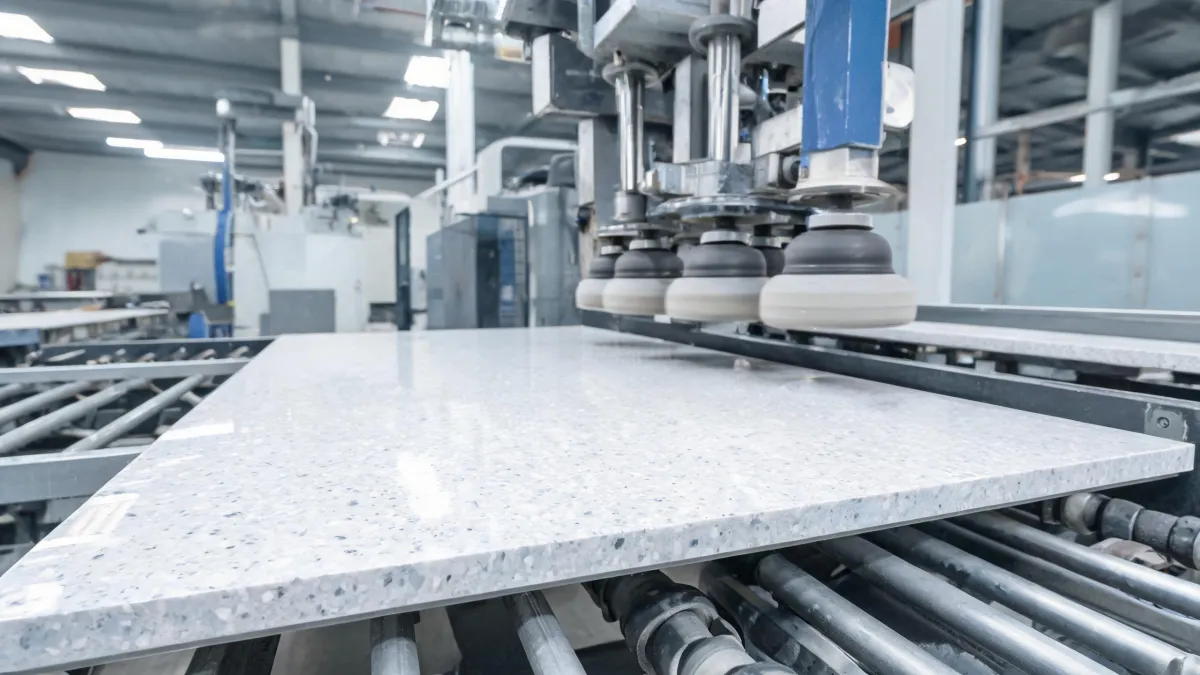
I don't ask a supplier if their quartz slab is good. I ask which production line made it and what the batch number is. If the answer references a Breton S.p.A. plant line, that gives me a useful starting point: it tells me the factory is using a defined engineered stone process, rather than a vague mixing operation.
I still verify the details. A slab can be made on a Breton-process line and still be poorly controlled if the operator cuts corners on resin quality, pigment dosing, or curing. So I treat a Breton line as the entry ticket, not the final guarantee. Then I ask for batch certificates, a physical master sample, and a written rejection policy.
One more thing I have learned from messy keyword reports and supplier emails alike: “Breton cap” is not a specification. I have seen that phrase show up in search suggestions, and I have no idea what it means in production terms. If a supplier puts it in a quote, ask for the exact line number and technical data sheet instead. The only cap I want in a contract is a maximum cap on future price increases. Everything else should be measured in millimeters, percentages, and batch numbers.
Where private label usually gets expensive
In 2023 I compared a branded quartz program with a private-label option from another factory. The branded slab was about $4 per square foot higher. At first, I thought the private-label quote was the obvious choice. Then I mapped out what a factory rejection would cost: inspection time, replacement freight, fabricator downtime, and potential claims against my own inventory reserve.
The branded supplier had a simple warranty process. The private-label contract left the rejection risk with me. When I calculated the total cost over a 1,000-square-foot order, the branded option was actually cheaper once I weighted the probability of a color or thickness issue. That was counterintuitive to me at the time. Now it is the first thing I check.
Bulk solid surface changes the risk math
Bulk solid surface can be a smart buying move because the material is repairable and easier to fabricate than quartz. But volume does not make color variance disappear. If you buy across multiple production lots, you are buying sheets of the same color that may behave differently under seams and heat-forming.
Before I sign a bulk solid surface order, I require three things: all sheets from one lot, or separate lot codes on each pallet; a master sample held by both parties; and a written acceptance tolerance for shade and thickness. The third one has been a deal-breaker more often than price. A small thickness variance may not matter in a 10-sheet order. In 200 sheets, it can double seaming labor and make your installers look bad.
Does this apply to granite and marble?
Natural stone is different because it doesn't run through a Breton line. If I am private-labeling granite, I ask for quarry block identification and slab-level photos before production. Natural stone will always have movement and variation, so the real question is whether the supplier can keep variation inside the range you agreed to.
OEM-branded natural stone is not automatically more consistent. The brand just gives you an external standard to enforce. If your private-label supplier has better grading and QC, private label can be the higher-quality route too.
My honest boundary
Private label is not a bad idea. If you have a QC person who can visit factories, a color standard you are willing to defend, and enough volume to negotiate real remedies, private label can outperform OEM by a wide margin. I have seen fabricators do it with a small number of high-margin colors and win consistently.
For a one-person operation, though, OEM is usually safer. The risk is not in the material itself. It is in your ability to absorb a bad batch without losing your best customer. At least, that is what my experience with mid-size distributors tells me. Larger homebuilders and smaller local fabricators have different math, and the best answer for them is often different too.