I spent my first year in stone countertops sourcing thinking the job was about price. It wasn't. The expensive mistake isn't paying too much; it's discovering too late that the slabs don't match the sample you approved.
I'm a quality/compliance manager at an engineered-stone supplier. I review product before it goes out the door — roughly 200 lots a year. In Q1 2026, I rejected eight first deliveries because they missed the standard we had agreed on. It might have been nine; I'd have to check the log. Not one of those slabs was ugly. They just weren't repeatable. And for wholesale stone, repeatability matters more than beauty.
The Surface Problem: Picking a Slab Instead of a Specification
Most wholesale buyers start with a sample. They put a polished quartz square on the desk, decide they like the tone, and ask two questions: “Can you match this color?” and “What's the price per square foot?”
Those are natural questions, but they're shopping questions, not sourcing questions. A sample tells you the color. It doesn't tell you how the slab behaves under fabrication, what the next batch will look like, or what happens if the factory changes its resin supplier.
The Deeper Problem: “Quartz” Is a Broad Category, Not a Guarantee
The deeper problem is hidden inside a word we overuse: “quartz.” In wholesale terms, quartz is a category, not a recipe.
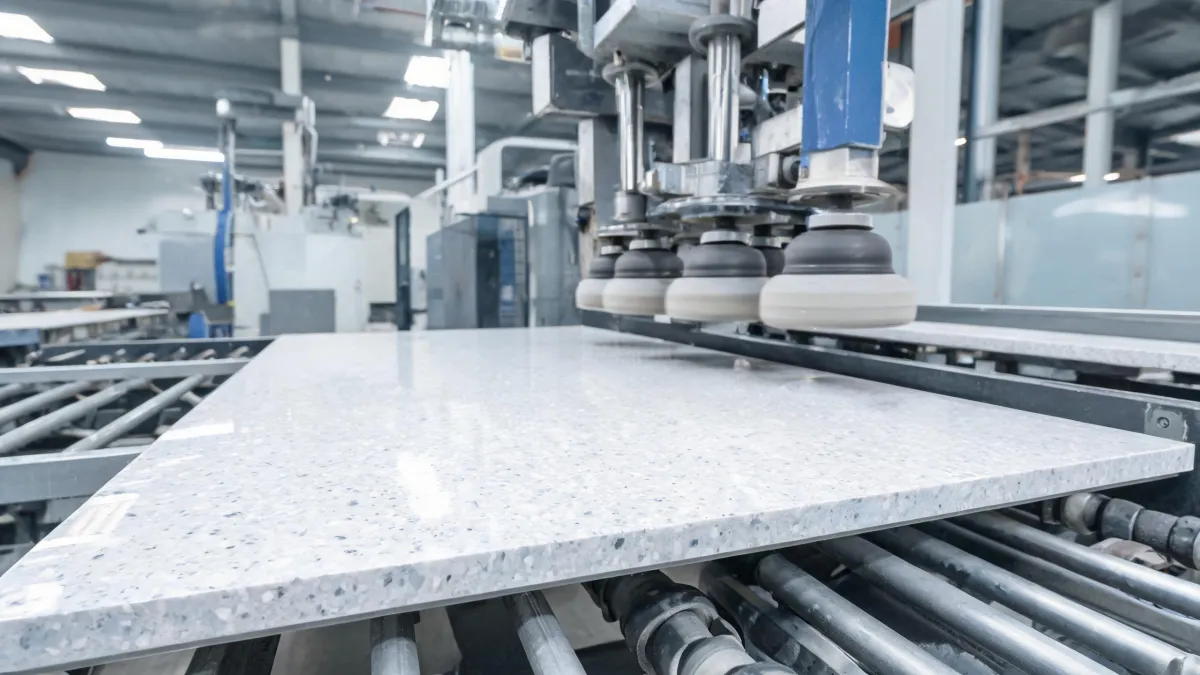
Engineered quartz slabs are made from crushed stone, resin, pigment, and sometimes recycled material. But the type and grading of the aggregate, the resin formulation, the pigment package, the compaction method, and the curing process all affect the final slab. Two surfaces can both be called quartz and perform very differently in the same kitchen.
That's where “Breton” enters the story. Outside the stone industry, a Breton cap is a fashion item, and a Breton horse breed profile on The Spruce Pets might be what you actually searched for. Inside the stone industry, Breton is shorthand for the engineered-stone manufacturing technology associated with Breton S.p.A. It refers to a production process behind many quartz surfacing products. It is also a useful quality signal — but not a guarantee.
A factory that runs a Breton line has invested in serious production equipment. That means something. But the process is only as good as the operators and quality system around it. I've rejected product from modern lines because the team had been told to “make it darker than last time” without adjusting the QC limits. The machine didn't cause the failure; the system around it did.
The Hidden Risk: Spec Sheets Are Not Batch Records
Stone countertop specifications usually include water absorption, flexural strength, stain resistance, and hardness. Those numbers belong in your procurement file. What they don't tell you is whether the slab in question is the same product described. A technical data sheet describes intention; a batch record gives evidence.
That gap between intention and evidence is where wholesale sourcing problems live. A supplier can show you a lab report. You ask if it comes from the latest production run. The answer is often, “Same product.” And maybe it is. But “same” is a memory, not a measurement.
I remember catching a color drift after a supplier quietly changed a pigment source. They didn't try to hide it; they thought it was close enough. Close enough is how brands lose fabricators.
What It Costs to Skip Stone Countertop Specifications
Let's talk about money, because price per square foot doesn't include what happens after the container leaves the factory.
Suppose one supplier is $0.35 per square foot less than the other. On a 10,000 square foot order, that looks like $3,500 in savings. Now suppose one slab in fifty is off-color, and one of those makes it into a kitchen under a window. Replacement cost with freight, fabrication, and reinstallation can wipe out the $3,500. But the larger loss is harder to measure: a buyer who loses trust in your brand. In wholesale, you aren't just selling stone; you're selling consistency.
Nobody at the job site says, “The resin formulation was off.” They say the countertop didn't look right. For the customer, that's your quality, not the factory's.
So How to Choose Quartz Countertops for Wholesale?
Start with your acceptance criteria, not with color. This is the shortest path I know.
- Write a pass/fail spec for every critical characteristic. Include slab dimensions, thickness, flatness, squareness, gloss range, color variation from the retained sample, and surface defects.
- Ask for lot-level test results, not brochure data. If the factory tests every batch, ask to see the last three reports. If they don't test every batch, decide what that means for your risk.
- Keep a physical reference sample from every approved production run. Color measurement is useful, but a reference slab catches what a number doesn't always show.
- Clarify what “Breton process” means in your context. It's a meaningful process detail, but it is not a full quality specification. Ask which line produced your order and how process deviations are recorded.
- Put the non-conformance rule in writing before you pay a deposit. If the batch fails, do you get replacement, credit, or rework? If it isn't defined, you don't have a standard; you have a preference.
This approach isn't flashy. It won't make a pretty sample less appealing. But it prevents the most expensive version of stone countertops sourcing: discovering the problem in front of your customer instead of at the factory. Start with the spec. Then choose the color. They both matter, but only one of them is something you can build a wholesale business on.