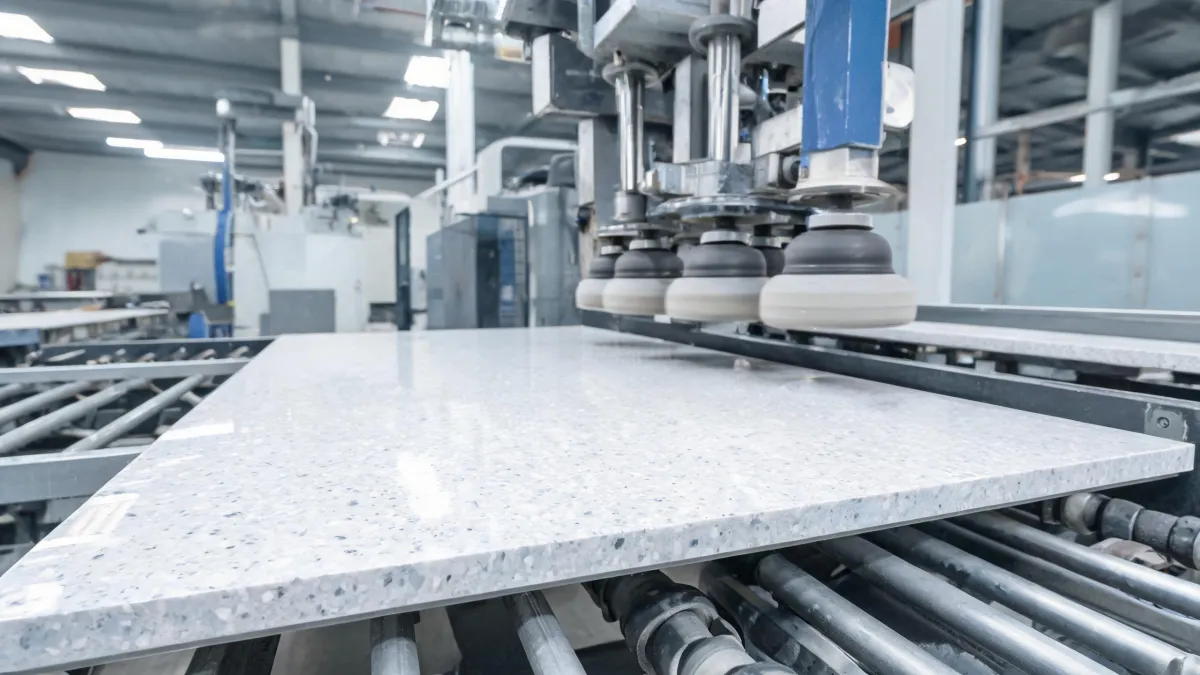
In 2021, I had seven years of experience as a solid surface distributor, and I still managed to blow up my first big quartz countertops private label order. The sample was perfect. The price was fair. The deposit was paid. Then the container arrived, and every slab was a slightly different version of 'white'.
That mistake cost us $14,600 in material and another $890 in handling, plus a week of trust with a very patient fabricator. I documented the whole thing. It's in a folder my team now refers to as 'the mistake list'.
This isn't a normal granite countertops distributor buying guide. It's a 'here's what I wish someone had shown me before I spent money' guide.
The Sample Looked Perfect. That Was the Problem.
Most people assume a sample is a miniature version of the slab you'll receive. It's not. A sample is a carefully selected piece from a controlled part of the process. A slab is the process under full production pressure. Those are two different animals.
With engineered stone, the difference comes down to one word: repeatability. A good factory can make a perfect slab. A great factory can make the same perfect slab 200 times in a row. The sample only proves the first part.
For a development the size of Gilden Woods Breton Village, where every countertop in a phase is supposed to match, that repeatability matters more than the original sample. One mismatched slab on a 200-unit build is a redo, a delay, and a contractor asking who sold you that order.
So what separates a repeatable process from a lucky batch? It's not the brand name on the resin. It's whether the factory controls the steps that create the slab's internal structure.
What I Call the 'Breton Cap'
Let me explain a term you won't find in a broker's PowerPoint: the Breton cap. (I don't mean a hat.)
I mean the capacity ceiling a serious factory respects when it's running Breton-engineered lines. The compaction cycle, the curing time, the calibration step—each one has a physical limit. If you push the line beyond that limit, slab density drifts. And when density drifts, color and polish behavior drift with it.
The factories I trust will tell you exactly what their cap is. 'We can run your color in this window, at this volume, with this lead time.' That's not a sales objection. That's a process statement.
If a supplier says 'no problem, we'll run it whenever,' that is a red flag. They either don't control their process, or they're about to make you the victim of one that's out of control.
Why Normal Buying Guides Miss the Real Issue
Open a typical granite countertops distributor buying guide and you'll see the same advice: check edge profiles, verify thickness, confirm the finish. That's fine for natural granite, where geology dictates appearance and you select slabs by eye.
But when you're ordering quartz countertops private label, the slab is not the product. The process is the product. If the process is consistent, the slab is predictable. If the process is loose, you get a material that looks fine in a 10x10 sample and falls apart in a 200-slab order.
People think Breton-engineered quartz costs more because it's a premium Italian brand. That has it backwards. The price follows the process. Repeatability is expensive to build. The causation runs from consistency to cost, not the other way.
Let me give you three examples from my own records. Not anonymous stories. Mine.
What a Loose Process Actually Costs
- The 30-slab veining disaster. I ordered book-matched quartz with dark veining. I approved the sample. I didn't ask for a paired layout plan. The slabs arrived with the veining repeated every three slabs, so the book-match effect was a joke. $4,300 in material, $1,120 in re-fabrication, and a customer who now double-checks everything I say.
- The batch traceability gap. We received 22 slabs in two batches. Same order number. Same color code. The second batch had been produced two weeks later with a different pigment load. Delta E was above 4.0, which is visible to anyone. The showroom had already installed samples. $3,600 to replace the affected tops, plus a very uncomfortable phone call.
- The sink cutout mistake. That one was mine. I processed a 47-slab order and approved the cutout specs from memory. Nine slabs were templated wrong. $450 in wasted material and a three-day delay for the builder. No factory process can fix a buyer who skips the review step.
On the solid surface distributor side, the same lesson applies with a slightly different twist. Solid surface can be seamed and repaired, so minor shade differences feel less scary. But that makes people lazier, not safer. If you don't match the sample before the seaming test, you'll match it after the customer complains. Both are expensive.
The Checklist That Finally Stopped the Bleeding
After the third rejection in Q1 2024, I wrote our pre-check list. It doesn't include edge profiles or corner radii. It asks five questions.
- What's your process? If the supplier can't describe compaction, curing, and calibration in one sentence, pass. We use Breton technology in our line, so we know what a real process statement should sound like.
- What's your Breton cap? What is the maximum number of slabs per production window for our color? If there's no cap, there's no control.
- What's the Delta E target? We request Delta E ≤ 2 at D65, measured per batch. It's the same logic as Pantone tolerances for print: if you can't measure it, you can't match it.
- Can we get a lot number and a QC report? Not just a certificate of origin. Actual batch numbers, compression data, and porosity data if available.
- What happens if a slab is outside tolerance? Get the replacement policy in writing. Not a promise. A policy.
That's the short version. It fits on one page. It saved us roughly $52,000 in avoided errors over the next 18 months.
When This Guide Is Not for You
I don't want to pretend this is universally applicable. My experience is based on about 80 mid-size wholesale orders in North America. If you're a homeowner buying one slab, this is overkill. Honestly, find a good fabricator and trust them.
If you're buying commodity granite by the container, natural stone selection is a different game. You're choosing inventory, not engineering a repeatable process.
But if you're building a private-label quartz program—or adding quartz to your existing solid surface business—this is the part people miss. The sample is not the promise. The process is.
'That looked close enough' is the most expensive sentence in our industry.
It took me seven years and one very expensive container to understand that the supplier's process is the product. The checklist helps, but the real fix is asking better questions before you order. That's the buying guide nobody wants to write. A list of uncomfortable questions.