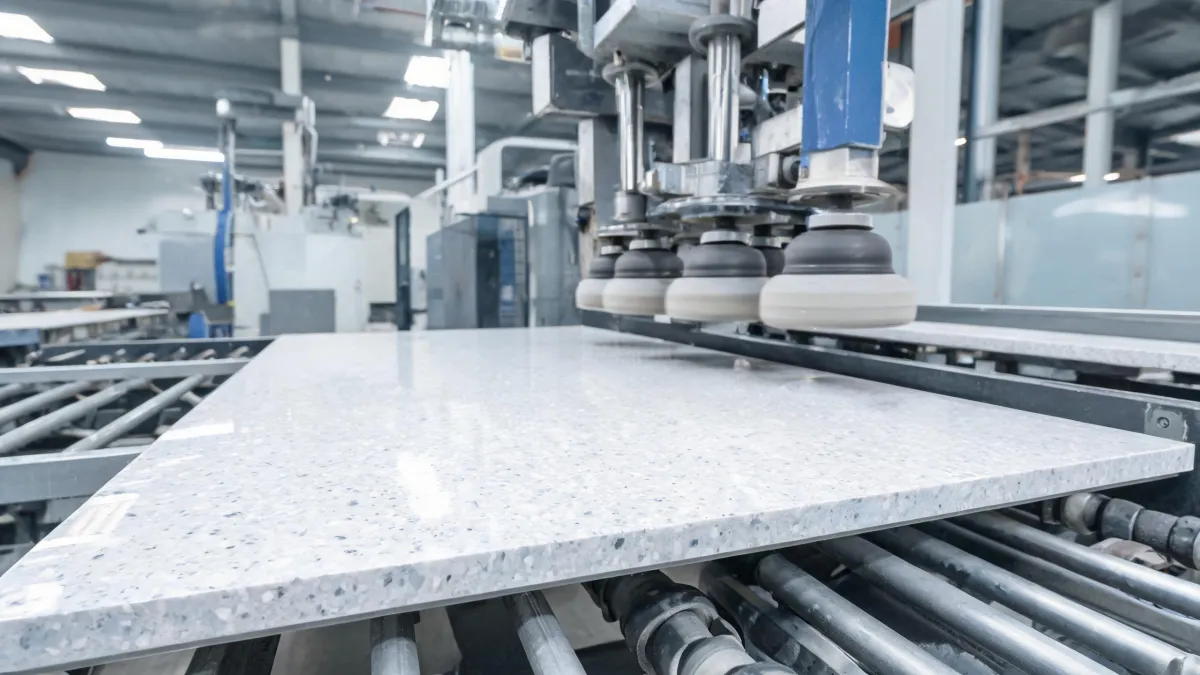
The short answer first
After roughly 400 wholesale stone orders since 2018, my answer to "what to look for in a quartz countertops supplier" is short: batch-to-batch consistency. Not the machine brand. Not the showroom sample. Not the "we've been in this industry for 20 years" speech. Can this supplier prove that the slab shipped in October will match the sample you approved in March? If they can't — or won't put it in writing — everything else is decoration.
Equipment names like "Breton" get all the attention, and for good reasons. It's genuinely advanced technology. But a Breton line doesn't guarantee strict quality management. A few years ago, a beautiful sample from a supposedly top-tier factory led me to approve a large order. The production batch didn't match. Seeing that contrast is what changed how I evaluate suppliers.
In the past 18 months, our team has caught 47 potential issues at the pre-shipment stage using the checklist I describe below. Things like wrong calibration tolerances, missing batch photos, and freight clauses that would have left us with no claim if slabs arrived damaged. None of those 47 would have been found by asking "do you use Breton?"
This article is aimed at people buying quartz, engineered stone, granite, or solid surface countertops wholesale or OEM. If you're a homeowner choosing one kitchen countertop, most of this is overkill — you need a good local fabricator, not a factory audit. If you're evaluating suppliers for a business, read on.
Where this checklist comes from
I'm a procurement lead handling wholesale quartz and granite countertop orders for about 8 years, for a distribution company that supplies fabricators and retailers in the U.S. and Europe. I've signed off on something like 400 wholesale stone orders — maybe 390; I'm probably missing a few from 2023 when we switched tracking systems. And I've personally made and documented 5 significant mistakes, totaling roughly $35,000 in wasted budget. The checklist my team uses today was built from those mistakes.
I should add: I'm not a materials engineer. My area is sourcing, quality claims, and failure patterns, not polymer physics. When a technical spec goes beyond my depth, I bring in someone who knows better. That type of boundary is exactly what I look for in suppliers too.
What "Breton" actually proves
In the stone countertops wholesale world, you'll hear the word "Breton" constantly. Breton S.p.A., an Italian manufacturer, developed the Bretonstone® process — a method of pressing quartz and resin under vacuum with high-frequency vibration. Many of the best-known engineered stone brands in the world use Breton technology.
What this process genuinely does: it compacts the mix more densely than older pressing methods, which means fewer voids, more uniform surface structure, and better polish results. In practice, slabs from well-maintained Breton lines do offer measurably better flexural strength than cheaper presses.
But here's what the name doesn't tell you:
- Whether the factory controls pigment and resin consistency between batches.
- Whether slab thickness stays in a usable range after polishing.
- Whether the line settings on your production date match the settings used for the approved sample.
- Whether the "Breton" in their catalog means full technology or a vague marketing association.
The surprise for me came when we compared two factories directly. One had a well-known Breton line. The other used a lesser-known pressing system. The Breton-equipped factory made physically denser slabs, exactly as expected. But the other factory held color consistency across batches better. It was a side-by-side reminder that equipment is only part of the quality equation.
What to look for in a quartz countertops supplier
When I evaluate a supplier for stone countertops wholesale, I don't ask for their best price first. I ask for quality-control documentation. "We do quality control" is not an answer.
1. A printed color-tolerance target. Ask how they measure batch-to-batch color variation and what their maximum ΔE is. In my experience, a decent quartz supplier can hold ΔE under 2 between production runs; a disciplined one may commit to 1 or better. If a supplier can't give you a number, they haven't measured it.
2. Thickness calibration evidence. For a 20mm slab, finished thickness typically lands between 19 and 20mm, depending on polishing allowance. What matters is the tolerance — usually ±0.3 to ±0.5mm. Ask for the last inspection sheet, not the spec printed in the brochure.
3. Resin and composition in writing. Standard engineered stone is roughly 90–93% quartz and 7–10% resin. That ratio affects cutting behavior, edge quality, and stain resistance. "Premium resin" without a number is not useful.
4. A sample-to-production rule. This is non-negotiable. The approval sample must come from the same production line and, ideally, the same raw-material batch as your order. "We copy it exactly" is a feeling, not a process.
5. A fair freight-damage protocol. In wholesale stone, some slabs will arrive chipped or cracked. The supplier doesn't have to cover every claim, but they should have a clear rule: how to document, who decides, and who pays return freight. Agree on it before the PO, not after.
If a supplier claims compliance with a recognized standard — for example, ANSI A137.3 for quartz or ASTM C615 for granite — request the current third-party test report. Also, per FTC Green Guides (ftc.gov), vague environmental claims like "eco-friendly" must be substantiated. Test reports are shareable; marketing phrases are not.
Granite countertops OEM: a different kind of risk
Granite countertops OEM gets searched alongside general quartz supply, but it's a different animal. When you buy OEM, you're not just buying slabs. You're buying the right to put your brand on them, plus the factory's discipline in following your specifications.
Start with the MOQ per SKU. Some factories will handle a single pallet for a private-label project; others require a full container. Both answers are acceptable as long as they're honest and written down. Next comes liability. Some OEM suppliers treat private-label work as "your spec, your risk." That might be fair — but you need to know it before signing, not after a rejected shipment.
I also ask about inspection rights: can we send someone to the factory before container loading? A supplier with confidence in their system says yes. And for any custom pattern you co-develop, put ownership in writing. I've seen a "custom" design show up on a competitor's catalog within a year because nobody documented who owned it.
One of my favorite supplier moments came from a factory that openly declined part of our request:
"That small prototype run isn't our strength. You'd be better off with a local fabricator."
That supplier earned our larger order a year later. In my opinion, a specialist who knows their limits beats a "we can do everything" generalist every time.
A note on "breton cap" and "breton wood"
Every quarter, our product team forwards search queries like "breton cap" and "breton wood." Here's the honest answer: neither is a standardized industry term in the stone sourcing world I've worked in.
"Breton wood" typically refers to wood-look engineered stone — quartz or sintered stone that imitates oak, teak, or other woodgrain patterns. "Breton cap" is fuzzier. It appears in some product listings, and the factory people I've asked have described it differently — a surface layer, a decorative coating, a specific pattern name. That inconsistency is exactly the problem.
The lesson: product names tell you very little. They don't tell you how a slab performs under stain tests, how consistent the batch is, or whether it fabricates cleanly without chipping. If a supplier leads with a catchy product name, respond by asking for the same measurable specifications you'd request for anything else.
The $18,400 mistake
In March 2023, I had two days to choose a supplier for a 1,100-slab hotel project. Normally I'd have visited the factory or run a pilot batch. There was no time for either, so I made the call based on a dealer referral and a sample that looked perfect in our showroom.
I still kick myself for not asking one question: "Which line produced this sample, and will my order come from the same line?" The sample had been pulled from a premium pilot line. The production line was a different one.
The result: $18,400 in sorting costs, scrapped slabs, and rush replacement freight, plus a 10-day schedule delay on a project that had zero slack. A 20-minute factory inspection would have exposed the whole thing. The factory manager knew which line the sample came from. I just didn't ask.
That mistake is why the sample-to-production rule is now at the top of our checklist. It's not a clever rule. It's common, cheap to check, and expensive to ignore.
When the equipment label actually matters
Having made the case that consistency beats the "Breton" label, here's the other side of the boundary. There are cases where production technology genuinely matters:
- Ultra-white or high-gloss quartz, where pressing density affects pinholes and gloss uniformity.
- Large-format thin slabs, where flexural strength depends heavily on compaction quality.
- Complex veining and bookmatched patterns, where density consistency affects pattern stability.
In those situations, I do ask about the pressing process. But I verify through test reports, line audits, and samples from the actual production line, not through a brochure logo.
One more boundary: direct wholesale isn't right for every buyer. If you're a fabricator who needs 15 slabs every few weeks, a local distributor is a better fit than a container relationship. You don't need a factory audit; you need a responsive supplier who handles damage claims fairly.
Final honest caveat
This checklist reduces your risk. It doesn't eliminate it. I've worked with suppliers who passed every item and still delivered a disappointing shipment. I've also worked with a sloppy documenter who shipped 14 clean orders in a row before failing on the 15th.
The way I see it, the goal is not finding the perfect supplier. It's finding one who is honest about limits and willing to document what matters. If a quartz countertop supplier can show you a color-tolerance number, a sample-to-production rule, and a clear warranty, start there. If they tell you what they're not good at, trust them even more.
That's what my failures taught me — and why our team still uses this checklist.