I’m a procurement manager at a 45-person wholesale distribution company. I’ve managed our countertop materials budget—about $1.8 million annually—for seven years. In that time, I’ve negotiated with 30+ stone suppliers, fabricators, and private-label partners, and I’ve documented every order in our cost tracking system. I’ve also eaten a few mistakes that still show up in our TCO spreadsheet.
When I first started buying granite countertops wholesale, I assumed the lowest FOB price per slab was the whole game. Three budget overruns later, I realized that the quote was just the beginning. The real cost lived in compliance delays, batch inconsistency, damaged edges, and OEM spec changes. If you’re sourcing solid surface OEM or Breton process engineered quartz, the same pattern shows up—just with different line items.
The Quote That Looks Fine Until It Doesn’t
Here’s the surface problem: a supplier sends you a quote. It looks clean. Slab price, maybe freight, maybe a rough lead time. You compare it to two other quotes. The lowest number wins. Then the order ships, and the “cheap” option starts leaking money. A container gets held at port because the solid surface compliance requirements weren’t fully documented. A batch of quartz slabs arrives with shade variation that your fabricator can’t blend. Or your private-label order gets delayed because the OEM switched resin suppliers without telling anyone.
None of that shows up in the first quote. But it shows up in your P&L.
The Deep Problem: You’re Not Buying Slabs, You’re Buying a Process
In my opinion, the countertop industry has a pricing problem disguised as a product problem. Most buyers compare material specs as if they’re buying a commodity. But granite, quartz, and solid surface are not commodities. They’re process outputs. And process outputs vary.
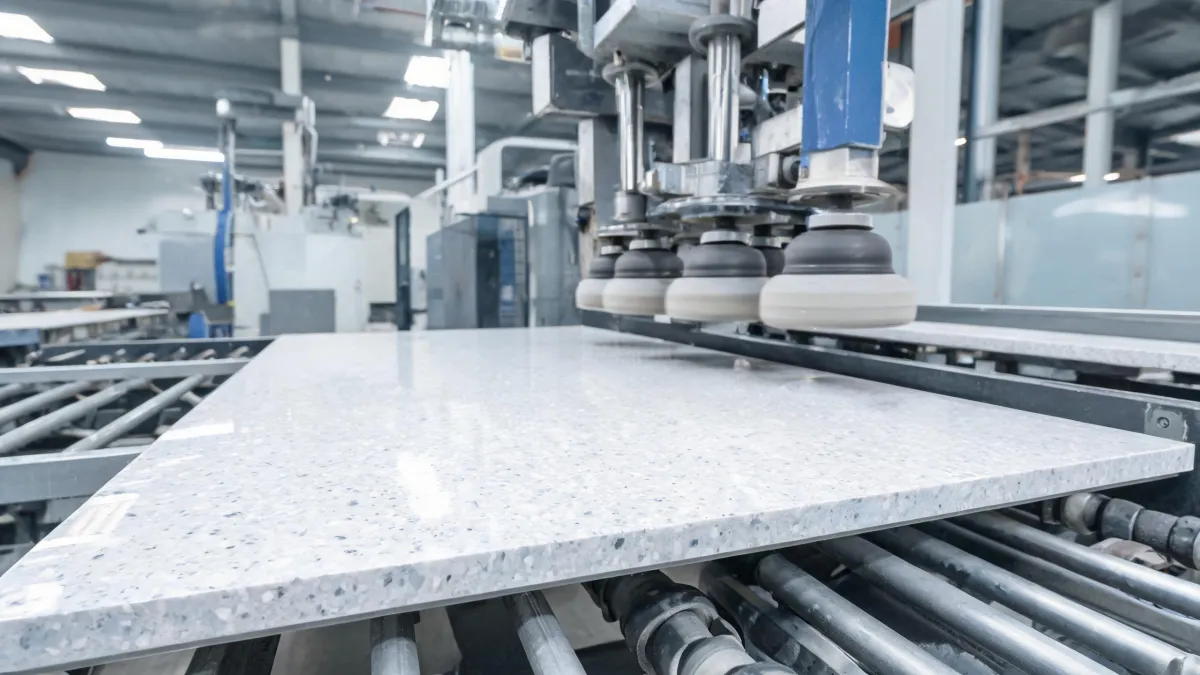
I used to think “Breton process engineered quartz” was just a marketing phrase. Then I spent a quarter auditing why one supplier’s slabs consistently fabricated better than another’s, even when the spec sheet looked identical. The difference wasn’t the quartz content. It was the pressing, curing, and quality control behind the slab. According to Breton (breton.it), its engineered stone plants use vacuum vibrocompression to bind quartz and resin. That’s the kind of process detail that determines whether your fabricator gets a 90% yield or a 70% yield.
When a supplier mentions “Breton CAP” or “Breton process engineered quartz,” don’t treat it as a badge you can check off. Ask what it means for your order. What’s the batch consistency? What’s the slab tolerance? How do they handle shade variation between lots? (Note to self: we added this to our supplier scorecard last year, and it cut our rework claims by about 18%.)
Compliance Is Not Paperwork—It’s a Gate
Solid surface compliance requirements are where I see the most expensive misunderstandings. Solid surface is used in healthcare, food service, schools, and commercial interiors. Depending on the application, you may need documentation for ASTM E84 flame spread, NSF/ANSI 51 for food equipment, GREENGUARD Gold or CDPH Standard Method v1.2 for VOC emissions, and ANSI/ICPA SS-1 for solid surface material performance. Local codes can add more.
They warned me about outdated compliance docs. I didn’t listen closely enough. In Q2 2024, we had a solid surface OEM order for a clinic project. The VOC report was two versions old. The fabricator caught it, but not before we had to air-freight a replacement batch. That “cheap” quote cost us an extra $6,300 and pushed installation by nine days. The compliance file is not a nice-to-have. It’s a gate.
OEM and Private Label Multiply the Variables
Solid surface OEM and private-label work adds another layer. You’re not just buying material; you’re buying someone else’s ability to repeat your spec. That means color matching, edge profiles, packaging, labeling, and documentation all have to line up every time. If the supplier changes a resin, a pigment, or a cure cycle, your brand takes the hit.
I’ve only worked with about 40 solid surface OEM runs. I can’t speak to how this applies to every product category. But in our experience, the OEM suppliers who survive our scorecard are the ones who treat process control as a cost-saving feature, not a cost center. They reduce the hidden rework that kills margins.
What These Misses Actually Cost
Let’s put numbers on it. Over the past six years, I’ve tracked about 180 container orders and 40 OEM runs. When I audited our 2023 spending, I found that 31% of our “budget overruns” came from three sources: compliance delays, batch inconsistency, and freight damage that wasn’t caught at the port.
Here’s a real example. In 2023, I compared costs across 8 vendors for a mixed container of quartz and granite. Vendor A quoted $28,400 FOB. Vendor B quoted $25,900. I almost went with B. Then I calculated TCO: B charged $1,200 for compliance document updates, $900 for re-palletizing, and their slab tolerance caused a 12% yield loss at our fabricator. That yield loss was worth about $4,100 in wasted material and labor. Total: $32,100. Vendor A’s $28,400 included compliance docs, consistent slab tolerance, and a packaging spec that survived the port. That’s a 13% difference hidden in fine print—and it ran the other way from the sticker price.
That’s the thing about countertop sourcing. The lowest quoted price often isn’t the lowest total cost. The bottom line is that a $2,500 “savings” on a container can disappear in one compliance hold or one batch of unusable slabs.
The Fix Is Boring, But It Works
After getting burned twice, I built a cost calculator that forces every quote through the same TCO model. It includes base price, freight, duties, compliance documentation, packaging spec, slab tolerance, yield estimate, and rework history. Our procurement policy now requires quotes from three vendors minimum because the first quote is rarely the full story.
We also ask different questions now. Instead of “What’s your best price?” we ask:
- Which solid surface compliance requirements do you document by default, and can you send current reports?
- For Breton process engineered quartz, what’s the batch consistency data and shade variation range?
- If we run a solid surface OEM program, what triggers a spec change—and how fast do you notify us?
- For granite countertops wholesale, how are slabs packed, and what’s your damage claim rate?
This worked for us, but we’re a mid-size distributor with predictable container volumes and a dedicated QC person. If you’re a smaller fabricator ordering LTL or a startup doing one private-label run, your mileage may vary. You may not need the same level of documentation. But you probably still need to know where the hidden costs live.
The Part Where Efficiency Actually Shows Up
I’m not a “digital everything” guy. Some traditional supplier relationships are worth keeping because they know your market and can solve problems fast. But efficiency is competitiveness in this business. When we moved our quote comparison into a shared TCO spreadsheet and required digital compliance files, our turnaround from quote to purchase order dropped from 11 days to 6. The automated checks didn’t replace judgment. They just stopped us from missing the same red flags twice.
If you’re evaluating a new supplier for granite countertops wholesale, solid surface OEM, or Breton process engineered quartz, don’t start with the price per slab. Start with the process behind it. Ask for the compliance file. Ask for the last three batch reports. Ask what happens when something goes wrong. The answers will tell you more than the quote ever will.
Prices and compliance standards change. Verify current requirements with official sources like ANSI, ICPA, ASTM, NSF, and Breton (breton.it). My experience is based on our own order history; your numbers will be different.