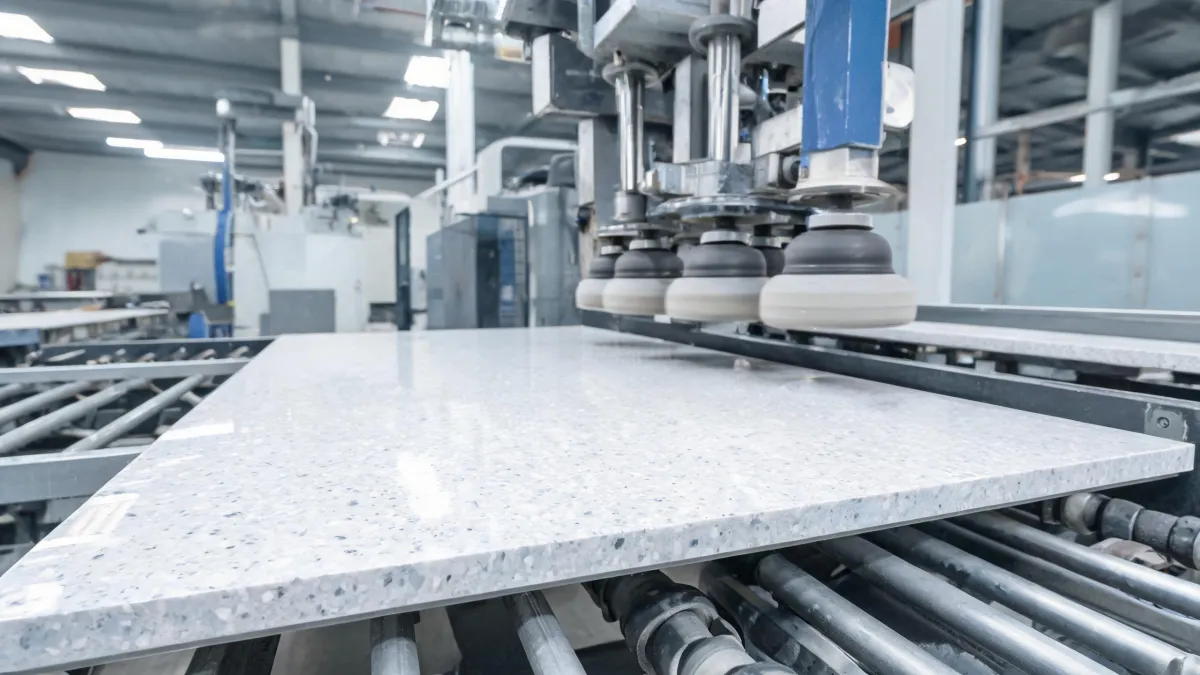
I've been coordinating stone deliveries for fabricators, distributors, and a handful of hotel groups for over a decade. The question I get asked most often isn't "which stone is better." It's "should we buy direct from the factory, or through a trading company?"
Both answers are wrong, which is why I keep writing this down.
Here's the framework I'll use. Five dimensions, in this order: private-label capability, lead time under pressure, slab-to-slab consistency, real landed cost, and what happens when something goes wrong. Those are the five things that have actually cost my clients money — usually in that order, and usually because they optimized for the wrong one.
Quick note on scope: when I say "manufacturer," I mean a real producer — someone who runs the press (for engineered stone) or owns the quarry and block inventory (for granite). When I say "trading company," I mean an importer or export broker who buys slabs and resells them. Both are legitimate. They just win in different situations.
Dimension 1: Private-label capability — who actually controls the press
If you're a distributor trying to build your own brand on stone countertops, this is the dimension that decides everything else.
Direct manufacturers with their own engineered stone process can produce under your brand name, with your labels, your packaging, your colors. They maintain the batch formulations. They can hold a colorway stable for years. That last part matters more than people realize — I've seen a distributor lose a commercial account because their "Calacatta Bianco" drifted two shades off between production runs and the designer noticed on-site.
Trading companies rarely own the press. They source from two or three manufacturers and repackage. Sometimes that works fine. But when you ask for a private-label run of 40 slabs in a specific formulation, you're often being routed through the same manufacturer you could have called yourself — with an extra margin attached.
Where trading companies win: low MOQs. If your first order is eight slabs and you're testing a market, a trading company will take that order. Most direct manufacturers won't. I've watched a small fabricator burn six months chasing a factory MOQ when they should have just paid the trader's markup and gotten to market.
If you're building a brand, you need the press. If you're testing a market, you don't deserve the press yet.
Dimension 2: Lead time under pressure
This is where my own work happens, so I'll be blunt.
In March 2024, a hotel group I work with was 36 hours from a mockup deadline. Their specs called for a specific engineered quartz, and their original supplier had shipped the wrong format. We had a manufacturer on the line who could pull the right slab from an existing batch — no new production run, just inventory matching. Total premium: about $1,400 in expedited freight on top of a $9,800 order. The alternative was pushing a $180,000 install by two weeks.
The pattern I've seen, over and over: manufacturers with deep inventory can move fast on standard items. Trading companies can often move faster on non-standard items because they have relationships across multiple factories and no single press to schedule around.
Honestly, I'm not sure why some vendors consistently beat their quoted lead times while others consistently miss. My best guess is it comes down to internal buffer practices — whether a sales rep quotes the production number or the "insurance" number. Manufacturers tend to quote the real number. Traders tend to pad it and then look like heroes when they deliver early.
Which one is better for you depends on whether you'd rather be surprised pleasantly or not at all.
Dimension 3: Slab-to-slab consistency
Manufacturers win this, but not for the reason most people think. It's not the stone. It's the batching.
In my first year doing this, I made the classic rookie error: assumed "same specification" meant identical result across suppliers. Didn't verify. Turned out two "Calacatta" quartz slabs from two different trading companies had visibly different veining density, and I'd already promised a designer they'd read as one continuous surface.
Cost me a $2,200 redo and a very awkward Tuesday.
Direct manufacturers control the batch. When you re-order the same SKU six months later, the resin-to-aggregate ratio and pigment load will match the original. Trading companies — even good ones — are aggregating from whoever has stock that month. The result isn't necessarily worse, but it is less predictable.
For renovation work, this doesn't matter much. For a 40-slab hotel lobby or a multi-unit residential build, it matters a lot.
Dimension 4: Landed cost, not quoted cost
The quote you receive is not the price you pay. I've never fully understood why this is so hard for some buyers — until I started tracking their actual invoices.
What I mean is: the "cheaper" trading-company quote is often cheaper only on paper, because it excludes slab-selection trips, crating differences, port fees, and the risk of a slab arriving chipped because it was bundled with lower-grade stock. Add those up and the 8% gap between the trader's quote and the manufacturer's quote can flip direction in a single shipment.
On the flip side, going direct usually means you're on the hook for a full container, higher MOQs, and your own logistics coordination. If you don't have volume, the manufacturer's per-unit price advantage disappears.
This is the dimension where I see the most wasted money, and it's almost always because the buyer compared unit price instead of landed cost. Simple mistake. Expensive habit.
Dimension 5: When something goes wrong
Everything above is about average case. This dimension is about the other 20%.
Direct manufacturers have corrective authority. If a slab is wrong, they can remake it. If a batch is off, they can hold production and fix it. The chain of command is short.
Trading companies have corrective relationships. They call the manufacturer on your behalf, which is faster if the relationship is good and slower if it's not. I've seen this go both ways. When a trader is tight with the factory, they can move mountains. When they're not, you're in a three-way phone call at 10pm trying to figure out who owns a cracked crate.
One more thing on this dimension, and it's worth stating plainly: engineered stone contains crystalline silica, and fabrication exposure is a real regulatory issue. Australia banned engineered stone in 2024, and OSHA has been ramping up enforcement on fabricator exposure in the U.S. If your supplier can't tell you the silica content in writing, that's not a supplier question — that's a liability question. Manufacturers should have this documented. Some traders won't.
Per FTC Green Guides (16 CFR Part 260), environmental claims like "recycled content" must be substantiated. If an engineered stone supplier markets a slab as "eco-friendly" without documentation, that claim is a regulatory risk, not a marketing feature.
Where each one wins
If you're building a private-label countertop brand — you want the press. Go direct. Accept the MOQ and the container logistics. This is not the place to save 6%.
If you're a fabricator running mixed orders under 20 slabs and you need flexibility, a good trading company will outperform a factory on responsiveness. Do not buy into the myth that direct is always cheaper. It isn't, at low volume.
If you're managing a commercial project with a hard deadline — hotel, multifamily, restaurant rollout — the deciding factor isn't manufacturer vs. trader. It's who has the specific slab in inventory this week and who can confirm it in writing. That's it. Everything else is theory.
And if you're in that last category, tell your supplier you're in that category. Rush pricing exists (typically 25–100% premium depending on turnaround, based on our own expedited freight logs for 2024–2025). The vendors who do this well will quote it honestly. The ones who don't will promise the impossible and then disappear the week it matters.
Between you and me, the biggest tell isn't the quote. It's the question they ask you first. If they ask about your deadline before they ask about your budget, they've done this before. If they ask about budget first, they're selling, not supplying.