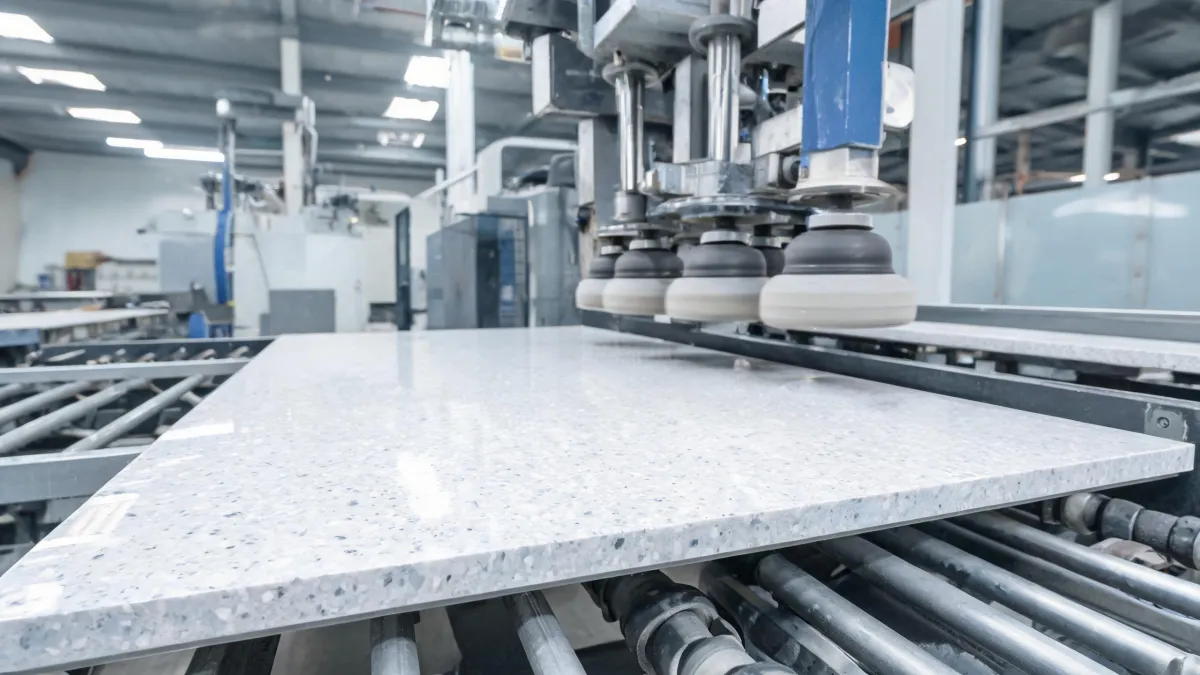
First, a routing note. If you landed here because you typed breton cap men looking for a hat, you're in the wrong room. This article is about Breton the engineered stone process—not Breton the cap. But if you're a wholesale buyer, fabricator, or company trying to build a private-label countertop line, keep reading.
I've managed procurement for a mid-sized construction materials company for seven years. Our countertop purchasing budget runs around $800,000 a year, and I've built a TCO spreadsheet after getting burned on hidden fees once too many times. Over that time, I've audited more than 20 stone countertops supplier claims, switched vendors, and helped build our current supplier scorecard. There is no perfect supplier. There is only the supplier whose process, capacity, and risk profile match your buying scenario.
Find Your Buying Scenario First
Most guides start with “look for a reliable supplier.” That's useless. What counts as reliable depends on whether you're stocking slabs, fabricating kitchens, or putting your own brand on a product.
Scenario A: Wholesale Distributor / Slab Stocker
If you buy by the truckload, your first concern is consistency—not just from slab to slab, but from lot to lot. A pretty sample means nothing if the next production run is a shade darker.
- Ask for lot numbers and production dates. A good supplier should be able to trace a slab back to the line and shift that made it.
- Check how slabs are packed and palletized. I lost a corner on a 15-slab order once because the supplier saved money on packaging. That claim cost more than the savings.
- Price per slab is not the same as cost per usable square foot. Small cracks, color drift, and edge chips turn into waste you can't sell.
Why does this matter? Because your profit is made in the processing and resale, not in the purchase. If the slab arrives defective, you're the one eating the freight and the rework.
Scenario B: Fabricator / Project-Based Countertop Buyer
If you're quoting kitchens and commercial bars, you need a supplier who can deliver specific cuts, finish options, and realistic lead times—not just a warehouse full of slabs.
Ask about overage and restocking policies before you order, not after. I still kick myself for not checking the restocking fee on an exotic color. The slab wasn't bad. The color just didn't move. The restocking cost turned a “safe” experiment into a $1,200 mistake.
Also ask: What happens when a slab has a hairline crack that's only discovered during fabrication? Does the supplier cover the slab replacement and your labor? Some suppliers replace the slab. Almost none cover fab labor unless you put it in the contract. That difference is a hidden cost that shows up exactly when you're least prepared.
Scenario C: OEM / Private-Label Partner
Now we're in deeper water. If you want stone countertops OEM support, you're not buying a product. You're buying a partner who can maintain tolerances, handle your specs, and keep your brand out of trouble.
This is where the Breton process matters most. Breton technology is a vacuum vibrocompression method that produces denser, more consistent engineered stone. It's not the only way to make good material, but if a supplier claims to use it, ask for machine model numbers, maintenance records, and test data. If they can't show you, treat “Breton” as a marketing word. If they can, it's a strong signal they understand process control.
For OEM, I'd add these checks:
- Who owns the technical specifications? A private-label project needs a documented spec for resin content, water absorption, flexural strength, and stain resistance.
- Can they commit to a minimum order and a maximum output? That maximum is your capacity cap.
- What happens during a color change or raw-material substitution? If they adjust resin or pigment, do you get notified and re-approve samples?
- If the finished countertops fail after installation, who pays for replacement and labor? Get that answer in writing.
And if they market “recycled content” in their quartz, ask for third-party documentation. Per the FTC Green Guides (ftc.gov), environmental claims have to be substantiated. If they can't back it up, don't put it in your own marketing.
What to Look for in a Engineered Stone Supplier
Yes, I know the grammar in that heading is wrong. It's also what people type. Let's make it useful.
Everyone asks about price per square foot. Here's the thing: price is the least reliable number you'll get. The real question is what happens around the price. I look for five things now:
- Process proof. Can they name their production process and show you QC records? If they say Breton, ask for the machine type and maintenance log.
- Test data. What standards do they test to—ASTM, EN, ISO? What are their water absorption and flexural strength numbers? If they don't know, they've never tested.
- Defect and reject rates. A supplier that can't state its reject rate isn't tracking quality. A published range is fine. “We don't measure that” is not.
- Lead time variability, not just lead time. A 4-week promise that becomes 8 weeks is worse than a 6-week promise that holds.
- The Breton cap. I call it that because I've seen plants sell more capacity than they have. Ask: “What's the maximum volume you can produce per month without slowing QC?” If they can't answer, they'll overpromise when you're on a deadline.
That last one cost me a contract in Q2 2024. A supplier quoted a 3-week turnaround for a project, then at week 5 admitted the production line was capped. The material eventually arrived, but our installation crew sat idle for two days. The invoice was lower than the previous vendor, but the TCO was higher.
The C Word: Total Cost
I've been in procurement long enough to distrust any conversation that stays at the unit price level. Stone countertops have a ton of hidden costs: freight damage, restocking fees, color mismatches, storage, and the most painful—re-fabrication labor after a slab fails under a sink cutout.
Most buyers focus on the per-square-foot price and completely miss these. It's the standard outsider's blind spot. The question everyone asks is “What's your best price?” The question they should ask is “What's included in that price?”
People also think expensive suppliers are expensive first, then quality. It's actually the other way around. A supplier with real process control has fewer defects, so they can hold their price steady without eating failures. The price is a result, not the cause.
I still kick myself for not building a supplier scorecard earlier. Once I started tracking reject rates and late deliveries, two “cheap” vendors lost more money for us than they saved. Switching to a supplier with better QC saved us about 17% of our countertop budget over the next year, mostly by eliminating rework.
When This Guide (and This Supplier) Is Not for You
If you're a homeowner looking for one kitchen countertop, this guide is overkill. Call a local countertop shop. If you're a buyer whose strategy is “lowest price, no matter what,” then this guide won't help—because you'll find a cheaper supplier somewhere, and you'll pay for it later in QC or service.
Also, no serious supplier should promise zero color variation forever. Engineered stone is manufactured, but raw minerals and resin still create acceptable variation. If a supplier promises perfect uniformity, they haven't tested enough. We've learned to ask customers to sign off on a color range before production. That doesn't weaken the product; it keeps the partnership honest.
How to Tell Which Scenario You're Actually In
If you're not sure which of the three scenarios fits, use this self-test:
- You buy slabs by the container and resell to fabricators → Scenario A.
- You quote jobs, fabricate, and install → Scenario B.
- You want a product line with your own brand, SKUs, and packaging → Scenario C.
If two scenarios fit, pick the one with the longer relationship. A one-time truckload can be handled by a trader. A five-year OEM agreement needs a manufacturer with engineering depth and a clear Breton cap.
At the end of the day, I don't look for the supplier that says yes to everything. I look for the one that can show me the process and tell me what they can't do. That honesty is worth more than a low quote. It's the difference between an invoice and a total cost.