I read a lot of “what to look for in a granite countertops supplier” advice before I started managing purchasing back in 2020. Most of it is written for homeowners picking a single kitchen slab. This is not that.
I’ve been the person signing off on stone countertop orders for our company for five years now. Processing 60–80 orders a year across 8 vendors changes your perspective. The expensive supplier is not always the problem. The vague supplier is.
There is no one-size-fits-all answer. If you are a wholesale distributor, your checklist is different from a contractor’s. And both are different from an architect who needs solid surface specifications for a building submittal. So here is a decision tree.
Three buying situations, one decision tree
In B2B purchasing, “what to look for” changes depending on your role:
- Volume buyer – wholesale, distribution, OEM/private label. You want material consistency, batch after batch.
- Project buyer – fabricator or contractor. You want a delivery date you can rely on.
- Specifier – architect, designer, facility owner. You want documentation you can hand to the building department.
Pick the branch that sounds like you. The other branches are still useful background, but they will lead you to different questions.
1. Volume buyers: wholesalers, distributors, and OEM/private-label partners
If you are buying stone countertops to resell or to put your own brand on, what matters most is process. A slab can look great in a photo and be inconsistent in the container. Ask the supplier to explain their manufacturing process in writing.
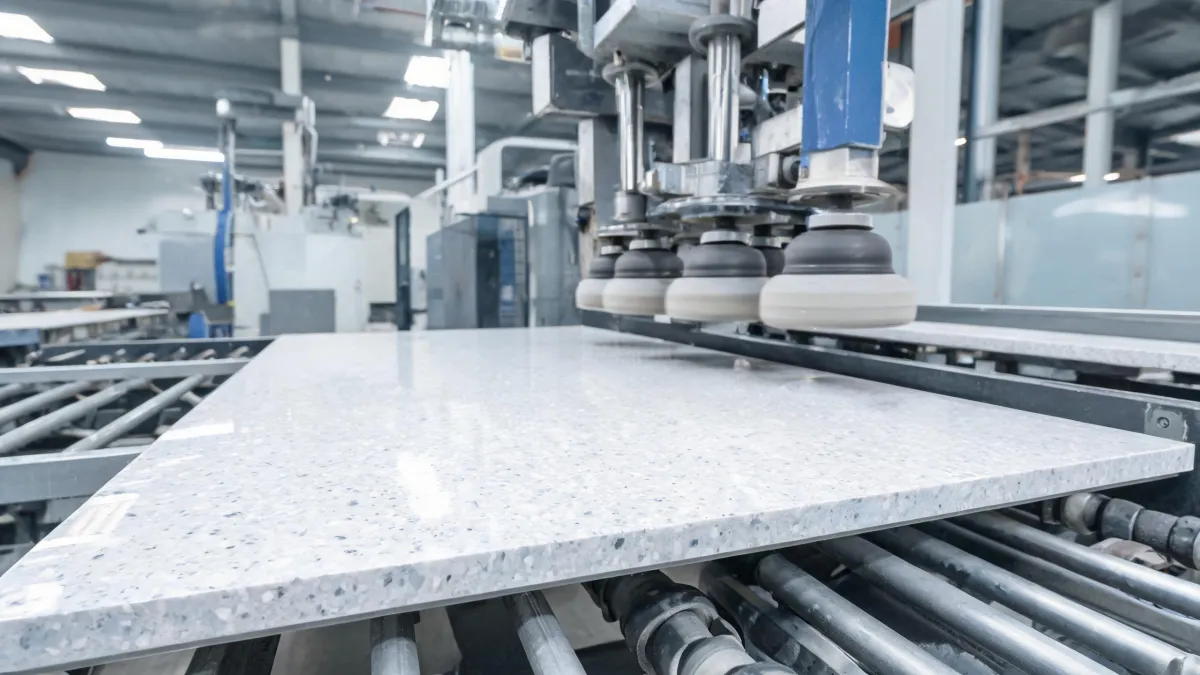
For engineered quartz, “Breton” is a name you will see again and again. You might see Breton CAP on a tag or a spec sheet, along with “Bretonstone” or “Breton engineered stone process.” Those are process labels, not magic words, but they give you a baseline: the slab is likely made with a vacuum-vibro-compression process rather than a simple cast. That matters for density, porosity, and how well it holds a polished edge.
What I look for as a buyer is whether the supplier can state it in plain language. We’ve done maybe 200 orders. Maybe 180, I’d have to check the system. Not a single one failed because the material was too consistent. The failures came from vague specs, missed dates, and bad invoicing.
2. Project buyers: fabricators and contractors
If you are a fabricator or contractor, the delivery date is your biggest risk. In March 2024, we paid $400 extra for rush delivery on a quartz order. The alternative was missing a $15,000 event. That $400 was a no-brainer. It was not just speed—it was certainty.
Ask for the delivery date to be written as a date, not a window. If a stone countertops supplier says “probably around the 15th,” they are asking you to share their risk. I learned this the hard way. The supplier who cannot commit to a date is a red flag.
The supplier who won’t commit to a date is asking you to share their risk.
We also learned to have an approval chain for rush orders. We didn’t have one, and it cost us when an unauthorized rush fee showed up on an invoice. Now any rush order requires two emails: one to authorize the fee, one to confirm the new date.
3. Specifiers: architects, facility owners, and custom projects
If the countertop is going into a commercial building, the material claim needs to be backed by documents. This is where solid surface specifications matter.
A solid surface countertop is not granite. It is usually an acrylic or polyester product, and its specs are different. A 1/2” sheet can be fine for vertical surfaces, but 3/4” is more common for horizontal countertops without extra support. Seams are meant to be nearly invisible, but only when the fabricator uses the manufacturer’s seam adhesive and follows the installation instructions.
I am not a materials engineer, so I won’t guess about lab-test numbers. What I can tell you from a purchasing perspective is this: if the supplier cannot send the manufacturer’s published specifications, do not assume they exist.
One more note: if a sales rep calls the product “green” or “eco-friendly,” per FTC guidelines (ftc.gov) that claim has to be substantiated. Ask for the basis of the claim. If it is not documented, it is marketing.
Red flags for any granite countertops supplier
No matter which branch you are on, these apply to every stone countertops supplier:
- They have not seen the slab from inventory and show only catalog photos.
- They cannot name the quarry or the manufacturing process.
- They say they meet international standards but cannot produce the certificate.
- They give you a price but not an invoice template. A vendor who couldn’t provide proper invoicing cost us $2,400 in rejected expenses.
- They offer “probably” as a delivery date.
How to tell which situation you’re in
Ask yourself three questions.
First, are you buying inventory or are you buying an install date? If you are buying inventory, the manufacturing process matters most. If you are buying an install date, lead-time certainty matters most.
Second, does your customer need a brand name or a building code? For private-label work, you need a supplier with stable formulas and branding flexibility. For code compliance, you need solid surface specifications and printed documentation.
Third, who owns the warranty if something fails? If you are a distributor, you need a supplier that will stand behind the slab when your customer calls. If you are a contractor, you need a supplier that will stand behind the end user.
The “breton woods nh” version of this question
I’m including this because “breton woods nh” is a common search that brings people to pages like this. If you are in the White Mountains area—or anywhere in New England where granite countertop suppliers are spread out—the location matters less than the logistics.
Granite is heavy. Freight can erase a great unit price. A supplier one state over with a written delivery date can beat a local supplier who says “we’ll get it there eventually.” Freight rates as of Q4 2024 were still changing quickly, so get a written quote with a validity date.
That isn’t a small concern. I do not mean it is only an accounting issue—I mean a missed freight appointment can push a whole construction schedule.
Bottom line
There is no perfect granite countertops supplier. There is a supplier that matches your situation. If you are a volume buyer, make them prove their process. If you are a project buyer, make them commit to a date. If you are a specifier, make them hand over the specs.
The most important quality is not price. It is certainty. The supplier who can give you certainty on the thing that matters most is worth more than a supplier who gives you a lower quote and a shrug.