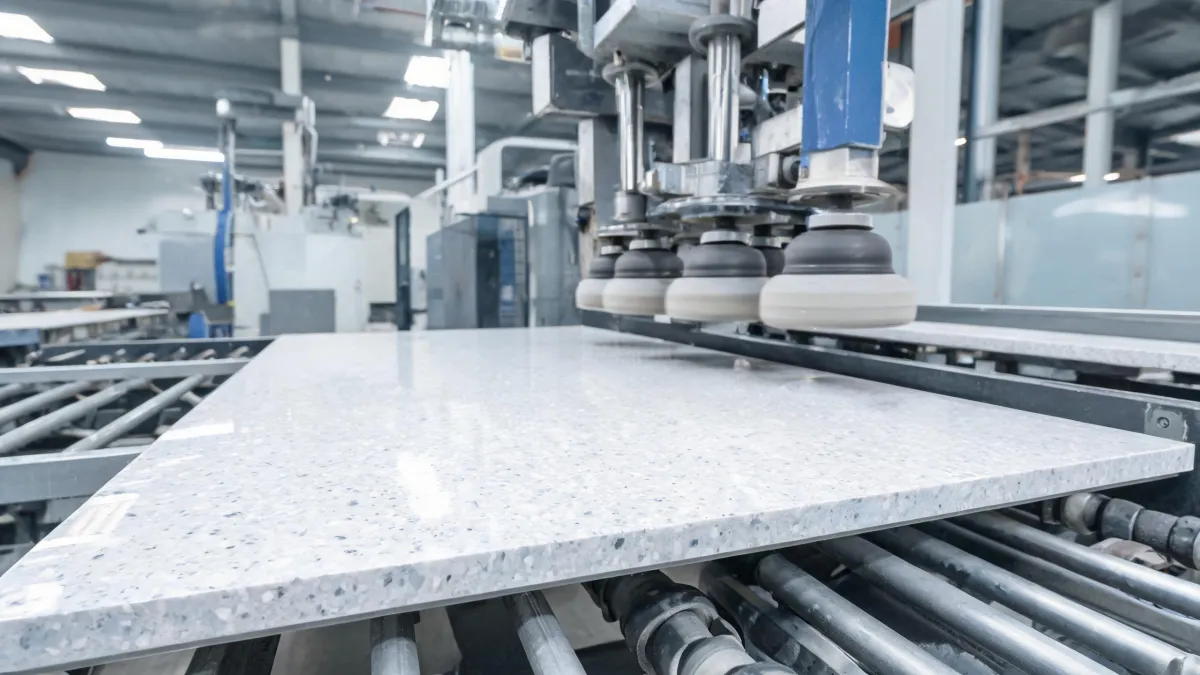
There's no single spec that works for every countertop buyer. You might be a distributor stocking slabs for a hospital renovation, a fabricator quoting jobs in three states, or a brand owner trying to launch a private label line without a factory. The right specification depends on your role.
I'm the procurement manager for a mid-sized stone importer. For the past six years, I've managed a countertop spend of about $1.4 million a year, tracked every invoice in our ERP, and made enough mistakes to know what actually matters.
Let's start with the first search term everybody tags onto this industry: Breton. People hear Breton and think it's the same as premium quartz. It isn't. Breton builds the equipment that many quartz and engineered stone makers use to make slabs. A slab can be produced on a Breton line and still be mediocre if the raw material ratios or curing steps are wrong. Breton tells you a lot about the process. It doesn't tell you everything about the batch.
Basically, every countertop order is a bundle of promises—thickness, color, compliance, durability. The spec sheet is how you make those promises checkable. The question is not, 'Breton or not?' The question is: which of the three countertop buying scenarios are you in? Most buyers fit one of three scenarios: you resell slabs, you fabricate them, or you private-label a solid surface product. Each one needs a different spec sheet.
Scenario 1: You resell slabs
If you're a distributor buying finished slabs, your biggest risk is a mismatch between what the quote says and what the container delivers. This is where stone countertops specifications get real.
- Thickness: nominal 1cm, 2cm, or 3cm. If you need 3cm, ask for the measured maximum and minimum. My own 2.8cm regret came from a quote that said 3cm and a QC report that somehow rounded up.
- Slab dimensions: seam planning changes if the actual slab is 122 inches instead of 126 inches.
- Flexural strength, water absorption, and stain resistance: these matter more for quartz than for granite if you're supplying high-traffic commercial kitchens.
- Color consistency: ask for the color code and batch number, then request photos of the actual slabs, not a catalog render.
Here's something vendors won't tell you: the first spec sheet they send is usually the material family spec, not the batch spec. When you put your own name on a stone, batch-specific is the only safe language.
And to be fair, some big suppliers are better at paperwork than small ones. But a clean binder doesn't automatically mean a clean slab. In 2023, I audited twelve incoming containers and found that the worst color deviation came from a supplier with the best-looking PDFs.
Why do I care? Because total cost. If a $650 slab yields three fewer square feet of usable fabrication than a $710 slab, the cheap slab is the expensive one. We learned that the hard way when a bargain truckload of quartz caused 11 percent fabrication waste—and one very angry restaurant client.
Scenario 2: You fabricate or install
When you fabricate countertops, the spec sheet doesn't end at the slab. It ends at the edge profile, seam placement, and sink cutout tolerance.
This is where Breton CAP enters the conversation. I'm not talking about the slab-making process anymore. Breton also makes CNC machining centers—the C.A.P. series—used by top fabricators to cut, shape, and finish stone. A shop running a 5-axis Breton CAP machine can hold much tighter tolerances on undermount sink cutouts and mitered edges than a hand-fabrication crew can.
Honestly, I'm not saying CNC guarantees good work. A careless programmer can ruin an expensive slab just as fast as a careless grinder. But if you're writing a specification, you should specify process capability where it matters: CNC-machined sink cutouts is a spec. experienced installer is a hope.
What most people don't realize is that rush turnaround times on fabricated stone are often built around a buffer that the shop added on top of the actual production time. That buffer isn't lying—it's risk management. But it means we can deliver in 7 days is not the same as your job will take 7 days.
If you're a fabricator buying stone for specific projects, the hidden cost to watch is yield. Ask for slab dimensions, veining pattern, and defect maps before you commit. A perfect slab with a hairline crack that appears under the second edge pass is not a perfect slab for your job.
There's something satisfying about a slab that cuts exactly the way the spec said it would. After six years of close enough, I now write those words into every RFQ: we will measure selected slabs and approve a layout before cutting. It costs an hour, and it has saved us thousands.
Scenario 3: You want a solid surface private label line
This is the situation that gets most people confused, because they're not buying slabs at all. They're buying a product with their own name on it.
A solid surface private label program is more than picking a color and slapping on a logo. You need formulation control, material certification, packaging, warranty support, and a clear answer to the question: who is liable if a product fails?
Here's the part that's hard to hear: if you're just starting out, you probably should not build a factory. I know vertical integration sounds impressive. Someday you may need to talk to plant builders—the kind of turnkey engineering and construction work that shows up under search terms like Breton Avenir construction services. But for a first launch, buying into an established private label program is almost always cheaper when you count total cost.
Why? Because of solid surface compliance requirements.
- Food-contact surfaces: if the countertops go into kitchens, NSF/ANSI 51 (nsf.org) is the standard most U.S. specs ask for.
- Fire performance: building codes often require a flame spread rating. ASTM E84 (astm.org) is the test method you'll see referenced.
- Solid surface material performance: ISO 19712 and its regional equivalents cover classification and properties for decorative solid surface materials. Ask your supplier which version they tested.
- Local regulatory checks: some regions have restrictions on engineered stone dust and silica content. The finished slab may be fine, but your fabricator's process can still be regulated.
Notice what I didn't include: the color looks nice. That's because nice colors don't get you through a spec review.
Now, about small orders. I have been on both sides of this. When I was starting out, the suppliers who treated our $1,500 trial orders seriously were the ones who later got the $150,000 contracts. I still work with one of them today.
Small doesn't mean unimportant. It means potential. A well-run solid surface private label program will let you do a small pilot run, test the market, and scale. The per-unit price will be higher than a truckload order—that's not discrimination, that's math—but you should never be treated like an inconvenience.
If a supplier makes you feel guilty for asking about minimums, walk away.
How to know which scenario you're in
Look at the invoice you issue, not the invoice you pay.
- If you sell the same slabs you received, with no cutting, no finishing, no rebranding: you're in scenario 1.
- If you resell modified countertops—cutouts, edges, seams, finishes—you're in scenario 2.
- If you put your name on a material manufactured to your specifications, you're in scenario 3.
Mixed models exist. Many distributors also fabricate; many fabricators also develop private-label accessories. If you're in more than one, write a separate spec sheet for each role. Don't blend them.
This is where a lot of RFQs go wrong. A distributor sends a fabricator-level spec to a slab supplier and gets confused why the quote is high. A private label buyer sends a distributor-level spec to a manufacturer and gets a quote with no compliance documentation. Different scenarios need different documents.
The last thing I'll say is this: if you take away one habit, ask for the batch-specific certificate.
I still kick myself for not doing that on a private label run in Q2 2024. The first order sold fine. The second one triggered a customer audit, and the factory suddenly had trouble producing the paperwork. We kept selling, but I spent three months chasing documents—three months that could have gone into actually improving the product.
Today, batch number and certificate language are in every PO. Trust me on this one. It sounds like a small thing. It's not. It's the difference between a stone countertop specification and a stone countertop hope.
If you're small, don't settle for a spec sheet that's vague about compliance. And if you're big, don't assume branded means documented. The only trustworthy answer is in the file.