If you're sourcing solid surface countertops — whether for distribution, fabrication, or a private label line — the supplier you pick affects everything downstream. Lead times. Defect rates. Whether your brand gets the credit or the blame.
I coordinate rush orders at a building materials company. Over the last four years, I've handled 200+ urgent orders, including 36-hour turnarounds for fabricators whose slabs were stuck at the port. That's where I learned the difference between suppliers who talk a good game and suppliers who actually deliver when it counts.
Here's the checklist I'd run through before committing to a solid surface supplier. Nine steps. Most take less than a day. All of them will save you a much worse conversation later.
1. Confirm What "Solid Surface" Actually Means to This Supplier
Solid surface is a broad category. Pure acrylic, polyester-acrylic blends, and modified composites all get called "solid surface," but they behave differently under heat, impact, and fabrication.
Ask directly: what's the resin composition? What's the warranty on the raw sheet? If the supplier can't answer without checking with someone else, that's information.
It's tempting to think one sample of a color tells you everything. But the same name across two suppliers can be completely different formulations. Get the spec sheet, not just the swatch.
2. Ask About the Manufacturing Process — and Why Breton Comes Up
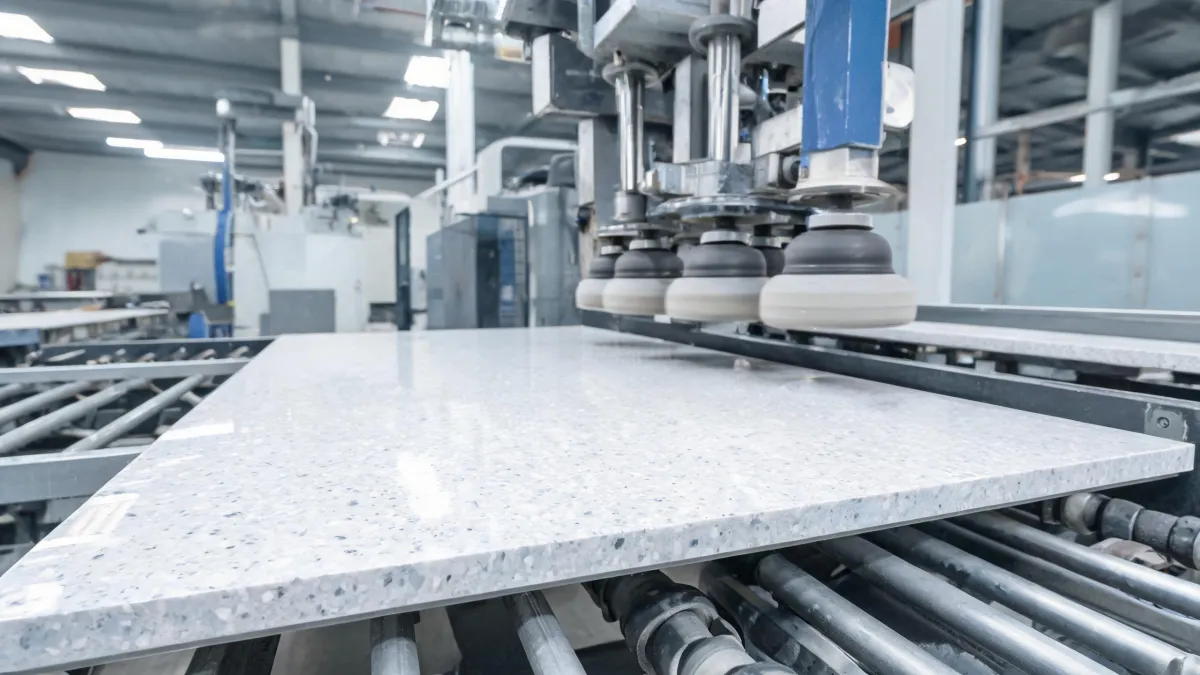
If you're sourcing engineered stone (quartz surfaces), the manufacturing method matters more than most buyers realize. Bretonstone — the process developed by Breton S.p.A. in Italy — uses vacuum vibrocompression to produce slabs with consistent density and low porosity. A lot of premium engineered stone on the market today is made on Breton lines or under Breton licenses.
Does that mean non-Breton slabs are bad? No. But when a supplier says "Breton technology" or "Breton process," they should be able to explain what that means for slab quality — not just drop the name as a marketing checkbox.
I'm not a materials engineer, so I can't speak to the exact resin-to-aggregate ratios that make one slab outperform another. What I can tell you from a procurement perspective is this: suppliers who can explain their process in specific terms tend to solve problems faster when something goes wrong.
3. Check Private Label and OEM Capabilities Before You Need Them
If you're building your own brand of countertops, private label support is not something you want to figure out after the first order. Ask early:
- Do they support custom labeling and packaging?
- What's the minimum order quantity for branded slabs or finished tops?
- Do they provide documentation your brand can pass on to your own customers?
I don't have hard data on how many suppliers in this space offer true private label programs. But based on our own sourcing over the past few years, my sense is that maybe 20-30% of mid-tier suppliers have real OEM infrastructure — the rest are resellers who will pass your logo request up the chain and hope for the best.
4. Test Response Time With a Real Question
Anyone can answer "hi, are you there?" within five minutes. Send a specific question instead: "Can you confirm the lead time on 50 slabs of [specific color] in 20mm, with edge profile X, delivered to [city] by [date]?"
Watch how long it takes to get a useful answer — not just any answer. Slow responses before the sale become slower responses after the deposit.
5. Request a Recent Order Timeline — With Actual Dates
Don't ask "can you deliver fast?" Ask for the last three orders they shipped to your region. Get dates: order placed, production started, shipped, delivered.
If they can't produce three recent examples, that's a signal. Every supplier has recent orders. The ones who can't share them usually have a reason.
In March 2024, we had a client who needed 40 slabs for a hotel project with a 10-day window. Our regular supplier couldn't hit it. We found an alternative vendor, paid about $2,000 extra in expedited production fees, and delivered on day nine. The client's alternative was pushing the hotel opening back two weeks. That's the difference between a supplier who knows their own capacity and one who promises and hopes.
6. Verify Certifications and Batch Test Reports
Ask for the actual certificates. Not a logo on a brochure — the document. Common ones in this space include ISO 9001 for quality management and Greenguard Gold for low emissions (relevant if your market includes commercial interiors).
Also ask for a test report from a recent batch. This tells you two things: whether they actually test, and whether they're willing to share results. Suppliers who hide behind "our quality is guaranteed" usually don't have much to show.
This gets into regulatory territory, which isn't my area. I'd recommend confirming compliance requirements with your own QA or legal team before finalizing specs for a regulated market.
7. Ask About Batch-to-Batch Consistency
This is the one most buyers skip, and it's the one that causes the most expensive problems. If you're ordering 50 slabs now and 50 more in three months, will the color and veining match?
Some materials — particularly vein-matched or marble-look engineered stone — can vary noticeably between production runs. Ask how the supplier handles this. Do they hold reserve stock? Do they offer a color-match guarantee? If you reorder in six months and the color is off, what do they do about it?
The "just order all at once" advice ignores cash flow and storage reality. Most fabricators can't warehouse a year of inventory. Consistency guarantees are the practical alternative.
8. Understand Packaging and Freight Handling
A slab that cracks in transit is a slab you paid for and can't use. Ask how they package: edge protection, A-frame or crate, moisture barrier, loading method.
Then ask about their claims process. What happens if three slabs arrive cracked? Replacement on the next order? Credit? Who pays freight?
I wish I had tracked damage rates more carefully from the beginning. What I can say anecdotally is that suppliers who invest in proper packaging — not just the minimum — have noticeably lower claim rates. It's usually a 5-10% difference in freight cost. Worth it.
9. Get the Worst-Case Scenario in Writing
Before you sign, ask: "What's the latest date this could possibly arrive if something goes wrong?"
If the answer is the same as the promised delivery date, that's not a plan — that's optimism. A good supplier will acknowledge delays happen and tell you their recovery protocol.
The upside of a cheaper supplier is obvious: maybe 10-15% lower cost. The risk is missing your delivery window. I've watched companies take that trade and lose a customer over a two-week delay that cost them a $40,000 annual contract. The math rarely works out in favor of the cheaper option when timing actually matters.
Common Mistakes to Avoid
- Judging by price alone. The cheapest quote often has the longest factory backup or the least mature process.
- Assuming "local" means "faster." That was true 10 years ago when logistics options were limited. Today, a well-organized overseas supplier can beat a disorganized local one. It depends on the operation, not the geography.
- Skipping the sample batch. Always approve a physical sample from the actual production batch — not a stock color chip.
- Ignoring after-sale support. The supplier relationship matters most after the invoice is paid.
None of these steps takes long. But they filter out the suppliers you don't want to be calling when your shipment is late and your client is asking questions you can't answer.
An informed buyer asks better questions and gets faster answers. That's not just good for you — it's better for the suppliers who actually know what they're doing, too.